



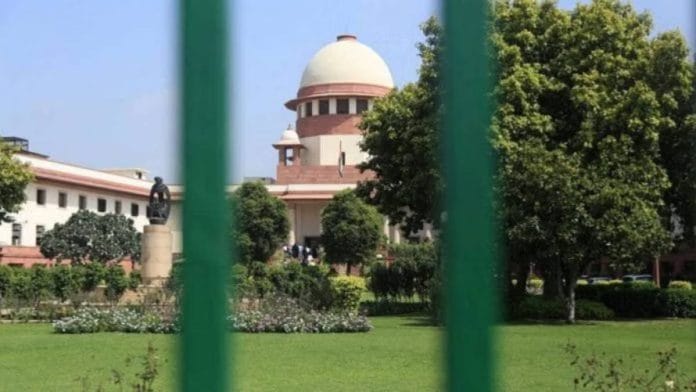
New Delhi: The Centre has proposed a structured skill-training programme for military cadets who are discharged from training after suffering disabilities, following a Supreme Court direction to create a welfare mechanism for those falling outside the statutory benchmark-disability framework.
The proposal, filed before the Supreme Court by the Ministry of Defence on 21 September, envisages 8-10 week job-oriented courses for such “out-boarded” cadets, with training to be tailored to their educational qualifications, aptitude and medical or functional limitations. But the affidavit also makes clear that the government has not accepted the long-standing demand to grant such cadets disability pension or Ex-Servicemen (ESM) status. Proposals for both benefits were considered in 2011 and 2022 but not accepted under the existing policy framework.
The affidavit has been filed in a suo motu writ petition regarding ‘Cadets Disabled in Military Training Struggle’, a case in which the Supreme Court is examining the treatment of cadets who suffer disabilities during pre-commission military training. The issue is different from that involving serving personnel who are invalided out. These cadets are still in training and have not been commissioned when they are medically discharged. That distinction has historically kept them outside the conventional pension and ESM framework.
What the Supreme Court directed
The case took a significant turn on 4 August, when a bench of Justices B.V. Nagarathna and Manmohan considered the position of out-boarded cadets under the Rights of Persons with Disabilities Act, 2016.
The court noted that the Act’s provisions, particularly those concerning benchmark disability, may not apply to cadets whose disability is below 40 percent. It therefore asked the Centre to prepare a suitable scheme for such cadets.
At the same time, the court held that out-boarded cadets with benchmark disabilities should be able to avail themselves of the reservation contemplated under Section 34 of the disability law. Section 34 provides for at least 4 percent reservation in government employment for persons with benchmark disabilities, generally defined as 40 percent or more disability.
The distinction is important: 40 percent is not a threshold for disability pension or ESM status. It is the statutory benchmark relevant to the reservation provisions under the disability law.
The court also directed states and Union Territories to consider placing out-boarded cadets in the ‘Ex-Military Personnel’ quota for employment. The direction was specifically made independent of the definition of ‘ESM’ used by the Department of Personnel and Training.
The court further directed the respondent departments to reconsider the recommendations of the Sabharwal Committee, which had examined the position of disabled officer cadets and recommended, among other measures, disability pension and ESM status.
The proceedings, therefore, have two distinct strands: securing employment and rehabilitation for disabled cadets, and reconsidering their longer-term pensionary and veteran-status position.
Also Read: Why SC junked Centre’s appeals against disability pension granted to armed forces personnel
Centre’s rehabilitation plan
The ministry’s latest affidavit responds most directly to the first of these issues. The Directorate General of Resettlement (DGR), under the Department of ESM Welfare, prepared a draft plan on 25 August for skill training of disabled boarded-out cadets.
The initial idea was to provide short-duration orientation modules of four to eight weeks. But the ministry says such a period would not be sufficient to provide the hands-on or on-the-job training required under the National Skills Qualifications Framework.
It has consequently proposed 8-10 week courses, broadly aligned with existing DGR resettlement programmes, with the objective of giving cadets a certifiable and placement-ready skill. The proposed courses have been divided according to educational qualification and discipline.
For graduates, the technical options include cyber security and IT support, solar photovoltaic system design and installation, industrial automation and PLC/SCADA, data analytics and business intelligence, and RPAS/drone pilot operations.
Non-technical graduates could be trained in logistics and supply-chain management, banking and financial services, retail operations, corporate and private security, and human resources and office administration.
For non-graduates, the proposed options include electrical technician, automobile service technician, solar-panel installation, CCTV and electronic security systems, AC and refrigeration, warehouse and logistics assistance, hospitality and housekeeping, professional driving and fleet operations, and fire and industrial safety.
The indicative cost ranges from Rs 15,000 to Rs 55,000 per cadet, with travel, daily allowance, boarding and lodging, wherever applicable, to be additional. The DGR would design and conduct the courses, while the ministry has proposed dedicated budgetary support to meet the training costs.
The ministry has also told the court that it has entered into multiple understandings with universities and colleges to enable ex-cadets to continue undergraduate degree programmes they had begun during military training. The proposed arrangements include lateral entry into appropriate semesters, recognition and transfer of academic credits earned during military training and completion of degrees with minimal or no loss of academic time.
Pension, ESM status remain unresolved
The more contentious part of the affidavit concerns disability pension and ESM status. The government records that a proposal to grant ESM status to medically boarded-out ex-cadets was processed in 2011, but was not accepted by the Department of ESM Welfare.
A separate proposal considered in 2022 sought disability pension at officer rates for cadets boarded out during training because of disability. That proposal too was not accepted on the ground that the existing policy did not provide for disability pension to such cadets.
The documents attached to the affidavit show that this has been a recurring policy question rather than a new dispute. A 2015 committee headed by Lt Gen Mukesh Sabharwal (Retd) had recommended granting proper disability pension to disabled cadets and changing the nomenclature of the existing benefit from ex gratia to disability pension, thereby bringing them within the ESM framework.
Government records from 2022, however, continued to maintain that cadets were boarded out before commissioning and therefore did not qualify for pension under the existing rules. The ministry also pointed to the distinction between regular pay and the stipend received by cadets during training, as well as the rules governing qualifying service.
The present affidavit does not announce a change in that position. Instead, it places the earlier policy decisions and the new rehabilitation proposal before the Supreme Court.
There has nevertheless been movement on medical support. The Supreme Court recorded in August that the defence ministry had extended ECHS (ESM Contributory Health Scheme) benefits to invalidated cadets, ensuring medical expenses throughout their lives. The court described the measure as a “laudable” one.
The court was also told that an officer trainee was receiving a monthly disability benefit of Rs 12,240 plus dearness allowance, compared with Rs 18,000 for a Jawan trainee/recruit before attestation. On the disparity in ex-gratia payments, the Centre pointed to the Eighth Pay Commission, which could consider enhancement of the amounts.
The latest affidavit therefore marks a concrete response on rehabilitation and employment, but not a resolution of the larger question of whether disabled officer cadets should receive the same pensionary and veteran-status benefits available to other categories of military trainees and personnel.
That question remains before the Supreme Court, alongside the implementation of the proposed skill-training framework. The court’s August order itself directed the government departments to reconsider the Sabharwal Committee recommendations in the context of the ongoing proceedings.
Aditya Edara is a TPSJ alum, currently interning with ThePrint.
(Edited by Nardeep Singh Dahiya)
Also Read: How father, son turned study buddies to achieve rare feat—both set to join UP Police as constables