







New Delhi: When two tango dancers glide across the floor, they could be coordinating more than their footwork. Scientists at the University of Colorado Boulder have found that when dancers are “in tune” with each other, their brainwaves sync up too, producing matching patterns of electrical activity.
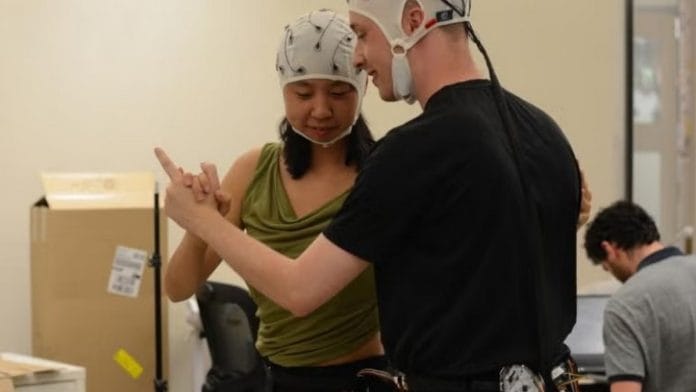
The researchers at University of Colorado Boulder’s ATLAS Institute, an interdisciplinary research hub, arrived at their findings after they fitted five pairs of experienced tango dancers with EEG caps — devices that measure electrical activity in the brain.
“When we dance, our brains are actually coupling,” said Thiago Rossi Roque, a graduate student at the ATLAS Institute who led the study, in a statement released by the university. “We are synchronizing our brains through our behavior.”
The study, titled ‘HyperDance: Real-Time Vibrotactile Stimulation Feedback of Inter-Brain Connectivity in Partner Dance’, was published in the proceedings of the 20th International Conference on Tangible, Embedded and Embodied Interaction (TEI ‘26), held in Chicago in March. The University of Colorado Boulder announced the findings on 4 May.
The researchers also developed a device that can be worn on the wrist to track dancers’ brain activity and vibrate when their brainwaves line up.
Roque said technologies that make unconscious signals conscious could one day help people who need to coordinate without words, like teammates in soccer or cycling.
“When we are performing, we aren’t conscious of this sort of synchronization. My goal was to bring unconscious things to the conscious level,” he added.
Also Read: Monkey see, monkey eat dirt—The social science behind primate ‘self-medication’
A leap in wordless communication?
The experiment may have initially looked like researchers taking a break, tangoing to some lively music. But on closer examination, the pairs doing the Argentine tango, in which partners hold each other tight, were wearing EEG caps as they danced.
The tango is rarely choreographed and relies heavily on intuitive movement. This allowed the researchers to capture moments when dancers were truly synchronised.
As the dancers moved together, the activity in their brains began to look startlingly similar. This phenomenon is known as “interbrain coupling” or “neural synchronisation”. The university’s statement said it had been observed in social activities such as playing guitar duets, but never in dancing.
When neurons fire in the brain, they create pulses of electrical activity, or brainwaves. Thinking or concentrating produces fast pulses known as beta waves, while relaxing leads to slower theta waves. Roque’s team found that the behaviour of these waves during the experiment depended on how in-sync the dancers were with each other.
When a leader stepped forward and the follower responded within 200 milliseconds, the pair’s brainwaves, including beta and theta, rose and fell together. When their steps fell out of sync, so did their brains, the researchers found.
While the wearable biofeedback device created by the researchers is still far from being ready for everyday use, Roque was optimistic that such technologies could change the way humans communicate and coordinate without speaking.
“In sports, you need to know what your teammates are going to do,” he said. “By using a system like this, they may be able to better learn how to understand each other during training.”
While this study reveals how Tango can synchronize brain activity, the dance form has also appeared in scientific studies and medical research as a form of therapy. A 2024 study by researchers at the Emory School of Medicine found that an adapted form of Argentine Tango can improve balance and other motor functions in people with Parkinson’s disease and Alzheimer’s.
(Edited by Asavari Singh)