



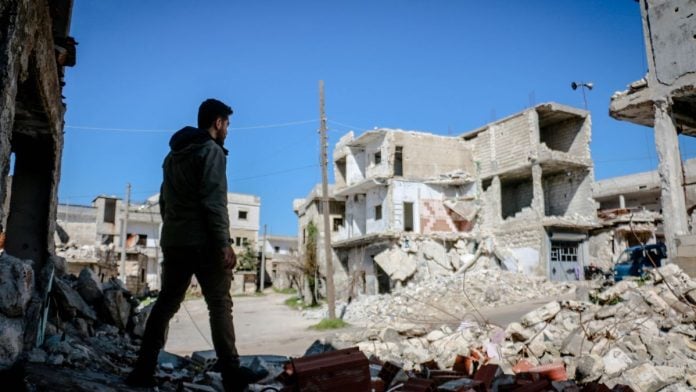
New Delhi: In a damaged house in Homs, Syria, an elderly man used a hammer to break through a concrete wall he had built in October 2011. Behind it, he found something he had feared the war had destroyed: his son’s private library, which had remained hidden for 15 years.
“Thank God, everything is fine so far, apart from some dust,” he said, looking through the hole as the shelves appeared.
The moment was a reminder of how the Assad regime treated certain books as a threat and could use their possession as evidence against people. For Abu Bilal, also identified in Arabic reports as Amr bin Mustafa Alwan, building a concrete wall was a way to protect the books from raids, arrests and destruction.
Now, after Bashar al-Assad’s government has fallen, he has returned from exile in Kuwait to recover what he hid.
“I built this wall in October 2011, and I’ve come back 15 years later. Thank God everything is still there, and these are my Quran memorisation certificates,” he said.
A war torn Syria
In late 2011 protests in Syria turned into a civil war and security forces were tightening their control over the people. In Homs, a city that would later become known for its destruction and long siege, Abu Bilal was preparing to leave for Kuwait. But he was worried about what would happen to his son’s collection of books, which included biographies of the Prophet, texts from the Sunni tradition, academic certificates and personal papers. He feared the books could be seized or destroyed, so he built a dummy wall and hid the library behind it.
“Even in the smallest space, we found room for a book, making the most of it as we ran out of room,” he recalled.
Then he left, fearing that the home he knew and the things he loved would not survive the war.
“Thank God, it’s still here and still in good condition. A thousand praises to God,” he said as he took out the books.
Some were religious and philosophical works that had been banned under the old government. They contained several religious works on hadith, fiqh and tafsir, along with copies of the Quran and certificates for Quran memorisation. It also had important books such as Tahdhib al-Tahdhib, Tahdhib al-Kamal, Tabari Tafsir, a commentary on Sahih al-Bukhari, a biography of the Prophet, works on Quranic grammar and Jami’ al-Usul.
“These are also Quran memorisation certificates,” he said, holding up certificates that connect his son’s learning to a long religious tradition.