


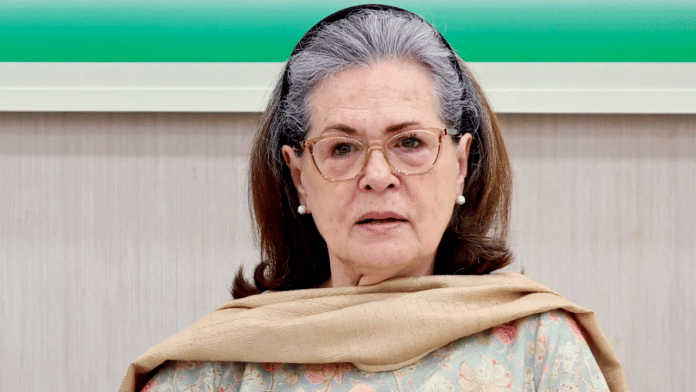
New Delhi: Few Indian politicians have chosen to document their experiences, political battles and private reflections in books. The gap is even more striking when it comes to women in politics. Indira Gandhi left an indelible mark on Indian politics but never penned an autobiography. J Jayalalithaa, too, did not leave behind a comprehensive personal account of her extraordinary political journey.
The book, published by HarperCollins India, has already found itself at the centre of a political and publishing controversy, even before reaching readers.
In August, Penguin announced that it would not publish her autobiography, citing disagreements over editorial changes and deletions suggested by the publishing house, which Gandhi was reportedly unwilling to accept.
Political memoirs have often challenged established political accounts, reopened old wounds and revealed private conversations, offering glimpses into the corridors of power that official histories rarely capture.
“Political memoirs have great potential from a selling point of view, but it depends on who wrote it. Selling depends on the aura of the person and what the person wrote in the book,” said Puneet, who runs Amrit Book Company, a 90-year-old bookshop in Connaught Place.
At Oxford Bookstore in Connaught Place, staff are looking forward to the memoir’s release.
“Sonia Gandhi’s book has great selling potential. She has a lot to write and reveal about politics,” said an employee at Oxford Bookstore.
With Gandhi’s memoir Belonging releasing today, ThePrint looks back at some of India’s most consequential political books that lifted the veil on the inner workings of power and offered personal accounts of defining moments in the country’s political history.
L.K. Advani — My Country, My Life
When veteran BJP leader L.K. Advani released his 1,040-page autobiography, My Country, My Life, in March 2008, it did not take long for the book to become a political talking point.
Advani also revisited the political storm triggered by his June 2005 visit to the mausoleum of Pakistan’s founder, Muhammad Ali Jinnah, in Karachi. During the visit, he described Jinnah as an “ambassador of Hindu-Muslim unity”.
In a separate chapter titled I Have No Regrets, Advani clarified that he had never personally described Jinnah as secular and blamed the media for reporting his remarks out of context.
Advani also argued that Operation Blue Star could have been avoided had Indira Gandhi taken decisive political action against Khalistani militants. He wrote that the BJP’s mass agitations against Sikh extremism and Jarnail Singh Bhindranwale had helped build pressure on the Indira Gandhi government to launch the military operation. This, in turn, fuelled tensions with the Akalis, the BJP’s ally at the time.
Three years after the book’s publication, during Advani’s 2011 visit to the Golden Temple, Akali Dal workers reportedly raised slogans such as Advani Katilan da Sathi (Advani, an ally of the killers).
M Karunanidhi — Nenjukku Needhi
For M. Karunanidhi, writing an autobiography was also a way to document Tamil Nadu’s political and cultural evolution. His six-volume autobiography, Nenjukku Needhi (Justice to the Heart), spanning around 4,168 pages, is an expansive account of his personal life, literary journey, cinema career and decades in Dravidian politics.
The book offers an insider’s account of the political rivalries that shaped Tamil Nadu, particularly the complicated relationship between Karunanidhi and MG Ramachandran (MGR). Once political colleagues, the two eventually became bitter rivals, transforming Tamil Nadu’s political landscape.
Karunanidhi also traced the origins of his political consciousness to the anti-Hindi agitations of the late 1930s. He recalled taking part in protests as a 14-year-old student, raising slogans against the imposition of Hindi as a compulsory subject in schools.
Pranab Mukherjee — The Presidential Years
Few Congress leaders had witnessed the party’s inner workings as closely as Pranab Mukherjee. A veteran parliamentarian, former finance minister and India’s 13th President, Mukherjee used his memoirs to offer an insider’s account of the Congress leadership, coalition politics and the functioning of the government.
In the final volume of his memoirs, The Presidential Years: 2012–2017, Pranab Mukherjee criticised the Congress’s decline to just 44 Lok Sabha seats in 2014, attributing it to weak leadership and governance.
Reflecting on the Manmohan Singh-led coalition government, he pointed to the lack of personal engagement with MPs and the growing pressure exerted by coalition partners.
He even suggested that the party might have avoided its disastrous 2014 Lok Sabha election performance had he been made Prime Minister in 2004.
“Some members of the Congress theorised that, had I become the PM in 2004, the party may have averted the 2014 Lok Sabha drubbing,” he wrote.
Sharad Pawar — Lok Majhe Saangaati
For the veteran politician from Maharashtra, an autobiography was also an opportunity to revisit the shifting alliances and political upheavals that have defined the state’s politics.
Pawar’s autobiography, Lok Majhe Saangaati, released in 2023, included developments after 2015. Pawar questioned Uddhav Thackeray’s absence from the Chief Minister’s office during the Covid-19 pandemic and criticised him for failing to address the growing discontent within his own party.
“Everyone has the right to write an autobiography, but what I have done as chief minister is a known fact,” Thackeray said in repsonse.
IK Gujral — Matters of Discretion
The former prime minister’s Matters of Discretion offers an insider’s account of the complicated world of coalition politics, diplomacy and the functioning of the PMO.
Gujral, who served as Prime Minister from April 1997 to March 1998, wrote about the political uncertainty of his tenure, the challenges of leading a coalition government and India’s diplomatic ties with its neighbours.
A key aspect of Gujral’s political legacy was The Gujral Doctrine, which advocated peaceful coexistence and non-reciprocal cooperation with India’s smaller neighbours.
Former Rajya Sabha MP Chandan Mitra wrote in a review that Gujral’s tenure will probably go down in history only as a footnote while praising him for maintaining a daily diary.
“Astonishing for a politician that has enabled him to present a complete picture of events since his association with politics,” wrote Mitra.
Arjun Singh — A Grain of Sand in the Hourglass of Time
Published posthumously in 2012, the Congress leader’s memoir offered a deeply personal and often critical account of his party’s internal politics.
Arjun Singh was particularly critical of former Prime Minister PV Narasimha Rao, accusing him of inaction in the run-up to the 1992 Babri Masjid demolition. Singh also referred to letters and warnings that, according to his account, went unacknowledged as the political mobilisation around the Ayodhya dispute gathered momentum.
One of the most striking revelations in A Grain of Sand… concerned former President Zail Singh. Arjun Singh claimed that KC Singh, who had served as a joint secretary to Zail Singh, met him in mid-1987 and offered him the possibility of becoming Prime Minister in place of Rajiv Gandhi.
Lalu Prasad Yadav — Gopalganj to Raisina
The two-time Bihar chief minister published his autobiography in 2019, just ahead of the Lok Sabha elections. In Gopalganj to Raisina: My Political, Lalu Yadav Journey recounted his rise from Bihar’s rural hinterland to the centre of national politics.
Among the book’s most talked-about claims was Lalu’s assertion that Nitish Kumar had repeatedly sent political strategist Prashant Kishor to nudge him as the Bihar chief minister was keen to return to the Mahagathbandhan. Kishor dismissed the claim as bogus.
Lalu also revisited one of the defining episodes of his political career: the arrest of BJP leader LK Advani in 1990 during the Rath Yatra.
He maintained that neither then Prime Minister VP Singh nor any central authority had instructed him to stop the procession or arrest Advani.
Sheila Dikshit — Citizen Delhi: My Times, My Life
Former Delhi Chief Minister Sheila Dikshit spent 15 years at the helm of the national capital. In her 2018 memoir, Citizen Delhi: My Times, My Life, she recounted the political battles, personal challenges and defining moments of her tenure.
One of the most revealing passages dealt with her decision to continue in politics despite serious health concerns in 2012.
Dikshit wrote that she had considered resigning but eventually decided against it. The December 2012 Nirbhaya gang rape case and the political storm that followed had put her government under intense pressure. She did not want her departure to be interpreted as an attempt to flee the battlefield at a difficult moment.
Zoramthanga — From Guerrilla Fighter to Chief Minister
Former Mizoram Chief Minister Zoramthanga’s 2026 memoir, From Guerrilla Fighter to Chief Minister: A True Political Memoir of Conflict, Conviction and Leadership, described his secret journey to China, where he met senior officials, including Premier Zhou Enlai, and attended National Day celebrations at Tiananmen Square.
The memoir also triggered controversy over its account of foreign assistance to the Mizo separatist movement. Zoramthanga wrote that the underground movement had received clandestine support from Pakistan and China.
He further recounted how he and MNF founder Laldenga were flown from Myanmar to Pakistan by the ISI for meetings with then Prime Minister Zulfikar Ali Bhutto.
Jaswant Singh – A Call to Honour – In Service of Emergent India
Army veteran and former Union minister in the Atal Bihari Vajpayee government, Jaswant Singh’s memoir, A Call to Honour: In Service of Emergent India, was published in 2006. Singh claimed in his book that an American mole had allegedly been operating inside the Indian PMO during P.V. Narasimha Rao’s tenure in 1995.
Singh quoted a 1995 letter from a US diplomat that suggested a senior Indian official had leaked information about India’s nuclear programme. India Today magazine also published a story titled Mole Controversy.
Yashwant Sinha — Relentless: An Autobiography
Former Union Finance Minister Yashwant Sinha’s autobiography, Relentless, offered an account of his bureaucratic career, political journey and years in the BJP. It also reopened old disagreements with colleagues from his political past.
One of the most striking claims concerned the National Highway Development Project (NHDP) and the Pradhan Mantri Gram Sadak Yojana (PMGSY).
Sinha claimed that these flagship programmes were his ideas, but others in the BJP government took credit.
He recalled former Prime Minister Chandra Shekhar’s warning to him that his decision to join the BJP had damaged his political credibility built over the years.
“He added that I would have to work very hard to regain the same,” Sinha recalled.
Shanta Kumar — Neej Path Ka Avichal Panthi
Not every political memoir is written to celebrate a leader’s own party. Sometimes, it becomes a platform to express disappointment.
That was the case with former Himachal Pradesh Chief Minister Shanta Kumar. The veteran BJP leader used his memoir, Neej Path Ka Avichal Panthi, to criticise the BJP’s changing political culture, accusing the party of drifting away from the values and idealism that had once defined it.
“I feel ashamed that my party got involved in the sale and purchase of MLAs. People made the BJP the world’s largest party due to its values and idealism, but it has now become power-hungry,” he wrote.
Mamata Banerjee — My Unforgettable Memories
Mamata Banerjee’s My Unforgettable Memories offers a personal account of her political journey, from her years in the Congress to the formation of the Trinamool Congress and her eventual rise to the chief minister’s office in West Bengal.
The memoir attracted attention for its observations on some of the country’s most powerful political figures. Banerjee described Sonia Gandhi as a reluctant “Queen Mother” and alleged that former Prime Minister Manmohan Singh often followed the CPI(M)’s political line on issues concerning West Bengal.
But the book also drew attention for what it left unaddressed.
Readers noted the absence of a detailed account of the Naxalite movement in Bengal during the 1970s and the excesses committed during the Emergency under Indira Gandhi. Banerjee also offered little detail about her stint in the Atal Bihari Vajpayee-led NDA government.
Sushil Kumar Shinde — Five Decades in Politics
Former Union Home Minister Sushil Kumar Shinde’s memoir, Five Decades in Politics, revisited his long political career and sparked debate over some of his most controversial statements.
One of the most discussed issues was the expression “saffron terror”. Shinde maintained that he had not coined the term himself but had come across it in a confidential Home Ministry document.
He also wrote about V.D. Savarkar, suggesting that the Hindutva ideologue should be examined not only through the lens of his political ideology but also for his contributions as a philosopher and scientist.
He recalled feeling frightened while walking around Srinagar’s Dal Lake and Lal Chowk, reflecting the security anxieties that accompanied his tenure.
Jyoti Basu — Jatadur Mone Pore (As Far As I Can Remember)
Few political memoirs carry the weight of an opportunity missed quite like that of former West Bengal Chief Minister Jyoti Basu.
In Jatadur Mone Pore (As Far As I Can Remember), the veteran Communist leader chronicled his decades in politics, his association with the Left movement and his long tenure as Chief Minister of West Bengal.
But one episode stood out above the rest: the CPI(M) politburo’s decision in 1996 to prevent him from accepting the offer to become India’s Prime Minister.
At the time, the United Front government was looking for a leader who could command support across the coalition. Basu emerged as a possible choice, but his party refused to allow him to take up the position.
Years later, Basu described the decision as a “historic blunder”.
Natwar Singh — One Life Is Not Enough
When the former External Affairs Minister published One Life Is Not Enough in 2014, it sent ripples through the Congress establishment.
One of Natwar Singh’s most explosive claims concerned Sonia Gandhi’s decision not to become Prime Minister in 2004. Singh argued that it was not her inner voice that prompted the decision but the strong opposition of her son, Rahul Gandhi, who feared for her safety and possible assassination.
Singh also described Sonia Gandhi as capricious and authoritarian, alleging that confidential files from the Prime Minister’s Office were regularly shared with her.
Reacting to the book, Sonia Gandhi said she would present her own version of events.
“I will write my own book, and then you will come to know everything,” she declared. Now, her memoir Belonging is here.
(Edited By Raunaq Lekhi)