


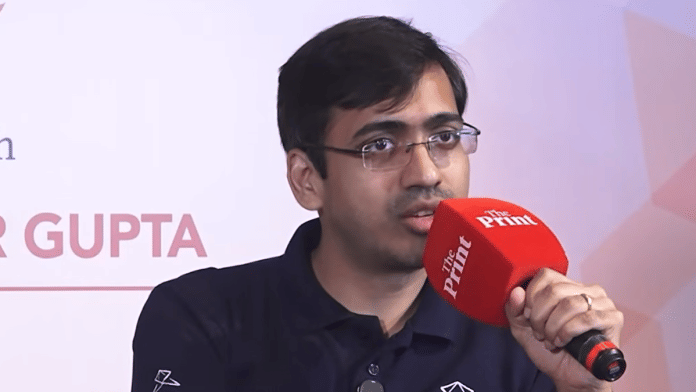
New Delhi: Pawan Kumar Chandana, co-founder and CEO of Skyroot Aerospace, has now been named in TIME’s inaugural TIME100 Next India list of 100 emerging leaders shaping the country’s future.
Earlier in July, Skyroot launched a 22-metre-tall Vikram-1 from the Sriharikota launchpad. It was the first time an Indian private company successfully sent its own rocket into orbit. Developed by Hyderabad-based Skyroot Aerospace, Vikram-1 completed its maiden orbital flight, marking an important milestone for India’s space industry. The rocket carried multiple payloads, including two satellites, SCOPE and Grahaa, which were successfully placed in low-Earth orbit, about 450 km above the planet.
For Chandana, the achievement was the result of years spent working towards a goal that once seemed difficult to imagine outside a government-run space programme.
“We also plan to build bigger vehicles, which will be reusable, where you launch and land, reducing the cost of going to space further,” Chandana said. “That will benefit launching even mega constellations of satellites. We also envision launching people to space.”
The launch puts India as the third country where private companies have demonstrated the ability to develop and launch their own orbital rockets. More importantly, it signals a shift in India’s space programme, which for decades relied largely on the Indian Space Research Organisation (ISRO). With the government opening the sector to private participation, companies are now looking beyond supplying equipment and components to building rockets, launching satellites and offering commercial space services.
Speaking about the possibilities ahead, Chandana told NDTV that the opportunities could extend well beyond satellite launches.
“The only way to go to space today is a rocket,” he said. “So the moment you build a rocket, you’re open to all these markets–from launching satellites, to launching humans, to building factories in space, to building air data centres, everything.”
Skyroot’s journey
Skyroot’s journey began in 2018, when Chandana and his former ISRO colleague Naga Bharath Daka decided to establish a private rocket company. Both had worked at ISRO, where they gained experience in developing launch vehicles and understanding the demands of rocket engineering.
The decision came at a time when India’s private space industry was still taking shape. The government had not yet introduced a comprehensive policy for private companies, nor was there access to funding and infrastructure.
The landscape began to change in June 2020, when the Union government announced reforms allowing private companies to participate across the space sector. It also established the Indian Space Promotion and Authorisation Centre (IN-SPACe), which provides regulatory approvals and facilitates private companies’ access to ISRO facilities.
Skyroot became the first private Indian company to launch a rocket in November 2022. Its Vikram-S rocket completed a suborbital flight under Mission Prarambh, reaching an altitude of about 90 km. Unlike an orbital launch, a suborbital flight does not place a vehicle into a stable orbit around Earth. However, it was an important test of the company’s technology.
Vikram-1 was the next major step. Standing approximately 22 metres tall, it is designed to carry payloads weighing up to 350 kg into low-Earth orbit.
In an interview with Mint after the launch, Chandana spoke about the uncertainty involved in rocket development.
“The thing with rockets is that you have known unknowns, and then the unknown unknowns,” he said.
Also read: Elon Musk feels ‘pretty foolish’ after spending nearly $500 million on Republican losses
Satellite launches
Skyroot sees a growing market for satellite launches. Satellites are used for communication, weather forecasts, navigation, farming and disaster management. But launching them into space is expensive, making it difficult for smaller satellite companies to book launches on their own.
Smaller satellite operators can book space on shared launches, known as rideshare missions. The difficulty is that they may have less control over the launch date and destination orbit. Dedicated launches offer greater flexibility but usually cost more.
This is where Skyroot hopes to find its market. Rather than competing directly with heavy-lift rockets, its Vikram series is designed for smaller payloads and dedicated launches. Such services could allow satellite companies to choose when and where their satellites are placed in orbit, instead of depending on larger missions carrying several customers’ payloads.
The commercial potential has also attracted investors. In May 2026, Skyroot became India’s first space-tech start-up to reach unicorn status, with a valuation of about $1.1 billion following a $60 million funding round, according to Reuters. The investment is expected to support manufacturing, more frequent launches and the development of larger rockets.
However, the competition is global. Companies such as SpaceX in the US have already transformed the commercial launch market, particularly through reusable rockets that bring down the cost of repeated launches.
(Edited by Janaki Pande)