





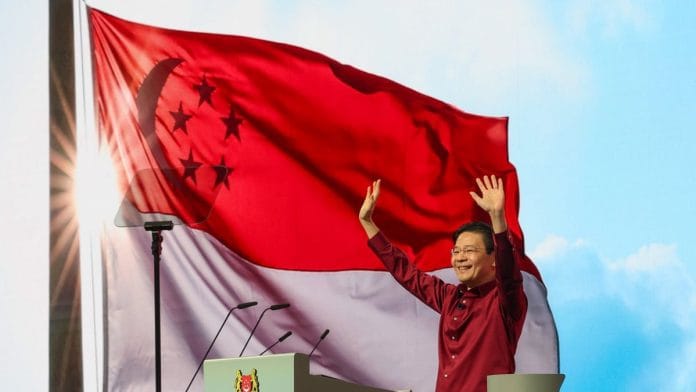

Mumbai: As fertility in Singapore falls to a record low, the country is expanding efforts to encourage citizens to have more children. The initiatives include a longer childcare leave, cheaper preschool, annual cash support until a child turns 16, and a better shot at public housing.
Prime Minister Lawrence Wong announced the measures at the National Day Rally on 23 August, framing them as part of a broader demographic challenge.
“Despite all that we do to support families, we have to be realistic – our Total Fertility Rate is still likely to fall far short of replacement,” he said.
Singapore’s resident total fertility rate fell to 0.87 in 2025, its lowest on record, from 0.97 in 2024 and 1.24 in 2015. Resident live births dropped 10.6 per cent to 27,529, according to preliminary government data.
At the centre of the overhaul is the SG Child Support Package, which will provide up to S$62,000 to every Singaporean child from birth to age 17, irrespective of birth order. Together with an existing S$5,000 newborn MediSave grant and roughly S$2,500 in Edusave contributions, the government puts direct support at nearly S$70,000 per child.
Singapore’s push mirrors a wider East Asian struggle with ultra-low fertility. Japan’s fertility rate fell to a record 1.15 in 2024, while that of South Korea slipped to 0.72 in 2023, prompting both governments to expand support for families. China introduced its first nationwide childcare subsidy in 2025, offering ¥3,600 per child annually until age three.
S$2,000 every year until 16
For children born in Singapore from 1 April 2027, the package starts with a S$10,000 Baby Gift, a S$5,000 Child Development Account grant, and up to S$5,000 in government matching parental contributions.
Each eligible child will then receive S$2,000 in Child Credits every year from age one to 16, adding up to S$32,000 altogether, followed by a S$10,000 Post-Secondary Education Account top-up at 17. Singaporean children born before 2027 will also receive benefits according to age.
The older Baby Bonus system was heavily weighted toward birth order. The first and second child received S$11,000 each in cash, while the third and subsequent children were awarded S$13,000. CDA matching ceilings ranged from S$4,000 for the first child to S$15,000 from the fifth child onward, with additional benefits for larger families.
Under the new system, the baseline becomes the same for every child and support extends much further into childhood.
“This is what you get at birth. But the support will not stop there. Every child will continue to get annual Child Credits of $2,000 every year, from age 1 all the way to age 16,” Wong said.
Also read: Kriti Sanon’s Raksha Bandhan ad draws backlash over pet dog, ‘revealing’ outfit
More children, more leaves
Each working parent currently gets six days of childcare leave annually if their youngest Singapore citizen child is six or younger, and two days if the youngest child is between seven and 12.
The new scheme merges the entitlements and links leave to family size: eight days for one child aged 12 or below, 10 for two, and 12 for three or more.
“The more children you have, the more leave you will get,” Wong said.
A couple with three primary-school children would consequently receive 24 days between them, compared with four now. The start date has not yet been announced.
The government will also reimburse employers for all statutory child-related leave, up to existing limits. Shared Parental Leave has already risen from six to 10 weeks from 1 April 2026, taking eligible parents’ combined paid entitlement to as much as 30 weeks — 16 weeks maternity leave, four weeks paternity leave and 10 weeks shared parental leave.
Cheaper preschool, better chance of a flat
Full-day fees at government-supported centres will progressively fall to S150 a month for childcare and S$300 for infant care by 2030, with reductions beginning in 2028.
Housing rules are also being eased. The monthly household-income ceiling for subsidised BTO flats will rise from S$14,000 to S$16,000, and that for Executive Condominiums would go from S$16,000 to S$18,000.
“Young couples hesitate to start a family. They worry about the responsibilities and costs. Parents face a different set of worries. Every day is a balancing act – between work and family, between earning a living and caring for loved ones,” Wong said.
From February 2027, first-time families will also get an additional ballot chance for every Singapore citizen child aged 18 or below they have or are expecting. Families with three or more children are promised further healthcare, transport, and housing support, with details still being worked out.
Also read: Kashmiri Pandits are on the edge again. Second threat letter targets 6 PM Package employees
Why are Singaporeans having fewer children?
Government surveys indicate money is only part of the problem. In Singapore’s 2021 Marriage and Parenthood Survey, 64 per cent of married respondents who did not want children or more children cited financial cost. About 49 per cent said raising children was too stressful, and 34 per cent cited difficulty balancing work and family.
Singapore’s annual demographic report, ‘Population in Brief 2025’, published by the government’s Strategy Group, also points to later and smaller families. Among ever-married women aged 40-49, the share with no children rose from 6.7 per cent in 2004 to 14.4 per cent in 2024, while those with three or more children fell from 34.5 to 20.6 per cent.
Wong acknowledged the limits of government intervention.
“Ultimately, the decision to have children is a deeply personal one. Policies alone cannot make this happen. But what we can do is make it easier for Singaporeans who want children to start and raise a family. And we want every family to know—if you choose to have children, the Government will stand with you.”
(Edited by Prasanna Bachchhav)