



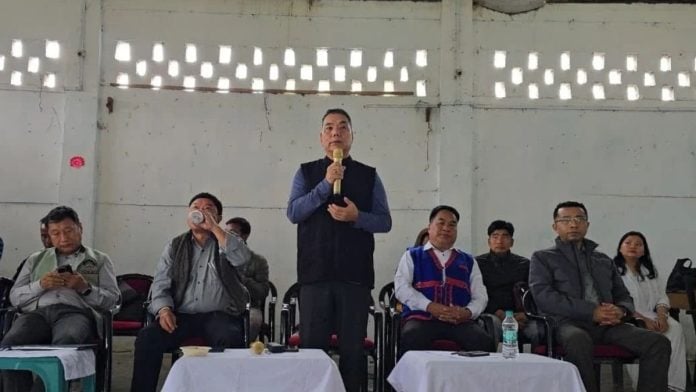
Itanagar: The Arunachal Pradesh government should have begun engaging villagers and local representatives much earlier to build support for the proposed Siang Upper Multipurpose Project (SUMP), Tuting-Yingkiong BJP MLA Alo Libang said, accusing the administration of failing to explain the project adequately and deliver on a promised livelihood scheme for affected households.
In an interview with ThePrint, Libang, who backs the proposed hydropower project, said he had repeatedly urged the chief minister and deputy chief minister to launch a grassroots campaign to explain the project to villagers. But, he alleged, he was subsequently left out of discussions, even though his constituency accounts for the largest area likely to be submerged.
“I told the DCM that we need to begin this campaign for the dam after the 2024 elections itself. But even till 2025 nothing happened,” he said.
The government also erred, he said, by not keeping local political representatives informed when officials and people from outside the region arrived to discuss the project and its preliminary feasibility report (PFR).
“People from Delhi, people from outside come without telling us. So obviously people will panic,” he said.
Libang’s criticism comes as villagers and community organisations continue to resist preliminary investigations and the proposed 11,200 MW dam in Siang and Upper Siang districts. The opposition has also turned personal for the MLA. In September, protesters reached his residence in Yingkiong, the Upper Siang district headquarters, tore down its gate and threw stones at the doors and windows. Vehicles parked outside were damaged.
Libang, 62, said the government could not expect to win over villagers through force or by sending outsiders to explain the project. It needed to work through local representatives who understood the community’s relationship with its land and alleged that anti-dam organisations and political groups from outside the region had misled villagers.
“We need to listen to them and talk to them with consideration. It should be a two-way street. We can’t forcefully suppress them,” he said. “All they have in their mind is that this is their ancestral land and without this, they are nothing.”
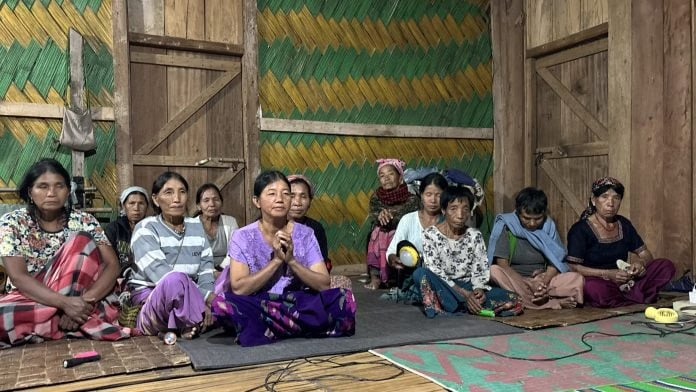
A promise that has fuelled distrust
For Libang, one of the examples of the administration’s failure to build confidence is the delay in disbursing money under a livelihood assistance scheme announced for households in the project-affected areas.
The payments were meant to offer some immediate support to residents. But, Libang said, the money had still not reached them.
“Even with the livelihood scheme, people have not got the money. Now in their mind, it creates distrust. If for this scheme they can’t guarantee money, what is the guarantee that they will compensate properly once the dam is built?” he said.
The district administration has maintained that the scheme was open to every household, rather than a select group. Upper Siang Deputy Commissioner Ashok Tajo had told ThePrint that villagers wanted written guarantees before agreeing to participate.
The MLA said the government’s planning was inadequate, particularly given the scale and national importance of the project.
“They should have implemented the scheme quickly if it wanted to build confidence among villagers,” he said.
The delay, he argued, had made it harder for the administration to persuade residents to trust its assurances on the project.
The distrust has been compounded by tensions over the deployment of security forces in the affected areas. Libang defended their presence, saying they were needed to prevent violence and protect villagers who supported the project.
He alleged that houses, farms and orange orchards belonging to people who had signed the memorandum of understanding (MoU) supporting the project had been vandalised by people from outside their villages.
Citing Begging village, which he said was among the first to sign the MoU, Libang claimed that people from Geku had subsequently intimidated its residents in May.
“This kind of action should have taken place in May itself when mobs started coming and damaging homes and fields. So now people are psychologically scared,” he said.
He said the security personnel were there to protect residents, not to confront protesters.
“The force is not to fight against them, or disturb them. They are there to secure them only,” he said, calling SIFF’s demand for the withdrawal of security forces unnecessary.
SIFF, however, has maintained that the heavy deployment has created fear among residents. It has demanded that the forces be withdrawn before any further dialogue with the state government.
Also Read: Siang Dam survey hits a wall. Villagers block drilling at 3 sites
The case for the dam
Despite the resistance, Libang argued that the project could bring better infrastructure, connectivity and jobs to the region, particularly for younger people who may not want to continue traditional agricultural livelihoods.
He acknowledged that low-lying agricultural land near the river would be affected, but said many existing homes and newer parts of villages were at higher elevations and would not be submerged.
He also questioned the characterisation of all the land under discussion as ancestral farmland, pointing out that shifting cultivation had traditionally been practised in the region.
“The younger generation doesn’t want to continue this day in and day out of farming. They want to sit in offices and work,” he said. “Now the whole world has gone ahead, then how will we keep walking barefoot? We have to secure the coming generation.”
Libang said he had also sought a larger share of the project’s Local Area Development Plan funds for affected areas. While the proposed allocation was around 2 per cent, he said he had demanded an increase to 5 per cent to ensure local communities benefited more directly.
“If I want something from you, I have to work with you and not forcefully. If the state and the central government think this can happen forcefully, they are very wrong. Things can go very wrong if that happens,” Libang said. “People are seeking accountability from me, but I am also seeking accountability from those above.”
(Edited by Stela Dey)