



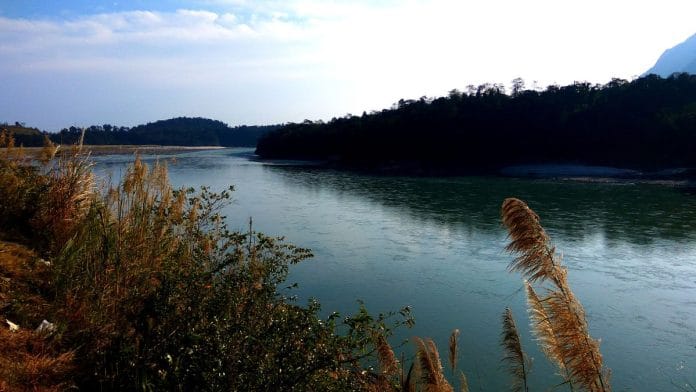
The National Hydroelectric Power Corporation Limited (NHPC), the public sector hydropower giant entrusted with preparing the pre-feasibility report (PFR) for the proposed Siang Upper Multipurpose Project (SUMP) in Arunachal Pradesh, is yet to begin drilling at the proposed dam sites, with opposition from villagers holding up survey work.
Amarnath Jha, general manager of the NHPC project, told ThePrint that preliminary surveys, including topographical surveys, geological observations and geophysical tests, had been completed. However, core drilling, which is necessary to assess rock characteristics and determine the feasibility of the proposed sites, remains pending.
The corporation has identified three alternative locations for the dam, near Parong, Dite Dime and Ugeng, and plans to conduct drilling at all three before finalising the location and layout.
“Only after drilling will we be able to decide whether it will be feasible or not,” Jha said, adding that the exercise could take three to four months. The plan is to drill four holes at each site, with work potentially taking place simultaneously.
The PFR is the first stage of the project assessment and involves preliminary investigations, comparative studies and identifying a possible location for the dam. A detailed project report (DPR) can be taken up only after this exercise, Jha said, citing the high cost of preparing a DPR for a project of this scale.
The drilling is expected to involve installing machinery at the three locations and extracting rock cores from depths of up to 200 metres. These samples will then be tested in laboratories to establish the characteristics of the rock, including its joints and other geological features, he said.
Jha said the NHPC had temporarily put the drilling exercise on hold because of opposition from villagers.
“Some people are agreeing, some people are not agreeing. Those who are not agreeing are protesting a little fiercely. So we are backing a little. Till the condition is not good, survey work cannot be done,” he said.
He said the corporation was finding it difficult to assess the extent of support for the project because protesters were preventing its officials from accessing the proposed sites.
The NHPC general manager also said that while some villagers had signed memorandums of understanding (MoUs) in connection with the government’s livelihood package, these were not a prerequisite for carrying out the project.
Explaining the scheme, Jha said the state government had used the MoUs as a means of gauging public support for the project. The livelihood package, however, was intended for people in the affected areas and would not be restricted to those who had signed the agreements.
“Basically, the livelihood package is for the affected area. It is for everyone,” he said, adding that it was meant to help deprived people in the region improve their standard of living.
According to Jha, 27 villages on both banks of the Siang river, stretching from the proposed dam site to Upper Siang, are expected to be affected, either partially or fully. However, the exact extent of the impact would only be known once the PFR was completed and the location finalised.
“Until the PFR is finalised, we will not finalise the location. Until then, we cannot determine what is being affected,” he said.
NHPC’s public relations campaign draws scrutiny
Jha’s remarks come amid scrutiny of NHPC’s public relations campaign for the project, following a report by The Arunachal Times on 19 October that the corporation had spent more than Rs 10.9 crore on a public perception campaign since July 2025.
According to the report, NHPC hired Mumbai-based Concept Public Relations India Limited in July 2025 under an initial contract worth Rs 8.73 crore. An additional contract worth Rs 2.18 crore was issued in August 2026, taking the total contractual value to Rs 10.91 crore.
The scope of work included identifying and engaging influential local individuals, working with community leaders and NGOs, organising community events, collaborating with local and national media organisations, producing sponsored digital content and monitoring public sentiment. The documents also listed engagement with prominent national journalists as a separate activity, the newspaper reported.
The campaign has since drawn criticism on social media, with several influencers from Arunachal Pradesh also speaking publicly about the outreach efforts.
Asked about NHPC’s engagement with a PR agency, Jha confirmed that the corporation had hired a service provider for public outreach.
“For whatever project we do, we hire a service provider to tell people what we are doing. Here as well, we had done that,” he said.
He added that the corporation had also held consultative meetings and put out videos and informational material to explain the project. However, he disputed the suggestion that opposition stemmed primarily from a lack of information, saying people had their own concerns about the project.
Jha also said NHPC was unable to hold meetings in some areas because of resistance from villagers.
“There is a law and order problem here. The people who are opposing are adopting violent methods,” he said, alleging that houses had been damaged and gardens cut down.
The NHPC’s office in Pasighat was also burnt down during the recent unrest, he said, adding that an assessment of the damage was yet to be completed. “The entire office has been burnt down. It is difficult to work without an office,” he said.
Asked about the next steps, Jha said NHPC would follow the state government’s decision on engaging with residents and proceeding with the survey.
The proposed 11,200-MW SUMP has faced sustained opposition from sections of the indigenous Adi community, particularly in Siang and Upper Siang districts, over fears of displacement, loss of ancestral land and livelihoods. The government has maintained that the immediate exercise is limited to assessing the project’s technical feasibility and does not amount to a decision to construct the dam.
(Edited By Raunaq Lekhi)