





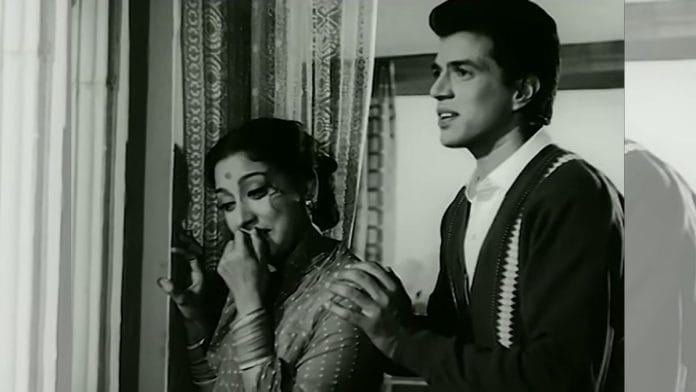


Bollywood of the early 1960s was flooded with crime thrillers and romances of Shammi Kapoor, Ashok Kumar, and Dev Anand. But Hindi films were also beginning to explore social issues. The 1962 film Anpadh was among the first few movies to do so.
Directed by Mohan Kumar, the film dealt with education, women’s rights, and the continuous struggles of caste and class. Through its characters and conflicts, Anpadh showed a society where wealth and social status held more power than education.
The film follows Lajwanti (Mala Sinha), who is pampered throughout her childhood. A small scolding from her teacher stops her from attending school, and her brother Chaudhary Shambhunath (Balraj Sahni) even scolds the headmaster. Aruna Irani played the younger version of Lajwanti.
Lajwanti gets married to Deepak (Dharmendra), a well-educated man who values learning and knowledge. Her lack of education becomes a sore point in their relationship. She struggles with even basic household chores, which makes her in-laws furious. But gradually, Deepak begins to understand her innocence and starts loving her.
Just as she finds respect and emotional safety in her husband, he dies in a car accident. Around the same time, her brother gets caught in a brawl and goes into hiding. Her in-laws throw her out, which changes the trajectory of her life forever.
Anpadh was part of a new generation of films that centred around women characters. Released the same year, Sahib Bibi Aur Ghulam also explored the subjugation and isolation of women in feudal households.
Dharmendra, who had only appeared in a handful of films before Anpadh, has a shorter but impactful role. Instead of relying on theatrical flourish, his performance is understated. Sinha does complete justice to the role, perfectly capturing the vulnerability of the character in her silences.
Breaking the cycle
In the film, suddenly forced to earn her own living, Lajwanti tries to find employment, but gets rejected everywhere.
When she gives birth to a daughter, she learns to tailor, earning enough to support herself and her daughter. She makes sure that he daughter, Kiran (Bindu), gets a good education. And she succeeds when her Kiran tops the college and is presented an award by Lajwanti’s father-in-law.
Through Anpadh, director Kumar linked education not just to knowledge but to survival itself. The film also challenges the feudal system through the character of Shambhunath, a man who relies on wealth and inherited land to see him through.
“Dhan ka bol bala hai aur rahega (Money rules, and will continue to),” he says in the film.
But his character arc shows that older ideas of wealth and status do not survive in a rapidly changing world. A person must also have skill.
Also read: Desi Bling’s Tabinda Sanpal is no Shalini Passi. There’s no glamour to her absurdity
Music of ‘Anpadh’
The album of Anpadh, composed by Madan Mohan with lyrics by Raja Mehdi Ali Khan, carries the emotional weight of the film. The songs trace Lajwanti’s journey. ‘Sikandar Ne Porus Se Ki Thi Ladai’, sung by Mahendra Kapoor, establishes the importance of education, which later becomes the film’s central plot. The song ‘Rang Birangi Rakhi Lekar’ highlights the bond between Lajwanti and Shambhunath.
Lata Mangeshkar’s voice forms the soundscape of Lajwanti’s inner life. ‘Jiya Le Gayo Ji Mora Sanwariya’ captures the brief moments of love and happiness she experiences after marriage. The song ‘Aap Ki Nazron Ne Samjha’ is beloved even today.
The film’s characters and the issues it raises still feel contemporary. Decades before ‘Beti Bachao, Beti Padhao’ came along, Anpadh showed the importance of women’s education. The film has parallels with Sridevi’s English Vinglish (2012). Both Lajwanti and Shashi are constantly treated badly because of their lack of education, and both eventually try to reclaim dignity and self-worth through learning and self-dependence.
The film’s message and chart-topping music turned it into a commercial success. Anpadh became the sixth highest-grossing Indian film of the year.
(Edited by Prasanna Bachchhav)