



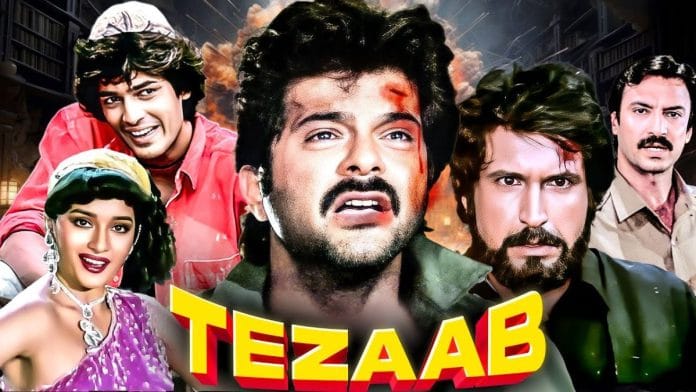
Growing up in Worli Naka, N Chandra absorbed the raw rhythms of Mumbai’s streets. As a film editor at the Film Centre in Tardeo, he turned that sharp observation into a cinematic lens.
Following stints with Gulzar and Rajshri Productions, Chandra channeled his gritty street notes into directing a devastating trilogy of realism: Ankush (1986), Pratighaat (1987), and finally Tezaab (1988)—each eclipsing the success of the last. Loosely inspired by the 1984 Hollywood neon-noir Streets of Fire, Tezaab was designed to cut straight to the bone.
The film stars Anil Kapoor and Madhuri Dixit in career-defining roles, backed by an ensemble including Chunky Panday, Kiran Kumar, Suresh Oberoi, Anupam Kher and Suparna Anand.
The casting jigsaw
Chandra had previously collaborated with brothers Boney and Anil Kapoor on Woh 7 Din. While Anil was always Chandra’s first choice for Munna, scheduling conflicts initially forced him to sign Aditya Pancholi. Boney Kapoor mediated, reassuring Chandra that Anil would prioritise Tezaab by personally routing any cancelled shooting schedules straight to the film.
The role of Inspector Singh saw a similar shuffle. Chandra initially shot a few scenes with Nana Patekar, but scheduling conflicts forced Patekar to bow out. Dharmendra was briefly considered, but deemed not a good fit. Ultimately, Suresh Oberoi was zeroed in on.
Finding Mohini proved just as complex. Chandra originally envisioned Meenakshi Seshadri, but negotiations stalled over her remuneration demands. Stymied by the deadlock, Chandra ran into Rikku Rakesh Nath (Madhuri Dixit’s manager) at the Rajshri office. Rikku presented Dixit’s portfolio alongside showreels of her work in her debut film, Abodh. Chandra recognised her magnetic screen presence instantly; the hunt was over.
Also read: Hero was Subhash Ghai’s musical experiment with newcomers. It gave us Jackie Shroff
An idealist’s descent
When Inspector Singh ( Oberoi) learns that a notorious criminal named Munna ( Kapoor) has entered his jurisdiction, he pulls his records. He recognises him as Cadet Mahesh Deshmukh. Years earlier, Singh had met the young cadet at the scene of a brutal Nashik bank robbery, where a ruthless gang murdered Munna’s parents.
When Singh confronts him, Munna lays bare how his life unravelled. Following the murders, Munna and his sister Jyoti (Suparna Anand) moved to Bombay, where he fell in love with a fellow student, Mohini (Madhuri Dixit). Mohini has been compelled to dance at nightclubs to fund the decadent lifestyle of her abusive, alcoholic father, Shyamlal (Anupam Kher). Shyamlal’s creditor was the dreaded don, Lotiya Pathan (Kiran Kumar)—whose younger brother, Chote Khan (Raj Nanvag), had killed Mahesh’s parents.
When Chote Khan later attempted to rape Jyoti, Munna killed him. A year behind bars hardened Munna, destroying the cadet and creating the vigilante.
Moved by his plight, Inspector Singh takes an uncharacteristic gamble, allowing Munna to remain free. Soon after, Lotiya kidnaps Mohini, forcing a desperate rescue. Though Munna frees Mohini, he honours his word and surrenders to Singh.
A final bloody showdown with Lotiya’s syndicate ensues. It claims the life of Munna’s closest friend, Baban (Chunky Panday). Singh intervenes directly, shooting the don dead to finally end the cycle of violence.
The crumbling, grand mansion used as Mohini’s oppressive home in the film—then known as Villa Vienna—would carve its own legend in Bollywood history. In 2001, it was purchased by Shah Rukh Khan and renamed Mannat.
Also read: Shashi Kapoor & Amitabh Bachchan played twins in Suhaag—a treasure trove of Bollywood cliches
The ultimate muses
The music of the film was provided by Laxmikant-Pyarelal and the lyrics by Javed Akhtar. Ek Do Teen, its most popular hit, was built on a melodic hook inspired by the nursery rhyme, Chanda Mama Door Ke. It shifted Indian pop culture, eventually selling over 80 lakh cassettes.
Legendary choreographer Saroj Khan found her ultimate muse in Madhuri Dixit. Dixit rehearsed relentlessly for 16 days. For the final cut, the shooting went on for 24 hours with nobody going home before the entire sequence was captured.
The impact was instantaneous. “I returned from a vacation in the US to find a crowd of nearly 40,000 people gathered at the airport, chanting ‘Mohini, Mohini!’ For the first time, I felt like a true star,” Dixit later recalled.
The haunting nocturnal anthem, So Gaya Yeh Jahaan, was captured across three cities over 17 gruelling nights. One evening, the cast wandered into a local hotel for a late-night meal without removing their bloody movie makeup. The terrified hotel staff, fearing the worst, nearly called the police. The crew had to quickly explain the entire plot of Tezaab just to secure their dinner.
On Ameen Sayani’s iconic Binaca Geetmala charts, Ek Do Teen clinched the #3 spot for 1988, while Keh Do Ke Tum Ho Meri Warna (#7) and So Gaya Yeh Jahaan (#9) dominated the 1989 countdown.
The album had platinum disc status.
The film was nominated for 12 Filmfare awards and won four: Anil Kapoor for Best Actor, Alka Yagnik for Best Playback Singer Female, Kamlesh Pandey for Best Dialogue. The cultural impact of Ek Do Teen was so high that Filmfare introduced a brand-new category: Best Choreography, awarded to Saroj Khan.
Tezaab was made on a modest budget of Rs 1.2 crore. It ran in theatres for 50 weeks, raking in Rs 16 crore, and was the highest grossing blockbuster of the year. It was later remade into Two Town Rowdy in Telugu and Rojavai Killathe in Tamil.
Views are personal.
(Edited by Theres Sudeep)