





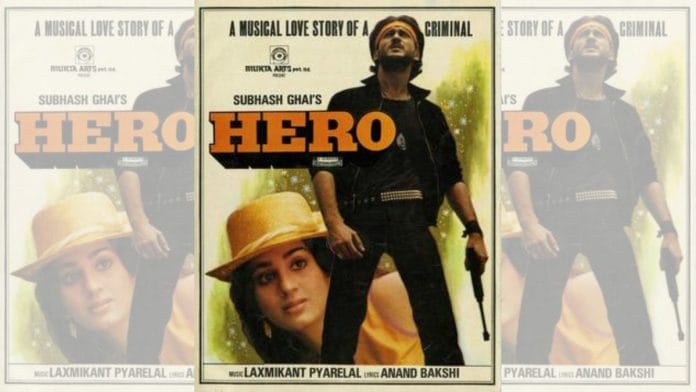


Raj was not the first hero to refuse to elope with Simran in DDLJ. Jackie had done the same for his Radha, a generation earlier in the 1983 blockbuster Hero. While SRK as Raj, a London boy, moved continents for his love, Jackie did one better—he reformed from a thug on the wrong side of the law to a hardworking honest citizen and rewrote the arc of his life.
Hero was the third-highest grossing movie of 1983. In the era of Amitabh Bachchan, director Subhash Ghai pulled off a big heist.
Two newcomers—Jackie Shroff and Meenakshi Sheshadri—led this love story where their purity, innocence & chemistry won over the heroine’s family and eventually the audience.
By the time Ghai had come to Hero, he had tasted success with Kalicharan and Vidhaata and failure with the all ambitious Karz. At this point, he was looking to make a musical.
Hero also marks a personal transition for Ghai who was moving away from established stars and experimenting with newcomers.
Also read: 1976 film Chhoti Si Baat is one of Bollywood’s most progressive portrayals of masculinity
A hero’s journey
The cast includes Sanjeev Kumar, Shammi Kapoor, Madan Puri, Amrish Puri and Shakti Kapoor. The film was written, produced and directed by Ghai, with music by Laxmikant-Pyarelal, lyrics by Anand Bakshi, playback singing by Manhar Udhas, Anuradha Paudwal, and Lata Mangeshkar, choreography by Saroj Khan and cinematography by Kamalakar Rao.
The film begins with Pasha (Amrish Puri), the most chilling villain pre Mogambo (Mr. India, 1987), being taken to prison. To ward off a possible death sentence based on the upcoming testimony of IG Police, Shrikant Mathur (Shammi Kapoor), he writes to his star protege, Jackie, directing him to prevent it.
Jackie threatens Shrikant. When he does not relent, Jackie kidnaps his daughter Radha (Meenakshi Seshadri). He tells her that he is a police officer sent by her father to protect her from a possible kidnapping by dacoits. They camp in the forest and gradually fall in love. Over time, she finds out that he is a gangster but does not leave him. She exhorts him to surrender. In a classic manifestation of Stockholm Syndrome, Radha’s fear pivots into a protective bond, binding her to stay even after the deception is revealed. Reformed by her love, Jackie surrenders to the police and is imprisoned for two years.
Back home, Radha confides in her brother Daamodar (Sanjeev Kumar). To ensure that Radha’s parents do not forcibly marry her off to somebody else, he enlists his friend Jimmy (Shakti Kapoor) to stage a sham romance. Jimmy misunderstands and falls for Radha.
After completing his sentence, Jackie starts working in a garage and tries to remake his life. Despite everything, Shrikant still does not want Radha to have anything to do with Jackie. Meanwhile, Daamodar finds out that Jimmy is a drug smuggler.
Pasha eventually escapes jail and is out for revenge. Jackie is forced to choose between his father figure (Pasha) and his newfound moral compass (Radha).
Pasha kidnaps Radha and her family. Jackie frees all of them. Pasha is killed. And our lovebirds get to a Happily Ever After—with Shrikant’s blessings.
Also read: Jab Jab Phool Khile cemented Shashi Kapoor as a star. Nanda played a rebellious, flawed heiress
Betting on newcomers
Jackie Shroff made his debut as a lead hero with the film. But he was not the first choice. Ghai’s first two choices were a post Ek Duje Ke Liye Kamal Haasan and a post Love Story Kumar Gaurav. But they did not work out due to unavailability of dates and demands for outrageous fees.
Ghai went with Shroff. Then a successful model, he was hesitant about acting. Ghai had to work very hard with Shroff as the newcomer had zero acting experience/training. Despite this, Ghai had immense faith in Shroff’s rugged looks and je ne sais quoi.
Meenakshi Seshadri was a beauty contest winner. Manoj Kumar discovered her for his film Painter. Having trained in four classical dance forms—Bharatnatyam, Kuchipudi, Kathak and Odissi—she was an extremely good fit for the role. Fresh-faced, idealistic and with agency, Radha danced into our hearts overnight.
Hero had a fairly slow start at the box office after its 16 December release. Amitabh Bachchan’s Coolie was released on 2 December. All eyes were on Bachchan’s film because the superstar had survived a near-fatal accident while shooting it. It was a moment of national crisis that left little mindspace for an earnest love story.
Gradually, on the strength of its music, Hero started picking up. It ran for an astounding 750 days. Made with a budget of Rs 3 crore, it did a business of Rs 13 crore and was a huge hit.
Like his debut movie, Shroff took some time to win over his critics and now has had an uninterrupted career spanning four decades.
Hero established Seshadri as a top leading lady. She had a long run in the industry till 1997 when she moved to the US to take care of her growing family post-marriage.
The movie was shot in Ooty, Mumbai, Matheran and on a prison set. It employed a modern, ‘western’ visual language with extreme long shot storytelling, use of golden hour & natural light, handheld action energy, and depth of field in musical sequences. This innovation was born of necessity—reflectors and natural light were used because generators could not be hauled up the mountainside.
Also read: 1988 film Waaris doesn’t romanticise rural Punjab. Smita Patil stole the show
The real star
Hero was envisaged as a musical. It had music from every genre. Tu Mera Jaanu Hai and Ding Dong, O Baby Sing Song were set to modern beats. Mohabbat ye Mohabbat is a Qawwali, Lambi Judaai is a folk song sung by Pakistani singer Reshma and Nindiya se Jaagi is set to Hindustani classical music.
The songs were extremely popular with Tu Mera Jaanu Hai charting at number four on Binaca Geet Mala 1984. Lambi Judaai was number eight. Nindiya se Jaagi and Pyaar Karne Wale spent time on the Weekly Top 25 & Top 20 lists.
But what defined the film and Indian cinema from the 80s was the flute montage provided by Hari Prasad Chaurasia. Even Ghai called “the flute passage” the actual star of the film. “It was outlined from the very beginning in the script that the Flute were the heroes of the film, which formed the basis of the intense romance between two passionate lovers,” he said.
The film also launched singer Anuradha Paudwal. In the 80s, with big names like Lata Mangeshkar, Asha Bhosle and Kishore Kumar being extremely busy, younger, relatively lesser-known artists used to record scratch tracks, often without being credited. They helped Music Directors finalise orchestra details and allowed shooting of scenes where the actors used to lip sync. Then, whenever the ‘main’ singer had time, they would come into the studio and do the final recording. Paudwal used to ‘dub’ songs for Lata Mangeshkar.
She did the same with Tu Mera Janu Hai. But Laxmikant-Pyarelal liked the recording so much that they decided to use it in the film, providing a new voice for a new heroine. By 1990, with Aashiqui, she established her credentials in the pantheon of great Bollywood playback singers.
The Brand Integration of Rajdoot Yamaha RD 350 within the story was an inspired casting choice. The motorcycle, the most powerful in India in 1983, instantly inherited Shroff’s ‘cool’, ‘rugged’ and ‘rebel’ persona.
All the gambles with lesser-known/unknown names, including Manhar Udhas (elder brother of Pankaj Udhas), over the far more established and popular Kishore Kumar paid off handsomely. Subhash Ghai was able to establish his own production company Mukta Arts from the proceeds of Hero.
Hero was remade as Vikram in Telugu and Randheera in Kannada.
In the end, Hero didn’t just launch two stars; it proved that in the roaring 80s, a flute could be just as powerful as a young man’s guns and anger.
Views are personal.
(Edited by Theres Sudeep)