





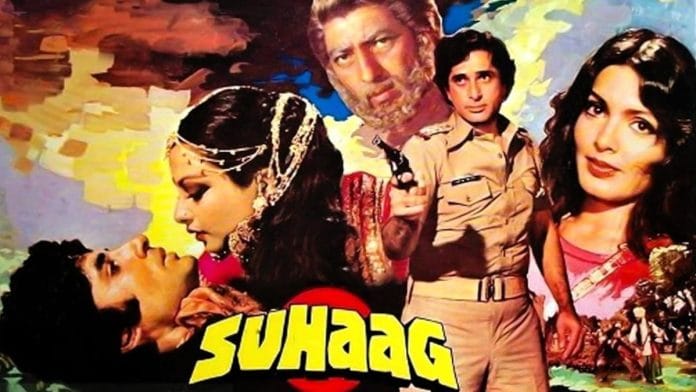


Manmohan Desai’s 1979 blockbuster Suhaag is proof that cross language remakes are not a new thing.
Even recent pan-India hits like Jawaan, RRR or Pushpa hearken back to the Manmohan Desai school of filmmaking. The lost and found trope in these films was perfected through experimentation in a more culturally cohesive, secular, poorer and chaotic India of the 1970s and 80s. Bang in the middle of this time period came Suhaag—the biggest hit of 1979.
Suhaag was made on a budget of Rs 2 crore and did a business of Rs 5 crore. It was remade in Telugu as Satyam Sivam (1981).
The ensemble cast included Shashi Kapoor, Amitabh Bachchan, Rekha, Parveen Babi, Nirupa Roy, Amjad Khan, Jagdish Raj, Jeevan, Kader Khan and Ranjeet.
Amitabh Bachchan had already cemented his ‘One Man Industry’ persona by 1978. And Desai brilliantly toned down his ‘Angry Young Man’ image by pairing him with Shashi Kapoor.
The dialogues were written by Prayag Raj and Kader Khan, cinematography by V Durga Prasad, lyrics by Anand Bakshi, music by Laxmikant Pyarelal and playback by Mohammad Rafi, Lata Mangeshkar and Asha Bhosle.
The film follows the tale of twin brothers—Kishan (Kapoor) and Amit (Bachchan) separated by circumstance. Kishan grows up to be a police officer while Amit is a petty criminal. What unfolds is a typical melodrama filled with romance, action and even a murder-for-hire.
Rekha and Parveen Babi play their love interests. Basanti (Rekha), a courtesan with a heart of gold, has chosen a life of dancing and kothas. She’s Amit’s love interest. And Anu (Babi), is her younger sister, a westernised medical student, being put through college by Basanti.
Vikram (Amjad Khan), the father of the duo has taken to a life of crime after having forsaken his wife Durga (Nirupa Roy) and children. The movie also features the scheming Jaggi (Kader Khan), his son Gopal (Ranjeet) and the bootlegger Pascal (Jeevan), all petty villains. These men are responsible for the separation of the twins and all misfortune that provides the drama in the film.
In any other movie, a criminal of Vikrams’s proportions would have met a gory end. In this, by virtue of being married to the virtuous Durga and being the twins’ father, he gets to live. All the other villains die.
Full of stunts, singing, dancing, dramatic twists and turns, the film has a strong moral undertone of good triumphing over evil despite all odds.
The film is a treasure trove of tropes—from the separated-at-birth twins and the suffering mother, to characters bumping into each other through coincidence. The over the top emotions are anchored by a strong bromance. As with earlier Desai films, all loose ends are magically tied up in the end.
Also read: Jab Jab Phool Khile cemented Shashi Kapoor as a star. Nanda played a rebellious, flawed heiress
An eventful shoot
The film was announced in 1976 and filming began in 1977—during the Emergency declared by Prime Minister Indira Gandhi so a lot of permits were impossible to obtain.
It led to the production of the movie taking place across Mumbai, London and Singapore.
Desai filmed the scenes and merged them in such a way that it seems that all the action is happening in Mumbai.
For a viewer in the 70s, the idea of non-identical or fraternal twins was hard to get used to. Hindi cinema had mostly relied on the same actor playing double roles. But Desai took a different direction which allowed him to cast Bachchan and Kapoor as brothers.
For people used to Salim-Javed’s battery of iconic dialogues, Suhaag might leave them wanting. But what it lacks in one liners, it makes up for in the banter between Bachchan and Kapoor.
People who have enduring memories of the 1990s remember Kader Khan as Govinda’s side-kick in over-the-top comedies. But that came after the veteran actor had already written screenplays and dialogues for 200 movies.
Desai had only Parveen Babi in mind for the role of Anu. When she moved to Europe with Kabir Bedi, he thought of Simi Garewal as an alternate option. To his relief, she came back after six months and he gladly gave her the role.
The stellar music team produced popular chartbusting songs. Teri Rab Ne Bana Di Jodi propelled the story forward. It was number 9 on that year’s Binaca Geet Mala countdown and continues to be played at weddings even today. Main to Beghar Hoon was at number 14.
(Edited by Theres Sudeep)