





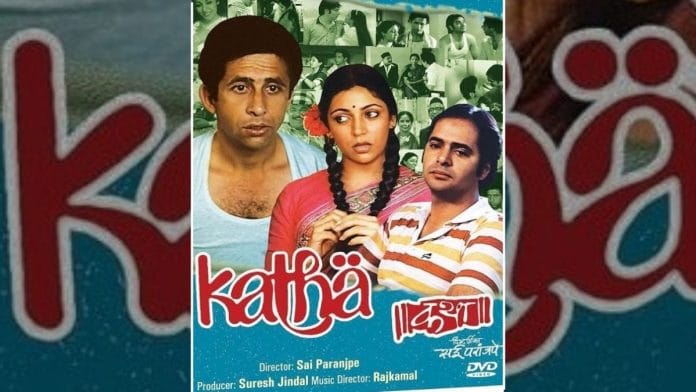


Sai Paranjpye’s 1983 film Katha opens with the protagonist entering his chawl with a smile. He had taken a taxi after many days to celebrate his job becoming a permanent one at a footwear company.
Played by Naseeruddin Shah, Rajaram Purushottam Joshi is a lower-middle-class man who wants to live by ethics and idealism in every step he takes, but they are tested in the now nostalgic streets of Mumbai. The film captures a lost era of government buses, radios, chawls, vintage outfits, and community-driven urban life in Mumbai that has been buried beneath high-rises and fast-paced modernisation.
Katha is a pure arthouse film in which Shah is a morally upright, innocent character, standing in front of the angry young men of Bollywood—Amitabh Bachchan’s Coolie, Andha Kaanoon, Pukaar and more. The years were filled with anti-heroes fighting the system, and in parallel, Joshi was trying to borrow some milk from his neighbour to make tea for a not-so-friendly friend.
Race for a better life
The film is literally about roti, kapda and makan—the three things Bollywood has reminded audiences are essential for survival in the country. The film, however, adds love, ethics and street smartness to the survival kit, seen in another character, Basu Bhatt, played by Farooque Shaikh. And he is not the kind of street smart that anyone wants to be friends with.
He manipulates everything, from Joshi to living in a room for less than half of the rent, which he forgot every time, to his love interest Sandhya, played by Deepti Naval, to every member of the chawl, and somehow also enters the job at a higher position where Joshi enters after much hard work.
Interestingly, Shaikh’s character was not originally named Basu, but the director gave him that name as a way to take revenge on producer Basu Bhattacharya, who delayed the director’s earlier film Sparsh for three years.
With every minute, Joshi is getting more ethical and more innocent. A colleague flirts with him; he hates it and wants to focus on work. He is not able to confess his love to Sandhya. His neighbours love Basu more as he knows how to influence people, but he tries to save the day.
Even after a harsh day at the office, while standing at the bus stop, Joshi listens to a radio announcement that a girl needs blood that matches his. He takes a taxi. That scene breaks the stereotype that he is a miser. Every month, he tries to send some savings to his old parents in the village.
Similarly, Basu is getting meaner with every minute. Without a proper degree, he enters the job by showing off his speaking skills, then flirts with his boss’s new wife and becomes Joshi’s worst nightmare. He is now ready to marry Sandhya, which breaks Joshi, but even then he does not utter a word and accepts it.
Also read: 1984 film Party got a second life in CJP protest. It is political satire at its finest
Slow but steady
In the climax of the film, Basu gets fired from his job after his boss unearths photos of him and his wife’s newly found love affair, and for Basu, it’s normal. At the same time, Sandhya’s father is arranging the marriage setup of Basu and their daughter, but now Basu is missing.
Joshi is back from his job. At the start of the film, he entered smiling, but now it’s the saddest moment in his life. He enters his room and reads a note by Basu that the story has ended and he has moved on.
While the marriage is pulled off, Joshi becomes the saviour and marries Sandhya at last, and they live happily ever after in the same chawl.
The film is based on a Marathi play Sakharam Aani Kasav (Hare and Tortoise) by SG Sathaye, and later in 1988, the play was adapted into the Malayalam romantic-comedy Mukunthetta Sumitra Vilkkunnu, starring Mohanlal and Ranjini.
Here in the film, the innocent and naive tortoise is Joshi, and the clever and street-smart hare is Basu. And at last, the tortoise won the race of love.
(Edited by Saptak Datta)