





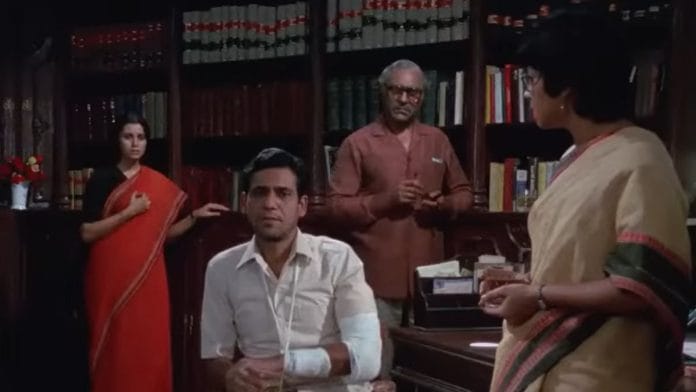


In Govind Nihalani’s 1984 film Party, Om Puri plays a journalist called Avinash who asserts that all art is a tool in socio-political conflict, arguing that it must be engaged with public ideas.
“You mean to say the purpose of art is merely to become a political weapon? Doesn’t it have any independent existence of its own?” asks Bharat (KK Raina), a poet.
Avinash doubles down. “If an artist isn’t politically committed, then their art isn’t relevant… when the human and the artist meet within an individual, they seek one answer: Do we want to live like an artist or like a human being?”
The exchange, widely shared on Instagram in the last couple of days as the Cockroach Janta Party-led student protests raged, also exposes the difference between two kids of people drifting through the party. One, like Diwakar Barve and Damyanti Rane, treats activism as an intellectual accessory. The other includes people such as Avinash and the largely absent poet Amrit (Naseeruddin Shah)—said to have left a comfortable city life to work with a tribal community—who risk their lives to push back on the system’s oppression.
Adapted from Mahesh Elkunchwar’s Marathi play by the same name, Party is a claustrophobic political satire that calls out the hollowness and hypocrisy among India’s urban intellectuals and artists.
Apart from the first 26 minutes, the entire film unfolds over a single evening at a lavish house party in Mumbai. It is hosted by Damyanti Rane (Vijaya Mehta), a wealthy, well-connected widow and arts patron celebrating the National Literary Award win of her friend, Diwakar Barve (Manohar Singh).
The guest list includes sycophantic critics, artists, English-speaking journalists, society fixtures, and armchair Marxists. These are people who have mistaken the party for the world, where politics, suffering, and commitment are things to be debated between drink refills.
Ghosts that haunt the narrative
Two absent figures haunt the film and give it a moral spine. One is Amrit, who the guests speak of constantly. It is learned that Amrit walked away from writing poetry to work with a tribal community fighting for its land and dignity. Barve calls it “a kind of romanticism”, while Rane calls social commitment a new “fashion”, adding that she isn’t ready to support Amrit’s stupidity.
Everyone at the party holds up Amrit as proof that the world still has integrity. Amrit seems to be hurt by what he witnesses in society. His patriotism is not loud or dramatic, like the guests at the party. This makes him the film’s moral centre, even though he is absent from the actual party. His character remains largely offstage, a legend the others use to flatter themselves.
The second figure is Avinash himself, who arrives late in the evening. His entry, over an hour late, with a fractured arm and the unpleasant news of Amrit’s arrest, raises concerns among the guests. When Barve calls the situation unexpected, Avinash says, “Zara Bambai se nikal kar vaha jaiye toh (Get out of Mumbai and go to other places).”
When news comes that Amrit has been killed, Avinash refuses to let the room mourn him. “Aap kyu use shaheed banana chahte hain (why do you want to make him a martyr)?”
The film ends with Barve having nightmares as he struggles to sleep. Amrit’s haunting face, where he is brutally injured, keeps flashing in front of his eyes. This is also the first time Shah appears on screen.
Rohini Hattangadi’s performance as Barve’s wife Mohini is the saddest and most human. A former stage actor who is reduced to the role of a plus one and drunkard, she carries her husband’s neglect and her ambitions to be loved everywhere she goes.
Where the people around her discuss ideology, Mohini’s despair is unpretentious and entirely private. Her pain and desperation are clear in the scene when she half-strips and says to Barve, “Mai ab bhi sundar hoon. Aakhein kyu fer lete ho (I am still pretty. Why do you avert your eyes)?”
Mohini’s part makes the film quite modern for its time.
Also read: Qurbani gave Bollywood a new kind of cool. It has never gone out of fashion
The party
The film’s title carries a double meaning. It gestures at both the social gathering and a political party. Nihalani, a director who spent much of the 1980s examining state violence and social injustice in films such as Aakrosh (1980) and Ardh Satya (1983), turns his scrutiny inward here. He turns his lens toward urban artists and critics, the very audience most likely to admire the film.
More than four decades later, Party has lost none of its bite. Its portrait of comfortable people performing concern while carefully avoiding risk feels more legible now than ever.
Party stands as one of the finest achievements of Indian parallel cinema: literate, furious, and entirely unwilling to let anyone in the room, including us, off the hook.
(Edited by Prasanna Bachchhav)