





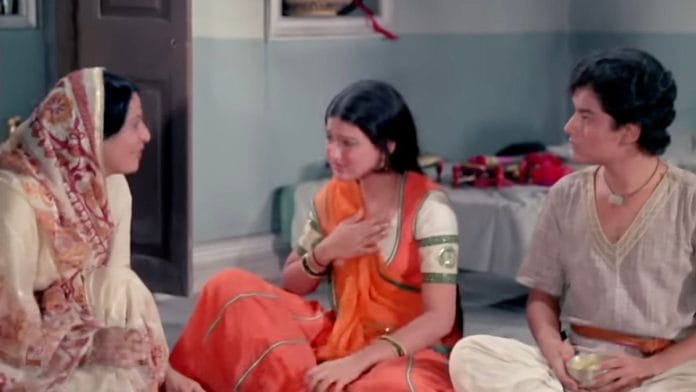


The 1970s belonged to the Angry Young Man. Zanjeer (1973), Sholay (1975), Deewar (1975) and Don (1978) ruled the decade, alongside romances like Amar Prem (1972) and Bobby (1973). In the middle of all that, Geet Gaata Chal, directed by Hiren Nag, offered something gentler. The film recently turned 51, and it still holds up as an outlier from a decade defined by rage and heartbreak.
The film follows Shyam, an orphan who wanders through green fields, eats wherever he finds food, and lives without a single regret. Played by Sachin Pilgaonkar, Shyam is innocence with a tune attached to it, singing the film’s title song “Geeta Gaata Chal” wherever he goes. He is not a trained artist. When he accidentally wanders into a drama company where the lead actor is boring the audience, Shyam breaks into song and lifts the room. The director is thrilled, the crowd is delighted, and when the female lead asks him where he learned to perform like that, Shyam simply says he does whatever his heart tells him to.
That instinct carries through the entire film, which unfolds almost entirely through its songs. Most Bollywood films of the era used music as filler between scenes. Geet Gaata Chal does the opposite: the songs not only tell the story but also take it forward. Ravindra Jain composed most of the soundtrack, sung by Jaspal Singh and Aarti Mukherjee, with “Shyam Abhimaani” performed by Mohammed Rafi and Asha Bhosle.
The plot kicks off in a marketplace, where Shyam runs into Radha (Sarika), the stubborn daughter of a rich village family who believes she owns the place. Their bickering over whose turn it is on the swing sets the tone for the rest of the film. Shyam later saves a woman from a commotion in the market, and she turns out to be Radha’s mother. Impressed by him, the family invites him to live with them on their sprawling green estate, exactly the kind of place Shyam loves. He agrees and moves in.
Sachin Pilgaonkar was seventeen when he played Shyam, and while he was still a few years from stardom, he was far from a newcomer.
“Before Geet Gaata Chal, I had already worked as a child actor in about 65 films, so I wasn’t exactly a newcomer to this industry,” he said in an interview. He also recalled that the film took nearly a year to complete because it was shot in portions, with each schedule reviewed and refined before the crew moved to the next.
“That procedure of filmmaking, which is actually the correct procedure, was meticulously followed,” he added.
Also read: The Angry Young Man is gone. Bollywood now celebrates only the anger
A different ending from Tagore’s
The film is loosely adapted from Rabindranath Tagore’s short story Atithi (1895), which had been faithfully adapted in Bengali by director Tapan Sinha in 1965. The screenplay for the 1975 film was written by Sachin’s father Sharad Pilgaonkar along with Madhusudhan Kalelkar, with dialogues by Vrajendra Gaur. When it was sent to Shantiniketan seeking adaptation rights, the trustees turned it down.
“We cannot give you the rights to this story because this is not our story. Your script is something else entirely; it does not match our story at all. Since this isn’t our story, how can we give you the rights?” read the letter from Shantiniketan, according to Sachin.
The reason for that rejection becomes clear in the film’s second half. Shyam settles into life with Radha’s family, their banter continues, and somewhere along the way, Radha falls in love with him, while he remains too innocent to recognise what love even looks like. A marriage proposal arrives for Radha, which she refuses to accept, still hoping Shyam will notice her feelings. Her family, unaware of what she is waiting for, only sees a daughter unwilling to settle down. Radha’s mother eventually convinces her husband to arrange Radha and Shyam’s marriage instead, and the two only find out once it is decided.
Radha is overjoyed. Shyam is not. To him, marriage feels like the end of the freedom he has spent his whole life protecting, and his hesitation breaks Radha’s heart all over again. She responds the way the film always lets her respond: through song, singing that if God ever wishes to punish her, He should do it only in Shyam’s presence. Overwhelmed, Shyam runs back to the drama company where his story began, leaving the house and Radha behind.
It is only once he is gone that he understands what he has been denying, both Radha’s love and his own. He returns to the village, confesses, and marries her.
In Tagore’s story, the protagonist leaves the girl behind for good, choosing his wandering life over her. Geet Gaata Chal couldn’t let that happen. It gave its hero a reason to come back, and in doing so, gave Hindi cinema one of its gentler love stories from a decade that mostly remembers itself for rage.
(Edited by Prashant Dixit)