





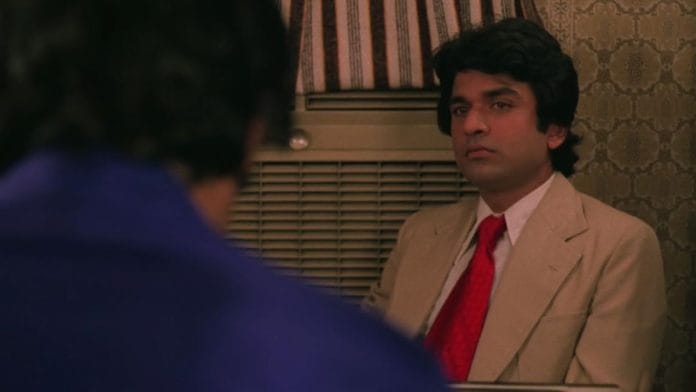

Syed Akhtar Mirza’s Arvind Desai Ki Ajeeb Dastaan is an expression of his personal philosophy. Something that would become more visible in his Albert Pinto Ko Gussa Kyoon Aata Hai a couple of years later, in 1980. Then came Mohan Joshi Hazir Ho! (1984), Salim Langde Pe Mat Ro (1989), and Naseem (1995). Socio-political commentary is a constant in his filmography.
At the time, Shyam Benegal was at the forefront of the parallel cinema movement with Ankur (1974), Nishant (1975), Bhumika (1977) and Manthan (1976). Mainstream Bollywood, meanwhile, was producing films such as Amitabh Bachchan’s Don (1978), B.R. Chopra’s Pati Patni Aur Woh (1978) and Trishul (1978). The Angry Young Man was in the making.
Somewhere between these two worlds stood Arvind Desai Ki Ajeeb Dastaan, where it was too political to be conventional commercial cinema, and too aspirational to be parallel cinema.
The film’s themes are deeply rooted in Marxist thought, but Mirza approaches them through the life of someone who exists on the better side of the class divide. Arvind Desai, played by Dilip Dhawan, is the son of a wealthy businessman played by Shreeram Lagoo. He has privilege, money and access and he knows exactly how to use those to protect himself.
The film discusses Maoism and Marxism, class and caste divide through its protagonist — a handsome, affluent, street-smart young man who knows how to flirt, navigate the city and move through different social circles. Arvind discusses revolution without ever having to sacrifice the comfort that capitalism has given him.
The film failed at the box office but gradually acquired cult status. At its heart, it is a film about a city and its relationship with a young man who has everything a person could ask for. And yet, Arvind remains lonely, unhappy. He wants something more, but he does not quite know what that “more” is, nor is he willing to do much to achieve it.
In one scene, when he is frustrated with Mumbai, Arvind says, “This bloody city, I hate it,” to his idealist Marxist friend Ranjan, played by Om Puri. The relationship between the two is fascinating because both seem to be searching for an escape from the world around them. They imagine a different, almost utopian world that would fit their own ideas, where they can spend their time discussing art, politics, and ideology.
Also read: 1984 film Party got a second life in CJP protest. It is political satire at its finest
A different kind of angry young man
Mirza’s Mumbai is different. In much of the popular cinema of the period, Bombay was presented as a lively city of dreams, where anyone could arrive and make something of themselves. The romantic Mumbai of Basu Chatterjee and Mani Ratnam. Mirza’s city is filled with beggars at street corners, performers at traffic signals and visible poverty. But he does not turn this poverty into a victim or ask the audience to pity his characters.
Bhaskar Chandavarkar composed the score of the film, focusing on subtle minimalist sounds that capture the chaotic ambience of Mumbai.
Like Albert Pinto Ko Gussa Kyoon Aata Hai, Mirza examines the consequences of capitalism through the lives of people most affected. He looks at the system from the perspective of the worker and the confused, frustrated Albert Pinto, a different answer to the question of what an “angry young man” could actually look like, far removed from the heroic, larger-than-life figure created by Salim-Javed.
In Arvind Desai Ki Ajeeb Dastaan, Mirza focuses his camera on the other end of the system. We see what happens inside the upper levels of a factory and within a wealthy business family. Arvind’s conflict with his father over the business is a conflict over money, power, and inheritance. His mother does not understand him, while his Paris-returned girlfriend is a corporate deal rather than love.
Arvind loved his father’s office secretary, Alice, played by Anjali Paigaankar, but he never really took a stand for his love and treats Alice as he treats everything in his life ‘carelessly’.
But the more his character arc develops in the film, the more we see his hatred for privilege and why he thinks they are more hygienic and cleaner than other people in society.
“We are clean people, aren’t we? We cannot stomach squalor,” he says to his sister. But several times, the same hatred for the other class can be seen on his face, like when he goes to the university with Ranjan.
In the film, the characters are dealing with their own problems. His sister always has a smiling face, even for her husband, who is involved with other women sexually. And like her brother, she also hates being rich. To make sure she is not arrogant, she contributes to charity. The same is happening with Ranjan. He is an intellectual college student who tries to manage the ethical compass of the film. But there are scenes when Arvind outsmarts him. The main character, that is Arvind, sees a painting in Ranjan’s room and describes it as if he has never seen anything like it before, and Ranjan is not able to imagine it in the same way.
The last scene of the film leaves the audience with one question. Arvind and Ranjan are having a conversation, and Ranjan says, “Perhaps all one can do is ask the right questions.”
(Edited by Ratan Priya)