






In 1994, three years after Rajiv Gandhi’s assassination, Sonia Gandhi placed a quiet, unassuming book on tables in Delhi bookshops: Rajiv’s World: Photographs by Rajiv Gandhi. There were no speeches, no political manifestos; only black-and-white and colour frames clicked by a man who, as prime minister, was constantly photographed by others but preferred to stand behind the lens himself.
Most of the images had never been published before. In her foreword, Sonia wrote that “a fair amount of this photography was at home,” with his most frequent subjects being Rahul, Priyanka, herself, Indira and Sanjay. She described Rajiv as a man who, “whatever activity he took up, immersed himself in every detail with tremendous curiosity and enjoyment” until he mastered it — whether it was flying an aircraft or learning the technical nuances of a camera.
Photography was only one of Gandhi’s private obsessions. He was also interested in amateur radio and fascinated by the machinery of communication. In retrospect, that curiosity seems almost like a preview of the technological politics he would later embrace.
That curiosity was a recurring theme in how colleagues described him. Sam Pitroda, the technocrat who worked closely with Rajiv Gandhi on India’s telecom and technology push, remembered him as a leader willing to take risks on ideas that had little precedent in India. When the US refused to sell India a Cray supercomputer over fears that the technology could be used to develop nuclear weapons, Pitroda told Gandhi that India could build its own. Gandhi agreed, and C-DAC was established in 1988. Within two years, its engineers had produced a prototype of PARAM, India’s first indigenous supercomputer.
Pitroda also recalled Gandhi’s frustration with bureaucracy. When ministries told him that a major science-and-technology exhibition for the Soviet Union could not be organised in time, Gandhi handed the job to Pitroda instead. “He was as frustrated with the country’s bureaucracy as I was,” Pitroda wrote.
For Pitroda, Gandhi’s defining quality was not simply his interest in technology but his willingness to give people the political backing to pursue it. After Gandhi’s death, Pitroda wrote that all the work on C-DOT, the Technology Missions and other initiatives had been possible because of his “political will and his support”.
From cockpit to 7 RCR
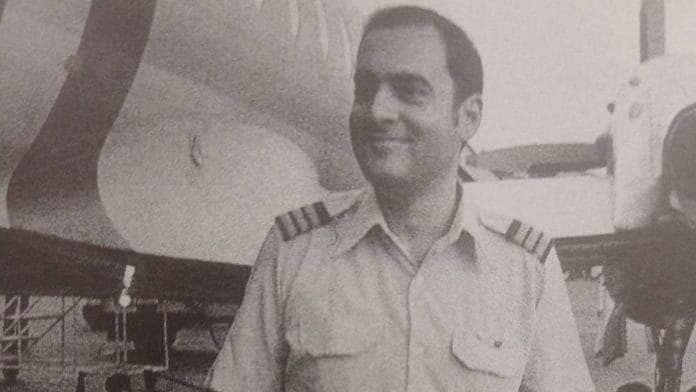
Born on August 20, 1944 into the Nehru-Gandhi family, Rajiv Gandhi studied engineering in Britain before becoming a commercial pilot with Indian Airlines. Colleagues remembered him as a “great pilot who also knew a lot about what’s what in the guts of his greatest love, aircraft”.
Captain Satish Sharma, his batchmate from the flying academy, who later became a Union minister, gave up a booming commercial career in 1983 to join Gandhi’s political team, a move that underscored the loyalty he commanded among peers.
Rajiv Gandhi had not planned a political career. He was working as a commercial pilot when his younger brother Sanjay died in a plane crash in 1980, and Indira Gandhi’s political circle began pushing him towards politics. He eventually entered electoral politics in 1981.
Some of his pilot traits followed him into political life. He drove his car himself, even during election campaigns, unusual for someone of his security profile. He maintained a circle of friends from his flying days. In private, he could be shy — an anecdote from his Doon School days describes a young Gandhi hiding away “embarrassed” when his grandfather Jawaharlal Nehru came to visit.
On 31 October 1984, Indira Gandhi was assassinated by two of her Sikh bodyguards. Rajiv Gandhi, then 40, was flown back from West Bengal and sworn in as India’s youngest prime minister later that day.
The long shadow of 1984
Gandhi began his prime ministership with what remains the greatest stain on his legacy, the anti-Sikh violence that consumed Delhi and other cities after Indira Gandhi’s assassination. Thousands of Sikhs were killed.
Commenting on the violence, Gandhi told a rally: “When a big tree falls, the earth shakes.” The remark became a lasting stain on his image and is still cited by critics as evidence of his government’s failure to confront the scale of the killings.
In 1985, the Supreme Court ruled in favour of Shah Bano, a divorced Muslim woman, ordering her husband to pay maintenance. After protests from conservative Muslim leaders, Gandhi’s government passed the Muslim Women (Protection of Rights on Divorce) Act, 1986, effectively overturning the judgment.
A year later, his government allowed the opening of the locks at the Ram Janmabhoomi-Babri Masjid structure in Ayodhya, permitting religious rites inside. Both decisions would become part of long-fought political battles over religion that defined the following decade.
Mr Clean, and the stains that wouldn’t wash out
Gandhi entered 7, Race Course Road with a carefully cultivated image: the clean, modern politician who would sweep away the corruption of old-school politics. He was soon dubbed “Mr Clean”.
That image cracked in 1987 with the Bofors scandal. His defence minister, V.P. Singh, raised questions over alleged kickbacks in the deal for field guns with Swedish arms firm Bofors. Swedish Radio reported that around Rs 64 crore had been paid in bribes.
Gandhi denied taking any bribe. A former Swedish police chief, who investigated the case later, said there was no evidence that Gandhi himself had received any bribe. But the scandal destroyed his credibility.
Mani Shankar Aiyar, who served in his government and later wrote The Rajiv I Knew, described him as “intelligent, intellectually alive, tireless, and dedicated to improving the moral tone of our democracy”, but also “essentially a good man, a trusting human being, honest with a high sense of probity and integrity”.
Yet, Aiyar also captured what he called the “central paradox” of Gandhi’s term: “What made him a good man, compassionate, diligent, honest, upright, unruffled, bold, truthful—was what felled him.” In Aiyar’s telling, Gandhi’s lack of political guile, his trust in people, and his refusal to play the rough games of “Hindi film politicians” left him vulnerable in a system that rewarded cunning over candour.
Bofors turned that vulnerability into a political weapon. By the 1989 Lok Sabha election, “Rajiv Gandhi chor hai” had replaced his image of the young, modern leader. Congress lost its majority, and Gandhi’s reputation for integrity never fully recovered.
Modernisation, technology, and reform
For all the controversies surrounding Gandhi’s political career, his fascination with technology was genuine and unusually personal. His relationship with computers went beyond government policy. His political organisation was experimenting with computerised data as an electoral tool. By the 1989 election, computers were reportedly being used to analyse constituencies and identify where Gandhi’s personal campaign appearances could have the greatest impact—a strikingly modern approach in an era before smartphones or social media.
Accounts of his working style suggest that Gandhi could refuse to begin discussions until the relevant floppy disk had been inserted.
The irony was that the man who became one of India’s most prominent advocates of computerisation had never completed his engineering education. His interest was intensely practical in a way that he was drawn to machines, systems and what technology could make possible.