





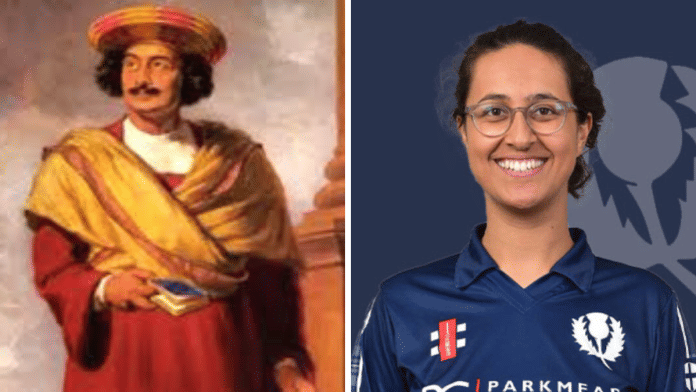


New Delhi: Raja Ram Mohan Roy has surprising links to the ongoing ICC Women’s T20 World Cup taking place in the UK, and it is none other than Scottish cricketer Priyanaz Chatterji. Chatterji stepped onto the field for Scotland against Ireland on 13 June during the ICC Women’s T20 World Cup, and helped her team finish strongly with an unbeaten 6.
The connection was first discovered by Instagrammer Amit Sinha in a video posted on his channel, RandomCricketPhotos. A right-handed batter and right-arm medium bowler, Chatterji has become an all-rounder for Scotland women’s cricket. Born in Dundee, she began her cricket career with Forfarshire Cricket Club before entering the Cricket Scotland pathway at the age of 12.
She made her senior debut for Scotland as a teenager and has since represented her country across international competitions, while also playing domestic cricket abroad, including stints with Surrey and Wellington Blaze.
Though the Scottish player is in the headlines for cricket, her family is also known for its contributions to the nineteenth-century Bengal Renaissance.
Chatterji’s father, Monojit Chatterji, grew up in a family closely connected with journalism and academia. His father, Manuj Mohan Chatterji, was the last editor of The Leader, a newspaper in Allahabad, before it shut down in 1968.
A journalist and commentator, he contributed regularly to newspapers, radio, and the BBC, and was known for his work on nineteenth-century Bengal. He also ghost-wrote a book on Raja Ram Mohan Roy.
Monojit himself followed an academic path. Educated in Bombay and Delhi, he graduated in 1970 from Elphinstone College with first-class honours and first rank in economics and mathematics before moving to Cambridge on a British Council scholarship.
At Christ’s College, he studied economic thought, attending lectures by Indian Nobel laureate Amartya Sen and was also taught by leading economists, including Nicholas Kaldor, Joan Robinson, Richard Kahn, and James Meade. As a young man, he also met political figures including Vijaya Lakshmi Pandit, Atal Bihari Vajpayee and Indira Gandhi.
Also Read: Raja Ram Mohan Roy, the polyglot reformist, journalist and educationist
The Bengal connection
Despite spending much of his life abroad, Monojit often speaks of his strong connection to Bengal.
In an interview with The Telegraph, he said, “Culturally, my roots lie deep in Calcutta.”
“On my father’s side, my ancestors include Dwarkanath Tagore and Ram Mohan Roy. My great-grandfather Mohini Chatterji translated the Bhagavad Gita directly from Sanskrit to English.”
These culturally affluent family roots connect the Scottish player to two of nineteenth-century Bengal’s most influential names: Raja Ram Mohan Roy and the Tagore family.
Family accounts state that Roy’s daughter was Mohini’s grandmother. The connection also influenced the family’s religious and social outlook. Mohini’s father, Lalit Mohun Chatterji, reportedly faced opposition after marrying into Roy’s family. The Chatterjis subsequently became closely associated with Brahmo ideals of reformist philosophy.
Mohini later cemented his links with Bengal’s intellectual and cultural circles through his marriage to Saroja Devi, daughter of Dwijendranath Tagore, the eldest son of Debendranath Tagore and Rabindranath Tagore’s elder brother.
Mohini’s work and ideas also attracted attention outside India. Among those he met was the Irish poet WB Yeats, who later wrote the poem Mohini Chatterjee.
“Mohini Chatterjee / Spoke these, or words like these,” Yeats wrote, recalling their conversations.
Preksha is a TPSJ alumnus currently interning with ThePrint.
(Edited by Insha Jalil Waziri)
Family accounts state that Roy’s daughter was Mohini’s grandmother. But Rammobun had two sons Ramaprasad and Radhaprasad and one adopted son Rajaram. There was no daughter, born out of Rammohun.