





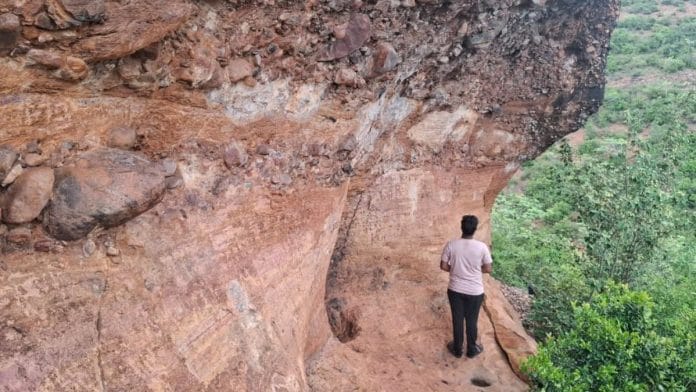

New Delhi: Indian archeologists have found a prehistoric rock shelter with petroglyphs and scattered stone tools in Nagalapuram Mandal, Tirupati district, Andhra Pradesh. This suggests the presence of Middle Paleolithic civilization nearly 300,000 to 50,000 years ago.
The discovery was made on 30 June by Shyam Daniel and Bharath, founders of Agzah Avaiyam, a Centre for Archaeological Excellence. Speaking to ThePrint, Daniel said that the petroglyphs, much like rock art, added to the significance of the region and provided fresh evidence of prehistoric human activity.
“If we excavate and find more about these places, we will be able to understand the Stone Age in this particular region much better,” said Daniel.
Study of stone age
The duo, former students of the University of Madras, were intrigued when their professor told them about the less explored areas of Tamil Nadu and Andhra Pradesh. They chose one of the sites along the border of the two states and spent hours climbing the nearby hills until they eventually stumbled upon the rock shelter. What they found was a well-preserved panel of prehistoric petroglyphs engraved on the rock surface.
“Rock shelters were not places where people stayed permanently. But they would have dwelled there for a particular period, and used the spot to make stone tools and drawings on the rocks,” Daniel told ThePrint.
According to Bharath the discovery of such a rock shelter marks an important addition to the prehistoric archaeological record of Andhra Pradesh.
“The presence of multiple engraved panels depicting anthropomorphic, zoomorphic, and geometric motifs, together with the associated Middle Palaeolithic and Mesolithic stone tool assemblage documented in the vicinity, highlights the archaeological potential of the region and contribute significantly to a better understanding of prehistoric cultural traditions in southern India,” he said.
However, since the duo did not find any complete tool, their discovery is a primary site, where tools have likely been left as they were by those who may have once used them. At such sites people often brought raw material from the hill, worked it into stone tools, and the flakes from that process were scattered across the entire region.
Also read: Sri Lanka’s Ibbankatuwa shows what India gets wrong about archaeology
Vulnerable remnants of the past
Many rock shelters in Tamil Nadu and Andhra Pradesh have been victims of weather and quarrying. The recently discovered one too is also vulnerable. Among the three panels found inside, Daniel said the first one suffered extensive natural weathering, and had only faint traces.
In the other two panels the motifs portrayed cup marks, vertical linear engravings, human figures, animal like figures including turtle, deer, animal footprints and jars. The duo also found motifs resembling rainbow-like patterns on the rocky floor, similar to prehistoric petroglyphs and geoglyphic motifs reported from the Konkan region.
“Rock art comes in three forms. One is a pictograph, which is a painting on the wall. Second is a petroglyph, which is a carving on the rock surface. Third is a geoglyph,” said Sudhir Risbud, a conservationist and naturalist from Ratnagiri. He added that geoglyphs are usually larger designs or motifs, often bigger than 4 meters, created on the earth’s surface using stones, gravel, earth, or cleared ground.
According to Risbud, although similar geoglyphic motifs may have been found in the Konkan region, drawing a comparison would take more time, research and evidence.
“It is not good to be in such a hurry”, he said.
(Edited by Janaki Pande)