






New Delhi: Even before its release, Sonia Gandhi’s memoir Belonging is already making headlines. At first, most were shocked by the announcement; some were excited. Now, though, the book is trending because the publisher Penguin Random House India has backed out months before its alleged release date.
According to The Indian Express, the international publisher will not proceed with the Congress politician’s book in India, paving the way for several others such as HarperCollins India.
The newspaper reported that the decision followed Gandhi’s rejection of certain “editorial changes” requested by the publisher.
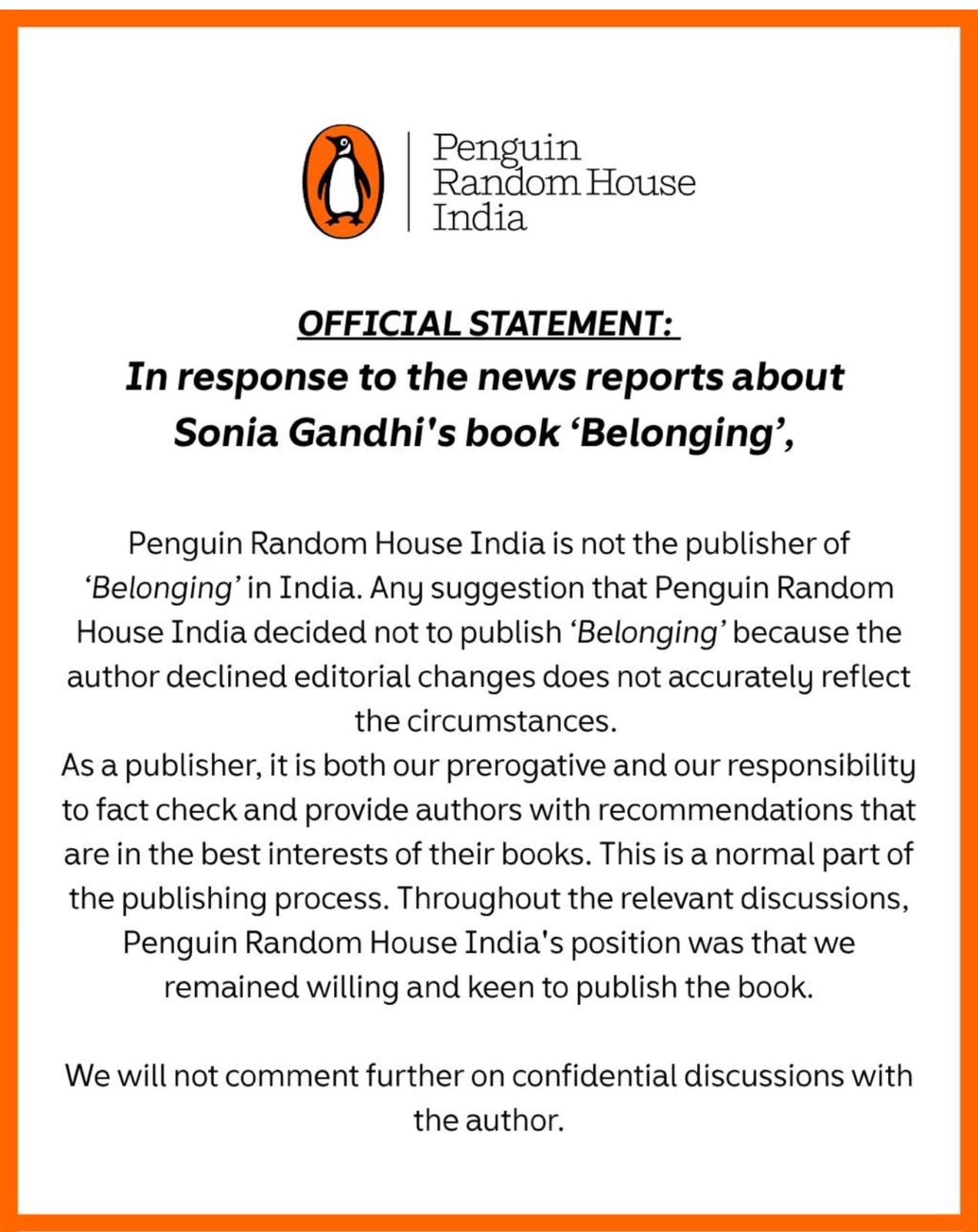
In a statement following the article, the publisher said that the claim that the book was let go of because the author did not comply with editorial decisions “did not accurately reflect the circumstances.”
“As a publisher, it is our prerogative and our responsibility to fact-check and provide authors with recommendations that are in the best interest of their books,” the statement read, adding that this is a normal part of the publishing process. The statement concluded with the publisher declaring that they will not be commenting on the issue any further. Penguin has also disabled comments for the Instagram post carrying the statement.
“Throughout the relevant discussions, Penguin Random House India’s position was that we remained willing and keen to publish the book. We will not comment further on confidential discussions with the author,” the spokesperson at Penguin Random House India told ThePrint.
However, Gandhi has not issued a statement.
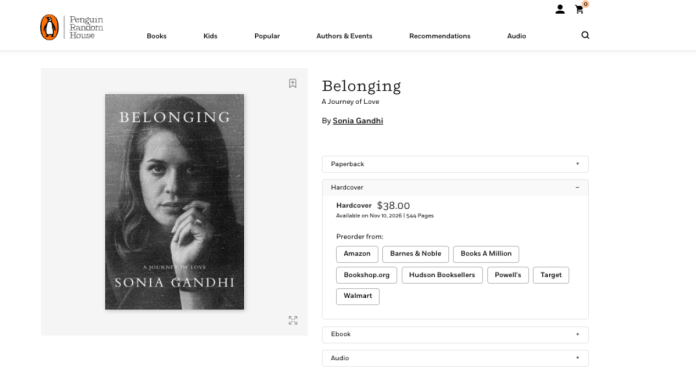
The book description and blurb are still available on Penguin’s website, priced at $38. The political memoir was set for release on 10 November.
It is described as a “revelatory” book and chronicles the rise of a girl from a small village in Italy to one of India’s leading politicians, known around the world.

The story begins in Cambridge in 1965, where Gandhi first met her future husband, Rajiv, grandson of India’s first Prime Minister, Jawaharlal Nehru. It goes on to detail their whirlwind romance and Gandhi’s eventual journey into Indian politics.
“Belonging is at heart one courageous woman’s story of finding the strength to remake her life and serve her country,” read the blurb.
The backlash
The announcement has since garnered significant media attention and criticism across social media platforms, with many likening it to an earlier controversy between the publisher and graphic novelist Joe Sacco.
In June 2026, the publisher backed out of distributing Sacco’s The Once and Future Riot, citing an inaccurate map of India and unresolved editorial and legal concerns. However, the author claimed that Penguin was looking for excuses to drop a politically sensitive title under a tumultuous political climate.
“The goal is to get the book into the hands of Indian readers so they can judge it for themselves. We will try to keep the price down to make it as accessible as possible,” Sacco told ThePrint.
He added that he told to remove a conclusion made on the Hindu nationalistic priorities, terming it “firing on all cylinders”.
“The publisher considered this statement as ‘inflammatory’ and likely to create ‘religious offence,” Sacco said.
The Sacco controversy further drew criticism from the literary community. Author Arundhati Roy criticised Penguin Random House India for caving to political pressures, noting that free expression in Indian art and literature faces relentless attack.
One X user, citing Penguin’s behaviour toward Sacco and Gandhi’s books, said, “A pattern is not a coincidence.”
Others were still more concerned about the material in question.
“The question is simple: What exactly did Penguin want removed?,” posted one X user.
Another said it was simply a way of controlling the narrative, adding that Gandhi’s story has been written by others for almost 20 years.
“‘Belonging’ was supposed to be her account — Italy, Rajiv, Indira, the assassinations, why she refused the PM’s chair. Knopf in the US is still printing 1 lakh copies. In India, the local arm asked for deletions. She refused. They dropped the book. This is how the ecosystem works: flood the public with propaganda for years, then choke the first-person record the moment it threatens the script. A free country does not ask its publishers to pre-censor memoirs of opposition leaders. A publisher that needs permission from the climate to print a memoir has already chosen a side. If this book is allowed to appear uncut, the propaganda of the last 20 years starts looking like what it always was. That’s why they’re nervous. Scissors can cut pages. They cannot cut history. The truth will prevail,” read one post.
However, this is not the first time that a story on the Italian has been shelved. In 2006, when the United Progressive Alliance was at the height of its power, led by the Congress Party, a biopic on Gandhi was supposedly in the works.
A LA Times article, citing the Times of India, even claimed that Italian actor Monica Belluci was set to star in the film directed by Jagmohan Mundhra. A follow-up TOI article then said that after a legal notice by the Congress, the biopic has been shelved.
However, the director hopes “better sense will prevail.”
“I’m certainly disappointed. But the decision to shelve this project has been taken by the producer Murli Manohar. I have no say in the matter,” Mohan said, adding that the film was not political at all.