


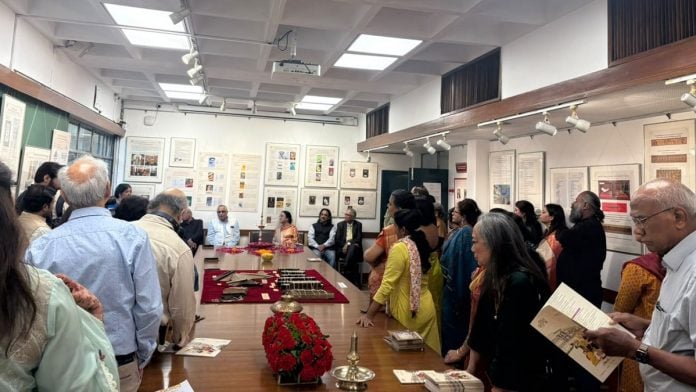
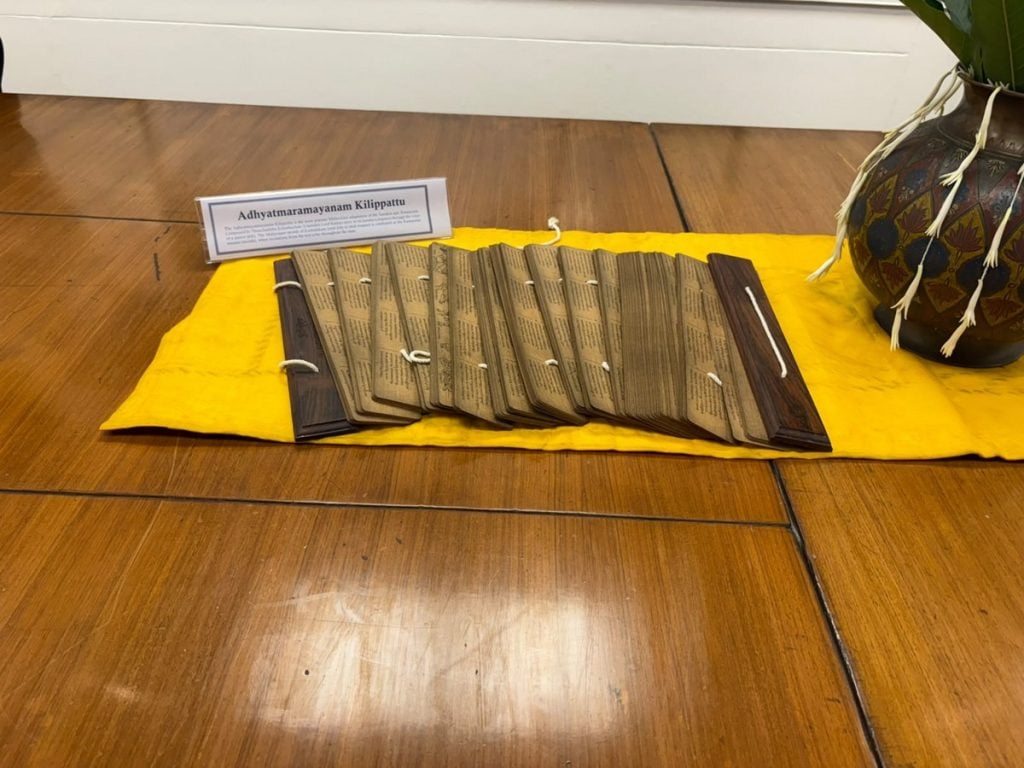
New Delhi: From a young boy sent by Travancore princely state to learn Dutch in the 1700s to free and compulsory schooling two centuries before the Right to Education Act, Kerala has always been ahead of India’s literacy curve. An exhibition in Delhi told the early chapters of that story, starting with fragile palm-leaf manuscripts, written in scripts that even those familiar with Malayalam may struggle to understand.
For Pooyam Thirunal Gouri Parvathi Bayi, a member of the erstwhile Travancore royal family who has been researching the kingdom’s past, Kerala’s palm-leaf manuscripts represent a large storehouse of knowledge yet to be explored.
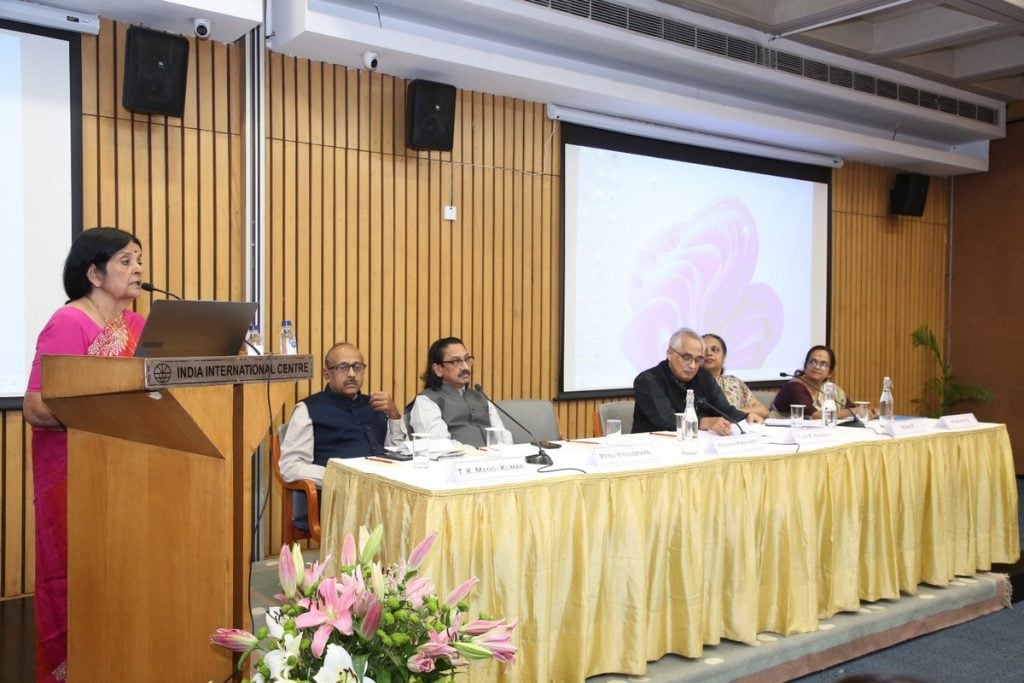
“Studying palm-leaf manuscripts takes time, especially when they are written in scripts that look different from the Malayalam used today. I can read some of them, but not all. Scripts such as Vattezhuthu and Kolezhuthu have distinct forms. They are part of the evolution of Malayalam, but they can be difficult to decipher,” she said at the exhibition Palms and Parchment: Keralam’s Heritage of Reading and Relics, organised as part of the IIC Experience 2026: A Festival of the Arts from 29 October to 3 November.
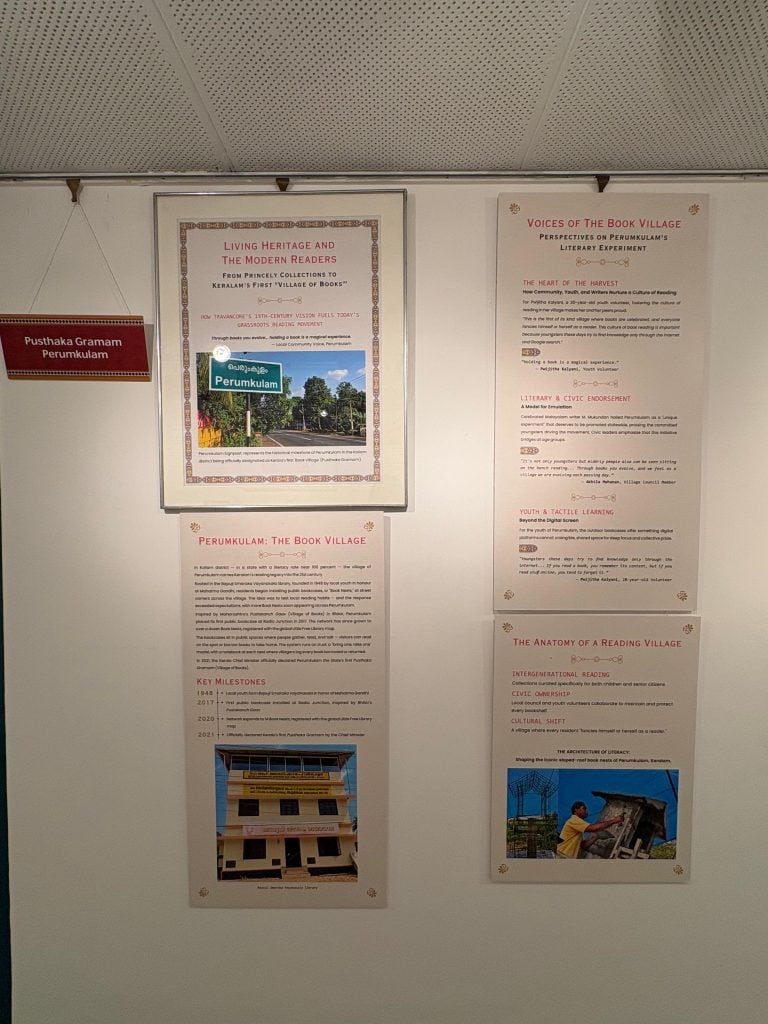
The exhibition, put together with institutions including Kerala’s State Central Library, the Oriental Research Institute and Manuscripts Library, Kerala State Archives and the Raja Ravi Varma Art Gallery, traced the history of reading and education in Kerala through panels with text and images. One, titled ‘Confronting Prejudice’, looked at the caste barriers girls faced in getting an education. Another featured Perumkulam, a ‘Book Village’ where residents can pick up books from roadside shelves.
Palm-leaf manuscripts lay on red and yellow cloth, some tied in bundles and others fanned open. A roomful of history buffs inspected them and leafed through brochures.
For Parvathi Bayi, who was chief guest at the exhibition, it was also a chance to share little-known stories about her ancestors, including her great-great-grandfather Raja Ravi Varma, one of India’s foremost artists.
Also Read: How the Maharaja of Baroda helped make Raja Ravi Varma an artist of the masses
Royal reforms and sacred vows
What Parvathi Bayi spoke of with the greatest pride was the educational vision of her namesake, Maharani Gowri Parvathi Bayi, who was regent of Travancore from 1815 to 1829. In those days, education took place in small traditional schools called kudipallikudas, where a munshi taught a handful of pupils. The maharani decided that the state should pay for school so that financial constraints would not discourage families from educating their children.
“The education rescript was issued more than 200 years ago,” said Parvathi Bayi. “In Malayali culture, women were not traditionally kept behind veils. Maharani believed that health and education were of paramount importance, in that order–health first, followed by education.”
The Maharani mandated that every child above the age of five was required to attend school. The system also included school inspection and efforts to involve parents and guardians in their children’s education. Teachers were appointed to teach dance and music, and girls were encouraged to perform at a time when it was still frowned upon for young women to do so in public.
The old Travancore administration was outward-looking as well. Parvathi Bayi came across an archival record from 1777 that said the administration had decided to introduce Dutch lessons and had sent a boy to Kayamkulam to learn the language.
She also told the family story behind Thiruvananthapuram’s annual Navratri procession. Kambar, the poet associated with the Kamba Ramayana, is said to have entrusted an idol of Saraswati to the ruler at Padmanabhapuram. He asked the rulers to regard the goddess as their mother, take her wherever they travelled and celebrate Navratri and Dussehra in her honour. The deities are still carried from Padmanabhapuram to Thiruvananthapuram in a procession every year.
Modernity and tradition were intertwined even at Thiruvananthapuram airport. Parvathi Bayi recounted how her uncle, the last ruling Maharaja of Travancore, made a vow when he gave the land for the airport. It would serve the public for 363 days a year, while the remaining two would be reserved for the procession of Lord Sree Padmanabhaswamy.
“It was a verbal commitment. There was no document, no signed agreement, no court proceedings or witnesses. It was simply a promise. It is continued till today,” she said.
Parvathi Bayi’s family also grew up hearing how her great-great-grandfather Raja Ravi Varma used to get scolded for drawing on the walls of Kilimanoor Palace. At home, he was known as Chitram Edutta Puppan, the grandfather who made pictures.
Also Read: South Korea’s food industry is eyeing the Indian market. A 10-day festival shows how
Gatekeeping to ‘book village’
The royal family’s stories are just one part of the exhibition’s account of how education in Kerala went from a privilege open to a few to a public resource. Princely rulers, Christian missionaries, social reformers, community organisations and successive governments all played a part.
Traditional ezhuthupallis, gurukulams and temple schools preserved knowledge of language, literature, medicine and philosophy, but access was largely determined by caste and social standing.
This started changing in the 19th century when Christian missionaries helped set up schools and colleges, including CMS College in Kottayam in 1817. Girls’ education also gradually gained ground, although social conservatism and caste discrimination continued to restrict access. Reformers such as Sree Narayana Guru and Ayyankali challenged these barriers and made education central to their struggles for dignity and equality.
Beyond schools, the exhibition explores the institutions that helped preserve and circulate knowledge. The State Central Library, established in Thiruvananthapuram in 1829, grew from a royal collection into a public institution. The Oriental Research Institute and Manuscripts Library preserved a collection of more than 60,000 manuscripts, while the State Manuscript Museum documents the evolution of writing, from stone inscriptions and copper plates to palm leaves.
On the streets of Perumkulam in Kerala’s Kollam district, books have found a home beyond school classrooms and library shelves. Kept in small, sloping-roof book nests along public spaces, they invite residents to stop, pick up a book and read. The initiative helped turn the village into Kerala’s first officially recognised ‘Book Village.’
The village’s book ‘nests’ run on trust, with a ‘bring one, take one’ model.
“It’s not only youngsters but elderly people also can be seen sitting on the bench reading,” said Akhila Mohanan, a village council member quoted on one of the exhibition panels. “Through books you evolve, and we feel as a village we are evolving each passing day.”
(Edited by Asavari Singh)