



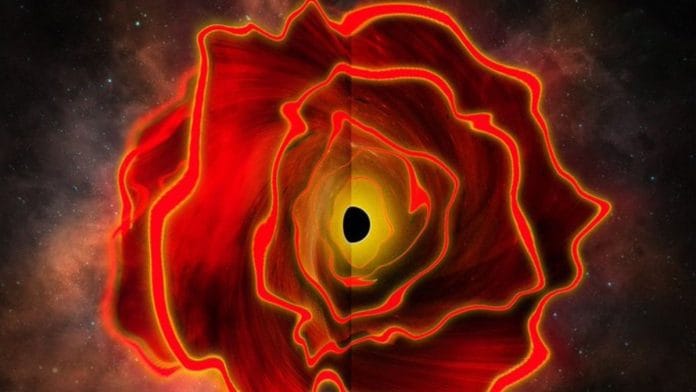
New Delhi: A mysterious red speck in a James Webb Space Telescope image may be something astronomers have never identified before – a black hole hidden inside a dense cocoon of gas, glowing so intensely that it resembles a giant star.
An international team of astronomers has identified what they believe could be a new type of cosmic object, which they have dubbed a “black hole star”. The study was published in the scientific journal Nature on 12 August.
The object, named MoM-BH*-1, is about the size of the entire solar system and lies billions of light-years from Earth, in the direction of the constellation Cetus, or the Whale. The light reaching telescopes today was emitted roughly 660 million years after the Big Bang, during a period known as cosmic dawn, when the first stars and galaxies were beginning to emerge.
An object unlike any known star
What makes the object unusual is the enormous amount of energy it produces. Although it appears similar to an immense star, measurements suggest that it releases nearly 100 billion times more energy than any known star. Its energy output is instead much closer to that associated with black holes.
The object was found while scientists were using the James Webb Space Telescope (JWST) to search for some of the most distant galaxies in the universe. After identifying the galaxy MoM-z14, which formed about 280 million years after the Big Bang, the researchers began examining other unusual sources in the telescope’s archive.
MoM-BH*-1 immediately stood out. It was the reddest object in the images, with almost all of its detected light concentrated toward the red end of the spectrum before abruptly disappearing below a particular wavelength. The pattern, scientists said, has no known equivalent among previously identified classes of cosmic objects.
A black hole wrapped in dense gas
Computer simulations suggest that the object is not an enormous star powered by nuclear fusion. Instead, it may be a black hole surrounded by an enormous amount of dense gas.
The gas could form a thick envelope around the black hole, making its light appear more like that of a star. The researchers believe the black hole may account for almost all the light coming from the object, with little contribution from the galaxy around it. They also suggest that the gas, rather than dust, could be responsible for its striking red colour.
The discovery could help answer one of astronomy’s biggest questions: how did black holes billions of times more massive than the Sun form within the first 700 million years after the Big Bang?
This has remained difficult to explain, as direct observations of how the first black holes formed and grew so rapidly have been elusive.
Could it explain JWST’s Little Red Dots?
The finding could also shed light on another mystery uncovered by JWST—the numerous compact red sources known as “Little Red Dots” (LRDs) that appear in deep-space images. Scientists have not yet established exactly what these objects are, but the researchers suggest that some could also be ‘black hole stars’.
The team believes that black hole stars may represent an early, gas-shrouded stage in the growth of present-day supermassive black holes, including the one at the centre of the Milky Way.
Supermassive black holes are found at the centre of almost all galaxies and are thought to influence how those galaxies develop. They may affect when stars form and when star formation stops, helping shape the subsequent evolution of galaxies.
If confirmed, the discovery could change how scientists understand the growth of supermassive black holes. It may also suggest that some of the earliest black holes began with far smaller masses than previously thought.
(Edited by Maryam Hassan)