



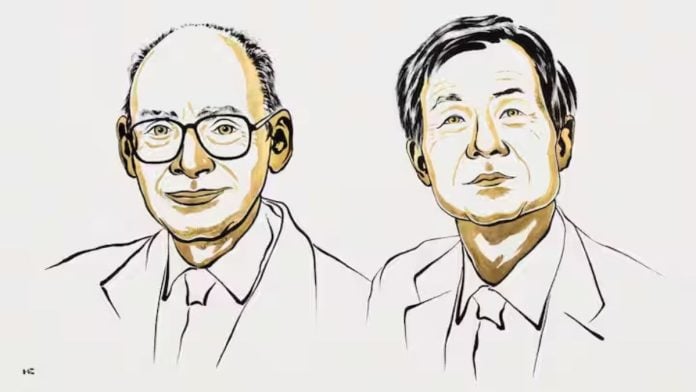
New Delhi: The Royal Swedish Academy of Sciences on Wednesday awarded French chemist Henri B. Kagan and Japanese chemist Kenso Soai the Nobel Prize in Chemistry for their work on solving “chemistry’s asymmetry mystery.”
In their announcement, the Academy said the awardees had discovered non-linear effects and autocatalysis in asymmetric organic synthesis, which is hugely useful for chemists in pharmaceutical and advanced materials manufacturing.
Kagan, Professor Emeritus at Université Paris-Saclay in France, and Soai, lecturer at the Tokyo University of Science, worked on understanding ‘mirror images’ in chemistry, which are molecules that appear as mirror images of each other — the same number of atoms, but structured differently, with different behaviours.
These mirror image molecules are known as enantiomers, and are often described as ‘left-handed’ and ‘right-handed’ versions of each other. Enantiomers exist in all forms of amino acids, and make drug development, or any other materials manufacturing, very difficult: a chemical reaction to produce a certain kind of amino acid will also result in its mirror image, which might have a completely opposite reaction in the body.
Also read: Kashmiri filmmaker Arfat Sheikh detained by ICE in US. Friends say ‘he had valid papers’
Mirror-image molecules
What made this problem even more complicated is that natural life, including the human body, is homochiral, meaning that it contains only one of these mirror-image molecules. This disparity between natural life and chemical reactions is what the 2026 Nobel Prize in Chemistry is centred around.
“For decades, researchers knew that it was theoretically possible to design reactions in which only one of these mirror images would be formed, but how to do this in practice remained a mystery,” said the Nobel Prize press release. “Kagan and Soai provided a solution.”
Kagan, who is 95 years old, has been working on the problem of synthesising this asymmetry since the 1970s, when he developed diisooctyl phthalate, or DIOP. This is a compound which was programmed to produce one mirror-image molecule over the other, proving that it is physically possible to solve this problem.
In 1986, he also made another breakthrough in the theory behind homochirality in natural life. Kagan published a paper that showed that even if a reaction yields both kinds of mirror-image molecules, it can still be amplified to produce single-handed molecules through catalysis. This also gave biologists an idea as to how homochirality or single-molecule-ness emerged in natural, living organisms.
Soai, a 76-year-old organic chemist at the Department of Applied Chemistry in TUS, took Kagan’s work forward in 1995 by discovering the Soai reaction. He worked with his team to develop an independent reaction that acts like a self-amplifying molecular engine and would result in a homochiral product all by itself.
By 2003, Soai pushed this self-amplifying reaction to its absolute limit. He proved that even a microscopic initial nudge would snowball with each cycle until the final product was virtually 100% pure one mirror-image molecule, or homochirality. Before Soai, this homochirality was thought to be a unique hallmark of living biology—seen in our exclusively right-handed DNA and left-handed amino acids. Soai proved that non-living chemistry could do the exact same thing entirely on its own.
Not only did this expand humankind’s understanding of living beings’ fundamental molecular structure, it also changed day-to-day chemical reactions in pharmaceuticals, flavours, scents and agricultural chemicals.
(Edited by Ratan Priya)