



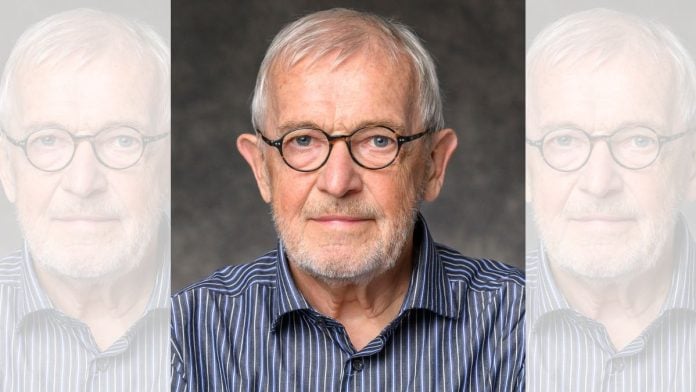
New Delhi: Francis Halzen, an 82-year-old Belgian particle physicist at the University of Wisconsin-Madison, US, has won the 2026 Nobel Prize in Physics for his discovery of high-energy neutrinos and his work on the IceCube neutrino observatory in Antarctica. The Royal Swedish Academy of Sciences in Stockholm announced the award on Tuesday.
Neutrinos are neutral-charged subatomic particles that are often called ‘ghost’ particles because of their limited interaction with other matter. They also weigh very little, but are the most abundant, mass-having particles in the universe. Proposed in 1930 by physicist Wolfgang Pauli, scientists have worked for more than a century to prove the existence of neutrinos and study their key elements, including mass and their interactions with other matter.
“Every second, without you noticing, 65 billion neutrinos from the Sun flow through your little fingernail,” said the Nobel Committee’s press release on the award.
Halzen’s award in physics is because he pioneered a new method of detecting neutrinos and using them to study the cosmos. An astrophysicist from Belgium, Halzen is the founder and principal investigator of the IceCube Neutrino Observatory in Antarctica, which is the world’s largest neutrino detector.
“Francis Halzen has led an international team of researchers and engineers who have provided us with a fantastic instrument. His tenacity and scientific vision have paved the way for a new kind of astronomy,” said Mark Pearce, Chair of the Nobel Committee for Physics.
Also read: Medicine Nobel winner Karl Deisseroth’s first love was literature
What Halzen did
Halzen first presented his idea of studying neutrinos in the South Pole in the 1980s, as a professor at the University of Wisconsin-Madison, by sharing the benefits of detecting neutrinos in glacial ice. Since most neutrinos are detected only when they collide with the nucleus of an atom and produce light, Halzen proposed that this light can be tracked by sensors in the clear glacial ice.
His idea gained relevance and was first developed into the Antarctic Muon And Neutrino Detector Array (AMANDA) in 1995. Built 1.5 km deep into the Amundsen-Scott South Pole Station, AMANDA consisted of optical modules and sensors that would detect neutrinos entering the Earth from the North Pole and exiting from the South Pole. Later, by 2010, AMANDA had developed into a much larger and more advanced neutrino telescope known as IceCube.
The reason Halzen, a particle physicist, wanted to study neutrinos was also because these tiny particles contained massive amounts of information about the cosmos, and about how energy is stored in the universe. He was soon proven right.
“In September 2017, IceCube provided the first evidence of a source of high-energy cosmic rays, whose origins have been notoriously difficult to pinpoint since they were discovered over 100 years ago,” said the National Academy of Sciences in a biography of Halzen.
This neutrino, discovered by IceCube, had an energy of about 300 trillion electron volts, which is more than 45 times the energy that is possible in the CERN Large Hadron Collider, which is the world’s largest particle accelerator. Moreover, NASA’s Fermi Space Telescope later found that this neutrino originated in a monster black hole, and travelled 3.7 billion years at almost the speed of light to be detected on Earth.
“The idea behind IceCube is to take neutrino astronomy to a new level, the hope being that neutrinos will provide information about phenomena that are hidden behind dust clouds,” said the Nobel Committee. “Francis Halzen has long been the driving force behind the IceCube Neutrino Observatory. His scientific vision thus provides the basis for new research in the future of this field.”
(Edited by Aamaan Alam Khan)