



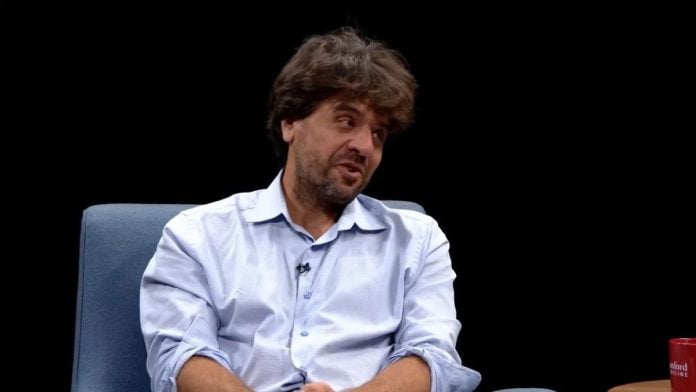
New Delhi: Karl Deisseroth, a neuroscientist, psychiatrist, author, and one of the winners of the 2026 Nobel Prize in Physiology or Medicine, began as a literature lover. He would be so moved by books that he set out to find out “what bridges matter to feeling”.
“I was a reader. I loved books, I loved literature, loved understanding how feelings could be stirred in people by a few letters on a page—that was an amazing thing for me. And I was introspective enough to think about that and be curious about how it worked,” Deisseroth said a year ago in an interview with Stanford Medicine.
Deisseroth, 54, is an American neuroscientist, bioengineer, practicing psychiatrist, and often dubbed “the father of optogenetics” for creating a technique that revolutionised biology and neuroscience. His aim is to illuminate brain circuits to figure out how the organ functions, and, in the process, even find new ways of diagnosing and treating psychiatric disorders.
Deserroth did his undergraduate degree from Harvard University and holds a PhD and MD from Stanford University. He is currently the DH Chen Professor of Bioengineering and of Psychiatry and Behavioural sciences at Stanford. He knows that his “dyad of departments” is not the most conventional one, but it allowed him to look at both biology and psychiatry in a new light.
“When I went to college, I explored creative writing, but I also got very interested in biology. And that led to the MD/PhD route as a way of, you know, both working with the human brain and the human mind and human feelings in health and disease, but getting down to the science of it, to the cells that were involved, and seeing if that was a bridge even that could be built,” he said.
According to Deisseroth, optogenetics, at its heart, is a classic example of how fundamental basic science can have far reaching implications. Single-celled organisms like algae are efficient creatures that often make single genes encoded with single proteins to get tasks done.
Also read: Why are American women saying ‘I am Jane Doe’? And what does it do for Cornell survivor
The first experiments
Nearly 21 years ago, Deisseroth conducted his first experiments to see if neurons in the brain could be turned light-sensitive. Since then, there have been over 1,000 papers on the subject where optogenetics has been used to understand not just the brain but also other cells across the body.
“So that discovery process, though, of course, it’s fundamental exploration of the natural world. But then along the way, you discover, oh, when we turn up or down these cells or these connections, that can cause or suppress a symptom-like effect,” he said.
“So whether it’s anxiety, whether it’s parkinsonian behaviors, memory, and social interaction—all these things that we and now many others have discovered along the way gave us clues, knowing that some cells are causal, that actually matter,” he added.
As Deisseroth chooses to remain both a physician and a researcher, he admits that his time with patients only enriches his interactions with his students and his experiments at the lab.
“I think at that very first experiment 21 years ago with testing the different optogenetic methods, I had no idea what was going to work, and I knew I didn’t know. And so I knew I had to try a number of different things. But if I’d been more dogmatic, I would have been steered the wrong way. And to this day, I’m in awe at the mysteries that face us, and I feel very small in front of them. And I think that’s very helpful for innovation: to realize the magnitude of what’s before us,” he said, nearly a year before his research would win him a Nobel.
(Edited by Aamaan Alam Khan)