





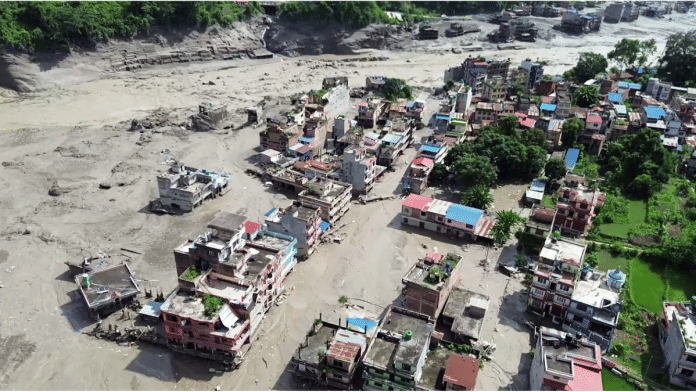

New Delhi: Nepal’s Rasuwa district, which was hit by devastating flash floods on 26 August, has experienced similar disasters at least five times in the last five years. The district’s location, the warming of the upper Himalayas, and unstable glaciers make the villages in the area particularly vulnerable to climate change-induced disasters.
Data from Nepal’s National Disaster Risk Reduction and Management Authority (NDRRMA) shows that between 2022 and 2026, five significant flash floods hit the Rasuwa district.
In 2023, water levels in the Bhote Koshi River rose suddenly on two occasions: 3 June and 13 July. On 25 August 2024, another flood hit the district from the Kerung rivulet, which joins the Lhende Khola River near Rasuwagadhi.
Local authorities said in their alerts that villages were promptly evacuated and no lives were lost in these floods.
However, in 2025, the intensity of these floods increased, as did the damage they caused. In July, the Lhende-Bhote Koshi river system flooded twice, on 8 and 30 July. Together, the floods killed at least 20 people.
“A sudden flash flood triggered by rapid discharge of a supraglacial lake on Purepu glacier in Tibet… approximately 35 kms upstream from the Nepal-China border caused widespread devastation along the Lhende River (known locally as Bhote Koshi river in Nepal),” an NRRDMA report read, describing the 8 July disaster.
Along with considerable loss of life, key infrastructure including the Nepal-China friendship bridge at Rasuwagadhi, large sections of the Rasuwagadhi dry port, and three hydropower plants in the catchment area were destroyed. A 16–kilometre stretch of the road between Syafrubesi and Rasuwagadhi was also damaged.
Locational disadvantage
Experts explained that the location of villages in the Rasuwa district is a major disadvantage. Located at a high altitude, it becomes the first landing point for rivers coming from the upper Himalayas. When water levels in the glacier lakes rise, the rivers descend rapidly into parts of Rasuwa, hitting particularly hard in the northern parts of the district, including Timure, Rasuwagadhi, and Syabrubesi.
“There is very little flat surface in that area, where the force of the river water can slow down, or the water can be absorbed before moving forward. So, when the water from higher mountains rushes down, through the narrow valley over such a short period, it hits these villages with massive force and causes great damage,” a scientist from Nepal’s International Centre for Integrated Mountain Development (ICIMOD) told ThePrint in a phone conversation.
The scientist explained that Rasuwa’s vulnerability to floods is not solely because of the warming of the Himalayan glaciers and the speed at which these ice masses are melting, but also because of the large infrastructure impeding the river flow.
This means that when water from the melting glaciers rushes down, instead of having ample space to land and spread, it is immediately met with houses, bridges, roads, and other infrastructure.
The residents of these villages are witnesses to how the frequency and the intensity of these floods are increasing every year.
“These are flood-prone regions, near the Nepal-Tibet border, and they’ve seen small floods almost every year,” said Ramesh Kumar Mahat, district president of Nepal Congress in Nuwakot district.
Last year, the region was affected by a glacial lake outburst flood (GLOF).
“Last year too, I remember the floods in Rasuwa; it was because of a GLOF, and I remember around 20 people had died,” he added.
Mahat said that yearly floods are not uncommon in these parts. But the 26 August flash floods broke all previous records. Entire villages were swept away before residents even had the chance to evacuate.
Also read: 88 Indian workers rescued by Nepal army. 11-member Indian team arrives to help
More disasters to come?
Multiple studies conducted on the Himalayas have warned that climate change-induced disasters are likely to increase in this belt.
A study by ICIMOD, released earlier this year, found that glacier wastage across the Hindu Kush Himalaya had accelerated sharply since the turn of the century. Its 2026 Glacier Outlook, based on observations from 38 glaciers, found that the rate of ice loss had nearly doubled since 2000.
Around 89 per cent of the glaciers in the past five decades recorded a negative glacier mass balance, meaning glaciers lost more ice than they gained.
“The immediate response to a flood should not be to rebuild the damaged bridges and roads, it is to understand and assess whether we need to concentrate our communities and infrastructure on ecologically sensitive regions,” the ICIMOD scientist said.
(Edited by Prasanna Bachchhav)