





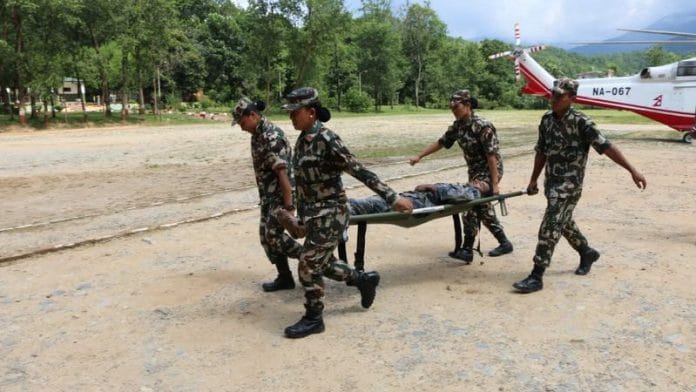

Kathmandu: Nepal’s Armed Police Force and regular police have buried over 150 bodies recovered from the flooded districts in mud, to be exhumed later upon identification. Police spokesperson Abi Narayan Kafle told ThePrint that the procedure has been done to protect the remains of the flood victims, adding that authorities have taken proper steps to extract DNA samples and are identifying marks for later identification by families.
“We did not have enough refrigeration and cold storage facilities, so according to international guidelines, we have properly stored the bodies in mud,” said Kafle. “But all identifying markers have been noted, so that we can provide details to family members later and exhume the bodies if need be.”
On Sunday afternoon, four days after flash floods struck Rasuwa, Nuwakot, and Dhading districts of Nepal after a glacial collapse at the Nepal-Tibet border, the Ministry of Foreign Affairs held a press conference in Kathmandu to provide updates on the rescue and relief operations.
Around 740 bodies have been recovered from the floods, with 2,500 people still missing or unaccounted for, said the ministry. Moreover, 19,000 security personnel, including the Army, Armed Police Force, and Police, have been deployed for rescuing stranded citizens and recovering bodies and remains of victims of the flood.
The ministry, in its press conference, also said that along with its own resources, it has sought help from China, India, and South Korea for rescuing workers stuck inside tunnels along the Trishuli River where the floods occurred. Since it has also been raining heavily in the flood-affected districts, the government has issued possible flood risk warnings to all citizens living near the river.
According to Kafle, the rains have also proved to be a challenge in the recovery of bodies, which is mainly being done in Chitwan, Gorkha, and East Nawalparasi districts, around 200 km downstream from Rasuwa.
Also read: Most painful was to see rescued mothers asking about their children—Nepal Red Cross chief
Mutilated remains
Another issue the Nepal Police is facing is that several bodies being recovered from the flooded sites and downstream of the river are mutilated remains, like hands and legs, rather than intact bodies.
“We have recovered 740 bodies until now, and 252 are only some body parts, not full corpses,” said Kafle. “These too have been tagged, fingerprints, and DNA samples taken, and then stored in the mud.”
Most of the bodies have been recovered from Chitwan district, and 96 bodies have been buried in the mud there. Additionally, 29 bodies have been buried in Gorkha district, and 30 in East Nawalparasi district.
The International Committee for Red Cross has a field manual for management of dead bodies after disasters, which recommends that if refrigeration of 2 to 4 degrees Celsius is unavailable, then bodies can be stored in the mud, 1.5 m deep and not close to any water sources. Along with that, the ICRC also recommends the proper procedures for taking photographs, removing jewellery, identifying markers, and storing bodies in body bags.
The Nepal Red Cross Society has provided over 2,000 body bags and dead body management kits to the Nepal Police and Armed Police Force personnel in the field to aid body recovery.
(Edited by Aamaan Alam Khan)