



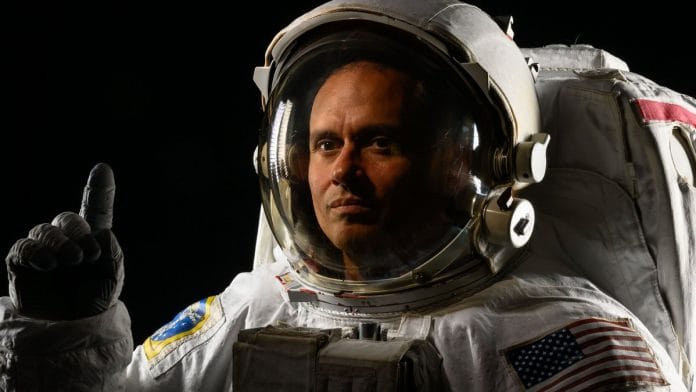
New Delhi: Indian-origin NASA astronaut Anil Menon is all set to fly to the International Space Station at 8.17 pm IST on Tuesday on board the Roscosmos Soyuz MS-29 spacecraft. Once at the space station, he will conduct research “aimed at advancing human space exploration and benefiting life on Earth”, according to NASA.
Menon, along with Russian cosmonauts Pyotr Dubrov and Anna Kikina, will launch from the Baikonur Cosmodrome in Kazakhstan. After a “two-orbit, three-hour trip to the station”, the spacecraft will dock with the ISS’s Prichal module, a Russian-built component of the space station.
“Once aboard, the crew will join NASA astronauts Jessica Meir, Jack Hathaway, and Chris Williams, ESA (European Space Agency) astronaut Sophie Adenot, and Roscosmos cosmonauts Sergey Kud-Sverchkov, Sergei Mikaev, and Andrey Fedyaev,” the NASA statement read.
“We are so excited to welcome our new crewmates,” Meir posted on X Monday.
We are so excited to welcome our new crewmates to the @Space_Station tomorrow! We’ve been prepping their supplies and will be welcoming Pyotr, Anna, and @astro_anil with the largest floating hugs we can muster. Godspeed Soyuz 75S (MS-29), we will see you soon! pic.twitter.com/IAsZCtPe8M
— Jessica Meir (@Astro_Jessica) July 13, 2026
While Soyuz MS-29 is Menon’s first space mission, Dubrov and Kikina have each flown to space once before. Dubrov previously spent nearly a year aboard the ISS, from April 2021 to March 2022, while Kikina was stationed at the space station for about five months, from October 2022 to March 2023.
Last August, Menon told Minnesota Public Radio that he would spend his time on the ISS conducting science “that’s really important for us to get to the Moon and to go to Mars… and just learn about things on Earth”.
Here’s a look at what the space mission will entail and the scientific experiments the new crew will carry out aboard the ISS.
Also Read: Indian origin NASA astronaut Anil Menon heads to space for the first time
What will Menon do on the ISS?
NASA and Roscosmos said that Soyuz MS-29 will complete a two-orbit flight in three hours. Around 40 seconds after first-stage separation, the spacecraft will exit the dense atmosphere at an altitude of about 79 kilometres, maintaining a velocity of around 2.2 km per second.
“Menon, Dubrov, and Kikina will spend about eight months on the orbital complex as International Space Station Expedition 74/75 crew members before returning to Earth in April 2027,” NASA said in its mission statement.
Menon’s research will cover a range of areas, including manufacturing in microgravity and improving medical care during long-duration space missions.
The US space agency said he will work on research to refine the production of semiconductor crystals in space to enable the large-scale manufacturing of components needed for high-performance computers, artificial intelligence and improved medical devices.
He will also perform ultrasound scans using augmented reality and artificial intelligence methods that could eliminate the need for medical support from Earth during future space missions.
“He (Menon) will be a test subject helping researchers understand how blood flow is affected in space to protect future astronauts,” NASA said. His work will also include testing the bioprinting of vascular constructs in microgravity to improve understanding of the ageing process and advance therapeutic developments.
Excited to launch aboard Soyuz MS-29 from Kazakhstan and begin an eight-month mission supporting NASA and Expedition 74/75. Grateful for the NASA community, friends, family, and loved ones and excited for tomorrow – tune in July 14th 9:43 am central time. Photo credit: Robert… pic.twitter.com/DdPLlmMEGo
— Anil Menon (@astro_anil) July 13, 2026
Menon, 49, is an emergency medicine physician, US Space Force colonel and former NASA flight surgeon who has worked extensively in aerospace medicine and human health research. He joined NASA in 2014 and was selected as an astronaut in 2021. Soyuz MS-29 is his first spaceflight.
In his MPR interview last year, he said he had spent two years training for the mission and that one of the key skills was learning to get along with other crew members.
“One of the most important skills is just figuring out how to live with 10 or six other roommates and resolve problems really well, and we practice it,” he said.
Menon added that he expected to follow a tightly scheduled routine on the ISS, covering experiments, exercise and preparations for tasks such as spacewalks, since “the time is so precious”.
(Edited by Asavari Singh)