



New Delhi: On his visit to India, Swiss President Guy Parmelin received an unusual gift from Prime Minister Narendra Modi—three award-winning cheeses. Gulmarg, Konark, and Yeoor soon made headlines, highlighting the growing craftsmanship in the country.
It’s not the first time Indian cheese drew attention this year. In April, four Indian cheesemakers won medals at Brazil’s international cheese festival.
1. Yak Churpi
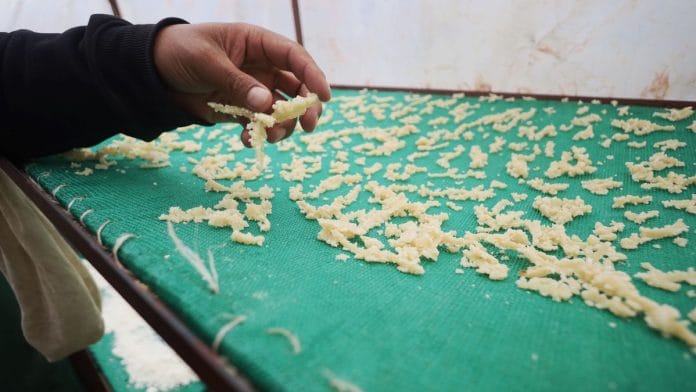
One of the winning cheeses, Yak Churpi Soft by Ladakh’s Nordic Farm, won gold at the festival. Churpi is made by families in the high altitudes of Ladakh, Arunachal Pradesh, and Sikkim. It is a taste-enhancer and a supreme protein supplement.
2. Eleftheria Brunost
India’s Eleftheria Brunost also won a gold medal at the festival. Produced by Mausam Narang, Brunost is a form of whey cheese. Although it is not traditional Indian cheese, Eleftheria adapted the style and produced it organically in India. It is a part of the country’s in-house cheese movement. Whey cheese is a byproduct of cheesemaking.
Eleftheria’s Gulmarg, a French-style Brie, won a ‘super gold medal’ in Brazil this year. The cheese is known for its rich, buttery texture and ‘exceptional craftsmanship’. Eleftheria’s efforts to evolve the cheese turned it into a creamier, richer version of the classic Brie. It is kept for one to two weeks before it matures in the next two or three weeks. In this time, the cheese creates “a perfect balance of a chalky centre and gooey, creamy periphery”. Its distinctive heart shape makes it all the more charming.
While Eleftheria has brought an Indian touch to traditional cheesemaking, the country has a thriving tradition of its own.
Also read: How Dutch water expertise could shape India’s massive Kalpasar dam project
3. Kalari cheese
The Gujjars of Kashmir have been producing artisanal cheese in the Himalayas, called Kalari. Often called “mozzarella of the Himalayas”, it is semi-soft and stretchy. When stirred in a pan, its periphery turns golden with a gooey inside. However, its origin is traced to the Dogra community in Jammu. The cheese improves with time, tangier and more pungent. It is an integral part of Jammu’s favourite snack, Kalari Kulcha.
Although the Himalayan region dominates cheese craftsmanship in India, the eastern region is also home to famous cheese. From West Bengal, Bandel and Kalimpong cheeses are globally known.
4. Bandel cheese
Bandel cheese is crumbly, dry, and salty. It is made from cow’s milk using lemon juice or other souring agents. It is then preserved in its entirety with salt, preventing it from rotting or melting during peak summers. The cheese has its roots in the 16th-century Portuguese settlement in Bandel, a town in Bengal. Over time, the cheese has been incorporated into several dishes.
5. Kalimpong cheese
The Portuguese brought Bandel cheese to India, while the Swiss brought Kalimpong cheese. The latter is a semi-hard cheese that must be stored in a refrigerator. Unlike the hardy Bandel cheese, Kalimpong cheese has to be handled with care. It is wrapped in wax or parchment paper, with a small opening for breathing room. Before serving, the cheese is brought to room temperature to soften its texture.
(Edited by Prasanna Bachchhav)