



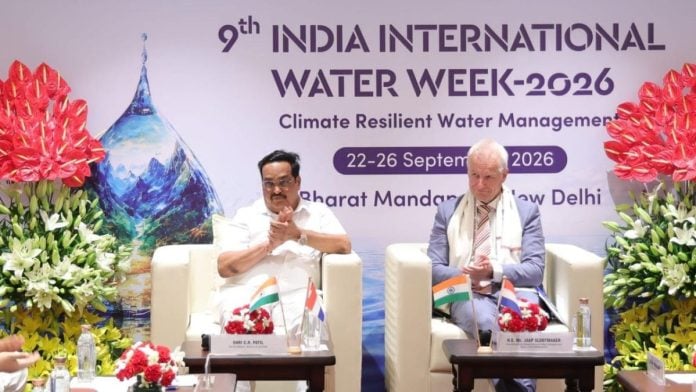
New Delhi: Four months after Prime Minister Narendra Modi visited the famous Dutch dam, Afsluitdijk, India and the Netherlands signed two Memoranda of Understanding at the India International Water Week on 24 September. The MOUs focused on technical cooperation between the two countries to build the Kalpasar dam in Gujarat, modelled around Afsluitdijk.
With over 800 years of experience in water management, the Netherlands can provide a blueprint for Indian dams and reservoir development, especially as climate vulnerabilities increase water stress.
In a conversation with ThePrint, Dutch water management vice president Jaap Slootmaker spoke about the two countries’ Strategic Water Partnership and how the Kalpasar project – a massive coastal freshwater reservoir building project – will be built.
“Our Afsluitdijk is 30 km, and Kalpasar 60 — so it’s double, and the situation is different from what it was 100 years ago when we built,” said Slootmaker. “But the technique can be similar, and we can use lessons from the last 100 years in this project.”
The Afsluitdijk is a 30 km long dam built in 1927 in the Netherlands, connecting North Holland to Friesland province, dividing the Zuiderzee or North Sea from the Southern Sea, and creating a freshwater lake in the process. The dam was built to prevent the constant flooding in the North Sea, and after the 1958 flood, the dam’s structure was also increased in height.
Meanwhile, as Slootmaker explained, India’s Kalpasar project is envisaged to create a freshwater reservoir, by building a dam across the Gulf of Khambhat, connecting Bharuch and Bhavnagar districts. This reservoir is expected to be 60 km long, and contain 8,000 million cubic metres of water.
“At the time when Afsluitdijk was built, we did not know the impact it had on ecology, fish migration … now, we do ecological impact assessments with every project, and I’m really glad because it is better to know upfront what the effect will be,” explained Slootmaker.
Also read: Bengal’s Buxa Tiger Reserve gets resident tigress after a decade. Relocated from Bihar
How the Netherlands built its water system
Speaking about the Afsluitdijk and other Dutch systems like dikes, canals and sluices, Slootmaker referred to the Netherlands’ long history of managing its water resources.
“Over the centuries, we always had to work very hard to keep the water out—prevent flooding by sea, and prevent flooding by the rivers,” he said. “It is existential for us. Without water management, 25% of our country is below sea level, 60% is prone to flooding.”
However, he acknowledged that when it comes to India, the needs for water management, as well as the geography and climate, are different.
The Netherlands-India Strategic Water Partnership is a bilateral framework signed in 2022 and strengthened in 2026, during PM Modi’s visit to the Netherlands in May. The two countries agreed to work together on coastal zone management, flood resilience, and integrated water resource management. Importantly, two MOUs signed during the India International Water Week last month also included civil society and academic collaborations between the two countries, setting up a Centre of Excellence (CoE) on Water at IIT Delhi.
“Hopefully the Center of Excellence can grow to a place where people exchange knowledge from both sides, and we both learn, and we both benefit,” said Slootmaker, referring to the contribution of Dutch institutions such as Deltares and TU Delft to the CoE. “I hope we can make both our countries more climate and water-resilient than they are today. This would be a fantastic result.”
(Edited by Ratan Priya)