



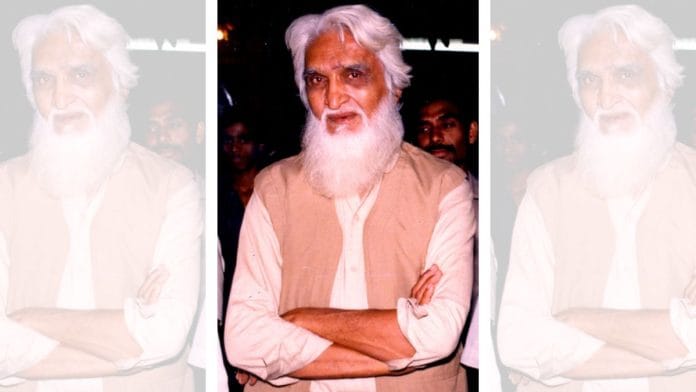
Mumbai: On 15 August, 1947, M F Husain was on the streets of Bombay watching the Independence celebrations. He was still earning his living at a nursery furniture and wooden-toy shop. Years later, he remembered how strongly the night had affected him.
“The whole celebration triggered my imagination. I decided I should also become free and I should enter the art world,” he had said.
According to most institutional biographies, M F Husain was born on 17 September 1915. Thirty-two years later, on 15 August 1947, he started another journey.
Born in Pandharpur and raised largely in Indore, Husain drew, practised calligraphy and cycled into the countryside to paint landscapes. On one such outing, he met artist NS Bendre, who encouraged him to study art. Husain attended evening classes at the Indore School of Art and later enrolled at the Sir J J School of Art in Bombay. After his father lost his job, he could no longer afford to continue.
By the 1930s, Husain was back in Bombay and needed work. He began by helping an acquaintance from Indore paint cinema hoardings, before taking on the billboards himself. He also designed furniture and wooden toys to earn money.
“If I didn’t do cinema hoardings, I would have been a different man,” he later said.
In 1947, a work was shown at the Bombay Art Society’s annual exhibition. Soon after, Husain joined the Progressive Artists’ Group, alongside FN Souza and SH Raza. The artists wanted to move away from the conventions inherited from British art schools without turning their backs on Indian traditions.
Husain put it more simply. They had to “find our own roots”.
“We adopted the Western technique but not concept,” he said.
From Ramayana to Gandhi
Over the next decades, Husain painted the Ramayana and Mahabharata, village life, MK Gandhi, Mother Teresa, cities, politics and horses. Horses became some of his most recognisable images.
In a 1997 online conversation, Husain explained why he returned to them: “The horse is a combination of male and female, the front part of the horse is the male which is very aggressive; the back part is like a woman.”
Women were another subject he kept returning to. Husain had no photograph of his mother and could not remember her face. In a 2002 interview, he said: “That is why my search for a mother figure is eternal. When I wanted to depict the affection of a mother, I painted Mother Teresa.”
He also linked the missing faces in his work to that loss.
“As I do not recall my mother’s visage, most of my female figures have no face details,” he said in a 2005 interview.
Artist Ila Pal, who knew him for more than five decades, remembered travelling through Rajasthan with Husain when she was 23. She recalled him looking at one of her sketches before dismissing his own as “fatichar”.
“He considered himself a student all through his life,” Pal said.
His art extended to cinema. In 1967, he directed his first film, Through the Eyes of a Painter. The 15-minute film had no dialogue and was shot in Rajasthan for the government’s Films Division. It won the Golden Bear for Best Short Film at the Berlin International Film Festival.
More than three decades later came Gaja Gamini in 2000, starring Madhuri Dixit, whom Husain had painted repeatedly and called a muse. Naseeruddin Shah later said he barely understood Husain’s narration of the film and had asked Dixit to explain it to him; she apparently told him not to ask her. It made more sense during the shoot. Shah realised that Husain had “so many images in his head, which he wanted to make tangible”.
Also read: 1 in 6 Americans are exhausted. Anxiety, low mood, trouble thinking come with it
The controversy
By the 1990s, Husain’s work had begun to draw protests, threats and criminal complaints. Nude representations of Hindu deities became the subject of cases against him, as did a work circulated under the title Bharat Mata. His work was vandalised.
Husain left India in 2006. In 2008, the Delhi High Court quashed proceedings against him over the Bharat Mata work and noted that Husain had not given it that title.
The following year, the India Art Summit in Delhi left out his work because organisers said they could not take the security risk. Husain asked: “How will they protect me if they cannot protect my work? How can I trust them?”
He continued to live mainly in Dubai and London. In 2009, he also rejected the idea that he had decided never to return.
“I am dreaming all the time to return to India. I never said I will not go back,” he said.
When Husain accepted Qatari citizenship in 2010, his son Owais said: “My father has been a nomad all his life. But he has been rendered homeless in recent years.” He added that his father “missed home in India terribly”.
Husain died in London in 2011. The return he kept dreaming about never came.
(Edited by Saptak Datta)