





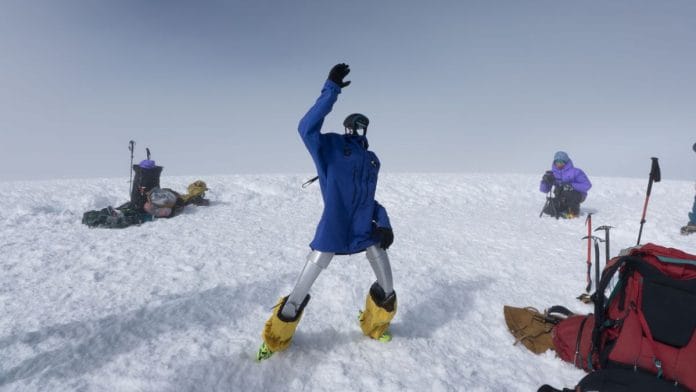


New Delhi: A climbing humanoid robot has set its eyes on the world’s tallest peaks, and the majestic Mount Everest is on its list. Pemba the robot has already summited Ecuador’s Chimborazo volcano this month, whose peak is the farthest point from Earth’s centre.
Pemba is a modified G1 robot manufactured by China’s Unitree Robotics. The adventure-loving climber has set off on an expedition as part of a project called Triple Crown, where it will scale three mountains that are the world’s highest by different definitions. These include the Chimborazo volcano in Ecuador, Mauna Kea volcano in Hawaii — the tallest when measured from its underwater base — and Mount Everest, which is the highest above sea level, according to Humanoids Daily.
The robot reached the 20,564-feet high peak of Chimborazo volcano on June 5 this year, and is now preparing for its next targets — Mauna Kea and Everest. The project is led by French engineer Pablo Berlanga, who founded Geologic Dome, a US non-profit. It is aimed at helping environmentalists collect data in remote areas instead of relying on thousands of cameras.
The first climb
Climbing the Chimborazo may be a first for a humanoid robot, but the trek wasn’t entirely unassisted. According to Pablo, the bipedal robot was on its own for most of the climb where the incline was less than 30 degrees. For steeper climbs, Pemba had to be carried by the expedition team. But Pablo clarified that no vehicles were used to take the robot to the top. The whole climb took 16 hours.
The team is currently working on the robot to make it capable for steeper climbs.
Apart from difficult terrain, the robot also had to withstand freezing temperatures on the mountain. For this, the team came up with a special ventilation system to handle both extreme heat and cold.
Also read: Researchers develop jacket that can harvest drinking water from air
The ultimate target
Pemba is aiming to scale Mount Everest this October, with the expedition team collaborating with a Nepalese logistics company. But the climb may not happen until April 2027 because Nepal currently doesn’t have any legal framework to regulate such climbs by a robot.
To fund the climb, the team has set up a website and has turned to digital fundraising. It aims to collect money in cryptocurrency through a tokenization project on the platform Virtuals, where the climb will be broadcast live.
“Turns out crypto is a pretty good way to fundraise for conservation,” a blog on the website reads.