





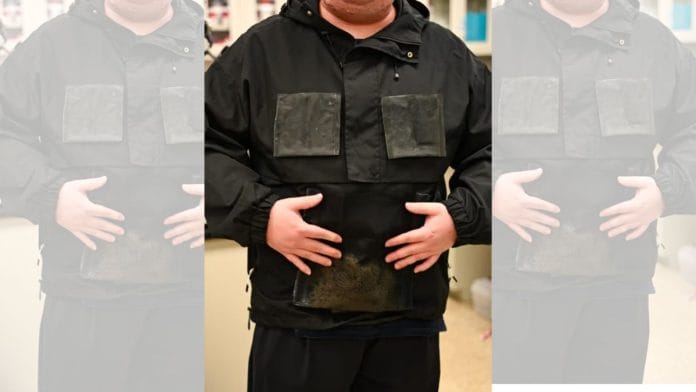


New Delhi: The level of water in your bottle often decides how long you are going to last on the hiking trail. But soon you may not have to worry about it, as researchers have developed a jacket that can harvest drinking water from the air as you go about your day wearing it.
The special fabric used in the jacket is the result of a new study conducted by engineers at The University of Texas at Austin. Its findings were published in the journal Science Advances on 10 June.
Successful attempts to obtain drinking water from atmospheric moisture have been made previously. However, researchers have often relied on portable devices or large systems with low efficiency.
Using a fabric to make drinking water can be game-changing, especially in places with water scarcity. It can also provide soldiers and hikers in remote regions with a reliable source of drinking water.
“Water harvesting from air is usually imagined as a stationary device such as a box, a panel or a large sorbent bed,” said Guihua Yu, chair professor of the Cockrell School of Engineering’s Walker Department of Mechanical Engineering and Texas Materials Institute and one of the leaders of the study. “Here, we wanted to rethink the form of the technology. If the fabric itself can collect water from air, it opens a new direction for personal and portable water access.”
During the tests, the jacket produced 400-900 ml of drinking water per day, which, according to researchers, showing a three- to 10-fold improvement at scale, when compared to traditional water-harvest devices.
Also read: Why did China just junk 12,000 degree courses? They were ‘obsolete’
The engineering
What gives the fabric its ability to absorb water are fibres made using amphiphilic hydroxypropyl cellulose, which are then combined with a salt called LiCI that can pull water from the air.
After absorbing moisture, the fabric transfers it to detachable harvesting units built into the jacket, which are heated in foldable collector pieces to produce drinking water.
“The important advance here is that the team did not simply make another material that absorbs water. They designed a pathway for water to move quickly, from vapor in the air, to liquid on the fiber surface, and then into the textile. That transport design is what allows the material to work not just in a small lab test, but in a wearable system,” said Keith Johnston, co-author and chair professor of the Cockrell School of Engineering’s McKetta Department of Chemical Engineering.
The researchers also conducted outdoor tests of the jacket and reported that the collected water had minimum lithium residue and was safe for drinking as per World Health Organization standard.
The team is now aiming to incorporate the textile in tents, backpacks, and other outdoor gears that can easily pull drinking water from the air.