



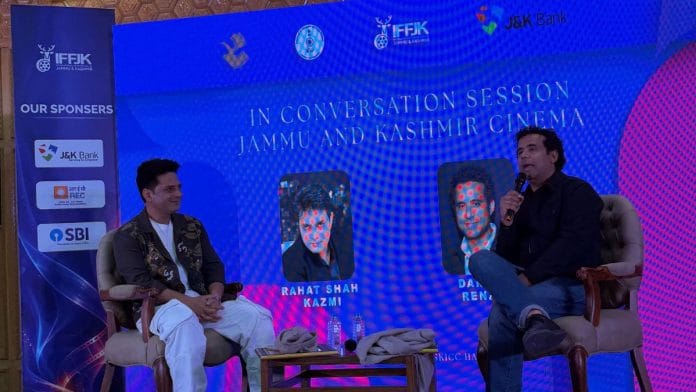

Srinagar: Kashmiri filmmakers express disappointment over the cliché depiction of Kashmiris in Bollywood films.
Filmmakers Danish Renzu and Rahat Shah Kazmi, during a talk on the sidelines of the first international film festival in Srinagar on 9 September, spoke about how Kashmiri cinema can evolve and break free from Bollywood’s typecasting of its people.
“Kashmir isn’t about attacks and politics. It’s annoying to see the same representation again and again,” said Renzu, who is known for his films Half Widow (2017) and Songs of Paradise (2025). He left his job as an electrical engineer in LA to come back home and make films about Kashmir.
“The filmmakers here have the responsibility to change that narrative and normalise the stories of Kashmiri people.”
Kazmi, on the other hand, spoke about how it might be difficult for first-time or new Kashmiri filmmakers to get their film on Netflix or Amazon Prime Video. Therefore, he wants there to be an OTT platform for J&K films.
“Our regional cinema is far behind because when people put in effort back in time, we had very few theatres, which later got shut. Then our language is very unique, and very few people understand it. But when people visit here, they fall in love with our culture. So there needs to be films that bring our stories to global platforms,” he said.
Kazmi added that he has been writing to authorities asking for a chance to bring an OTT platform where Ghojri, Bahadi, Kashmiri, and Dogri language films can be showcased.
Also read: Sunidhi Chauhan wants a Kashmir concert, says ‘I would love to perform here’
Where talent gets banned
Kazmi made his directorial debut with Mantostaan in 2017. He recalled that he had no money, the star cast like Raghubir Yadav and Veerendra Saxena came on board for zero fee, and the film was shot on a 5D camera. Kazmi’s goal was to just make the film; winning awards or, let alone, having a successful run in film festivals wasn’t on his bucket list.
“After six months of making that film, we were at Cannes. It was bought by Netflix. Platforms like the UK Asian Film Festival and BAFTA recognised and also awarded our film. It was made in a few lakhs, and it did ten times more business,” he said.
Both Renzu and Kazmi admitted that the film festival is a significant initiative and will play a key role in inspiring the youth of J&K.
“But we need more initiatives which will boost local cinema,” Kazmi said. “We should focus on local stories for a global audience.”
When the floor was open for the audience to ask questions, the most popular one was ‘why are Kashmiri actors picked for only negative roles like a terrorist or an antagonist?’
“That is changing now. People who are depicting these elements are not from here, they have limited research on our culture. They don’t know the nuance of our language and our culture. So we need more people from here in cinema who don’t treat it as a hobby but as a career. Zaira Waseem was a fantastic actress, but she stopped working,” Renzu said.
Kazmi also highlighted that society needs to evolve as it doesn’t let Kashmiri youth step out. The filmmaker said Kashmir should learn from Iran, as it is a Muslim country which has produced some of the best artists and athletes.
“Our culture and families don’t let us go outside. Because we are being told that it’s not for us. Here, if a girl band emerges, they get banned,” he said.
“We should learn from Iran. It’s a muslim country and they are going through wars and whatnot, but the kind of talent they have produced—the films, the athletes, the artists they have produced. Even America is impressed by their filmography. They win Oscars. Why? Because they didn’t kill their talent.”
(Edited by Ratan Priya)