



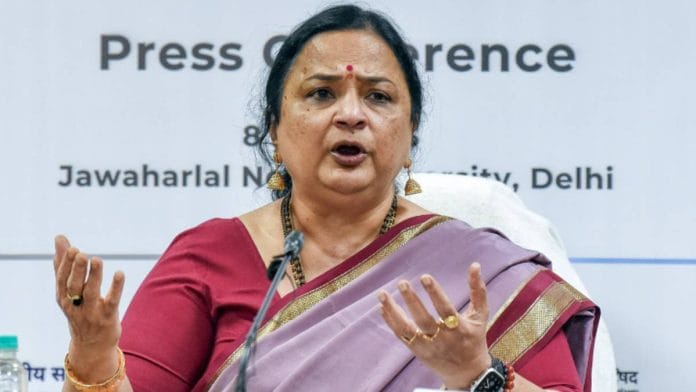

New Delhi: “Feminism in India began with Draupadi”, Jawaharlal Nehru University (JNU) Vice-Chancellor Santishree Dhulipudi Pandit said, arguing that Indian feminism should not be viewed through the lens of Western feminist thought.
Pandit was a keynote speaker at a three–day international conference that began on 10 August at Banaras Hindu University (BHU).
During her address, she also argued that India had transcended patriarchy.
“I would not like anybody who says that feminism began with Simone de Beauvoir. I would say Indian feminism has nothing to do with patriarchy. Draupadi is India’s first feminist,” she said.
‘No one like Draupadi’
Organised by BHU’s Pandit Deendayal Upadhyaya Chair, the conference focused on the theme: “Indian Knowledge Tradition and the Thought of Pt. Deendayal Upadhyaya: Global Perspective and Contemporary Relevance”.
Hindu saint Mithileshnandini Sharan was among the guests and attended the inaugural day as the chief guest.
Pandit argued against viewing Indian feminism through the lens of Western feminist thought.
In her speech, she cited Draupadi as an example, referring to the episode in the Mahabharata in which she questioned her husbands after they wagered her and lost her in a game of dice.
“Today, nobody would dare to ask these questions,” the VC added.
Pandit also argued that India has a tradition of mother goddesses, “whom everyone is scared of”.
‘JNU’s wokeism’
Describing JNU as a campus of “beggars”, Pandit suggested that a temple should be built there to bring more money to the institution.
The vice-chancellor also launched a scathing attack on the Left and the “historians” of JNU. “So we are against this wokeism, the left and others who say that they are the only intellectual tradition that can be there”, she said.
Pandit said that, earlier, people at JNU placed greater value on interpretations than facts.
“Facts are sacred,” she said.
She argued that a university cannot “function” or “flourish” when there is a monopoly of one ideology.
Pandit, who was appointed JNU Vice-Chancellor in 2022, also said that the Indian Right has not invested to the same extent in institution-building.
“Much of the right’s intellectual output remains reactive, topical and event-driven rather than cumulative and theory-building,” she said. For ideas to endure and flourish within institutions, Pandit said, scholarship, peer review, archives, translation, research centres and doctoral training are required.
She emphasised that this was why Pandit Madan Mohan Malaviya and his role in institution-building had become important.
(Edited by Maryam Hassan)