



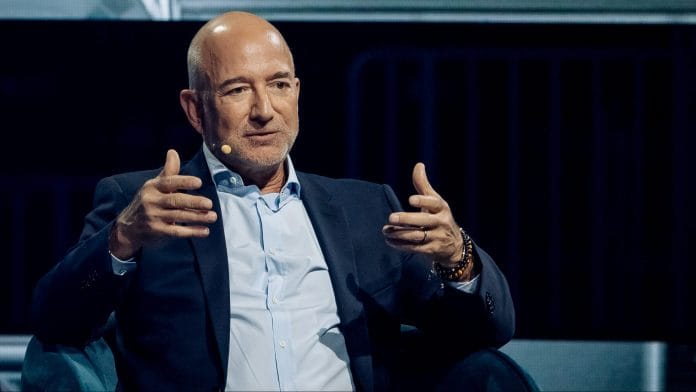

New Delhi: Amazon founder Jeff Bezos has stepped into the great American tax debate with a pitch that sounds simple but strikes at the heart of the welfare-state war: stop taxing the bottom half earners altogether.
In a series of posts on X and remarks to CNBC, the world’s fourth-richest man argued that federal income taxes for lower-income Americans should be “zeroed out”. Bezos said that the government takes only a tiny share of its revenue from them anyway.
“The important part is zeroing out taxes on the bottom half. Best way to put money in someone’s pocket is to not take it out in the first place,” Bezos wrote on X.
Citing CNBC anchor Andrew Ross Sorkin’s statistic that the top one per cent of United States taxpayers contribute nearly 40 per cent of all federal income tax revenue while the bottom half contribute only around three per cent, Bezos responded: “I think it should be zero, and not three per cent.”
Bezos furthered his argument by calling the taxes paid by low earners “a small amount of money for the government.”
“A nurse in Queens shouldn’t be sending money to Washington. Washington should be sending her an apology,” he said.
The remarks quickly triggered backlash online, with critics arguing that exempting large sections of society from taxes could weaken support for welfare programmes and public spending. Dutch historian Rutger Bregman said that strong welfare states rely on broad participation in taxation.
“The strongest welfare states in the world, the Nordics, tax everyone, including nurses. When the middle class has skin in the game, they defend the system. When welfare is ‘just for the poor’, it becomes a poor program,” Bergman posted on X.
The author of Utopia for Realists (2014) also criticised the Amazon founder, saying: “The real scandal isn’t that this nurse pays $12k. It’s that Jeff Bezos pays $0.”
Tesla CEO Elon Musk appeared to endorse Bezos’s proposal, reposting the Amazon founder’s comments with the word: “Bravo.” The exchange also fuelled fresh speculation online about Bezos potentially entering politics.
Bezos’s intervention comes amid growing political fights in the US over taxing billionaires and the uber-wealthy. Several states, including California, have explored additional wealth taxes in recent years to fund social welfare programmes and offset cuts to healthcare services.
New York City mayor Zohran Mamdani also pushed back against Bezos’s remarks. Responding to Bezos’s claim that higher taxes on billionaires would not meaningfully help working-class Americans, Mamdani wrote on X: “I know a few teachers in Queens who would beg to differ.”
The exchange sharpened an ongoing political divide over “tax the rich” policies in New York, where Mamdani has positioned higher taxes on wealthy individuals and luxury properties as central to funding public services and tackling the city’s affordability crisis.
The clash adds another layer to America’s widening debate over who should fund public services—billionaires through higher taxes, or a broader taxpayer base with lower individual burdens.
(Edited by Insha Jalil Waziri)