








New Delhi: In April 1980, a young and starry-eyed Jairam Ramesh penned his observations about India’s self-reliance on technology.
Ramesh, who went on to hold several portfolios at the Centre, had recently returned to the country after spending years in the United States finishing his studies. Upon his return, he wrote, “Technological self-reliance is the answer: what was the question?”
In a piece titled “Technology: Observations on moving beyond self-reliance” for the Economic Times, the 26-year-old argued that technological self-reliance should not be treated as an absolute virtue or an end in itself; rather, it must serve specific developmental objectives.
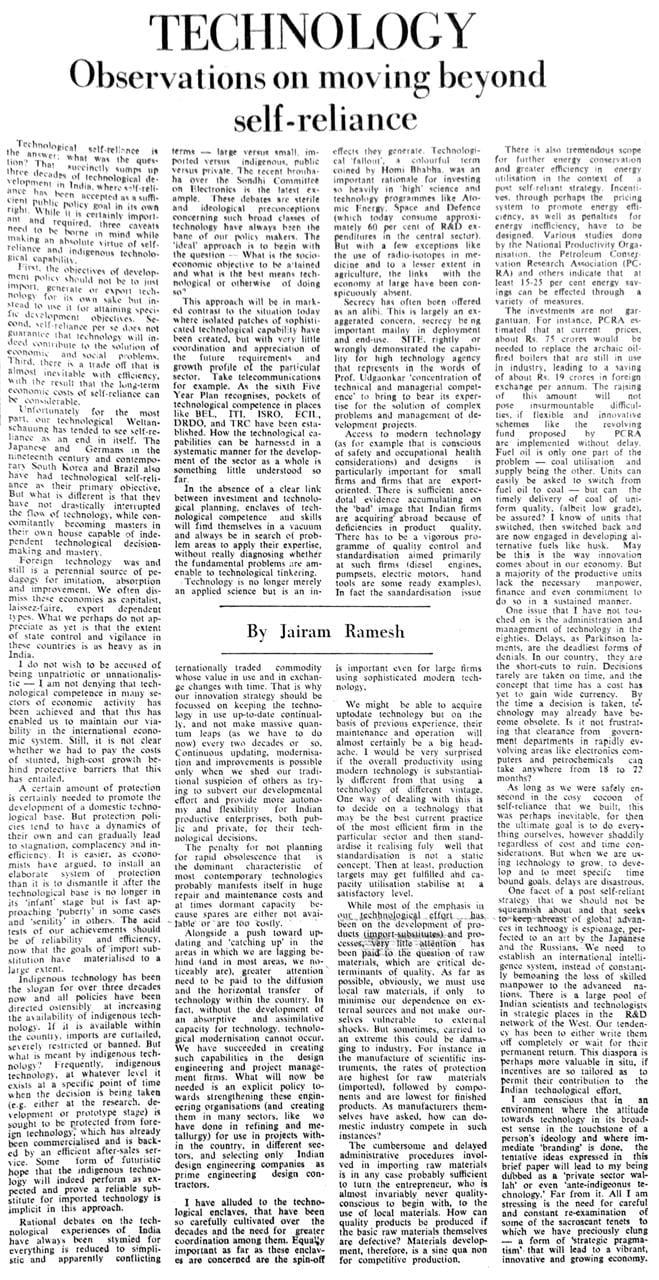
Ramesh maintained that self-reliance does not automatically guarantee that technology will solve economic and social problems, and it often creates a trade-off with economic efficiency, incurring substantial costs.
In short, he argued that India must move past its narrow view of self-reliance and re-examine its technological strategies to build a vibrant, innovative, and growing economy. He gave the example of Japan, Germany and South Korea, and how they pursued both technological self-reliance while conquering the ability of independent technological decision-making and mastery.
“Foreign technology was and still is a perennial source of pedagogy and imitation,” he said.
Developing independent technologies
Ramesh gave ISRO and DRDO as examples of how, in the past, India had created isolated enclaves of sophisticated technological capability, but failed to integrate them systematically into the broader growth of their respective sectors.
“In the absence of a clear link between investment and technological planning, enclaves of technological competence and skills will find themselves in a vacuum and always be in search of problem areas to apply their expertise, without really diagnosing whether the fundamental problems are amenable to technological tinkering,” he wrote.
He went on to cite the “bad image” that Indian firms often have abroad for their poor quality as a wake-up call for a “vigorous programme of quality control and standardisation”.
Ramesh said that materials development is “sine qua non” or essential for competitive production. He argued that the focus must shift to continuous updating, modernising, and improving technologies on an ongoing basis, rather than trying to make massive “quantum leaps” every couple of decades.
“All I am stressing is the need for careful and constant re-examination of some of the sacrosanct tenets of which we have previously clung—a form of ‘strategic pragmatism’ that will lead to a vibrant, innovative and growing economy.”