





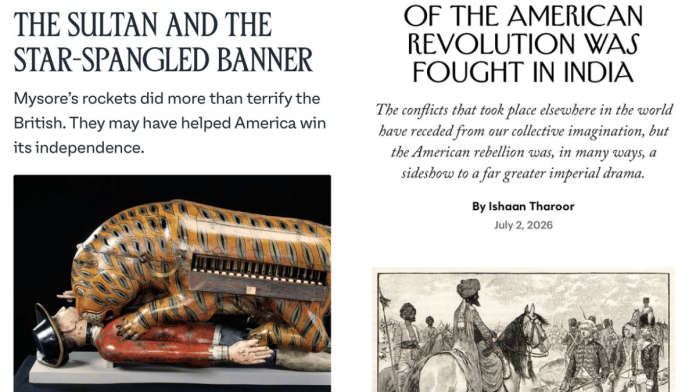


New Delhi: X is now aflame with a new controversy. Nikash Harapanahalli, a writer focused on South Asia, diplomacy, and pluralism, alleged that a column by prominent journalist Ishaan Tharoor in The New Yorker substantially parallels his earlier piece published in The Juggernaut. Quoting Tharoor’s X post about the column, Harapanahalli detailed how The New Yorker piece is derivative of his original work.
Harapanahalli’s article, titled “The Sultan and the Star-Spangled Banner: Mysore’s rockets did more than terrify the British. They may have helped America win its independence,” appeared on The Juggernaut’s website on 22 June. It explores connections between the American Revolutionary War and the resistance of Hyder Ali, the ruler of the Kingdom of Mysore in southern India, against British forces.
“My piece isn’t something you’d easily find online: it took days of archival work & conversations with researchers,” Harapanahalli wrote.
In contrast, Tharoor’s column, “Why the Last Battle of the American Revolution Was Fought In India,” was published in The New Yorker earlier this week on 2 July. It similarly frames the American war within a broader global imperial conflict, highlighting how the Sultan’s campaigns diverted British resources.
What each party claims
Tharoor, who is the son of Congress MP Shashi Tharoor and a global-affairs columnist currently working for The New Yorker, has not publicly responded.
However, a spokesperson for the magazine told ThePrint that Tharoor started working on the piece well before Harapanahalli’s article was published.
“Ishaan Tharoor pitched and began working on his column about the conflict in Mysore in the context of the American Revolution in early June, well before The Juggernaut article was published. Ishaan independently researched and wrote the column, and it was carefully edited and fact-checked by New Yorker staff. We stand by the originality of Ishaan’s work,” said a spokesperson for The New Yorker in an email.
Tulika Bose, a senior editor at The Juggernaut, has quoted Harapanahalli’s post to attest to his original work.
“@nikash_hara is our editorial intern, and I can attest that he spent a very long time on the original piece,” she wrote.
Some replies to Harapanahalli’s post defend the column by noting the topic’s prior coverage in historical sources, while others support Harapanahalli’s call for credit.
Anwesh Satpathy, who has previously written for The Wire, claimed that Harapanahalli’s piece too took quotes from an article by The Scroll.
“It did not take you days to pull up these quotes that are available for free publicly for anyone who can google. Your article quotes Ameen Ahmed, who, in a 2020 article for @scroll_in had quoted precisely the same letters and narrated the same sequence of events(1/n),” Satpathy posted on X.
Also Read: Aurangzeb tried banning eunuch trade. But they were indispensable in the imperial harem
What is the controversy?
In the detailed thread posted on 3 July, Harapanahalli pointed out structural and content overlaps. Both pieces open with the story of the American ship Hyder Ally (named after the 18th-century ruler), its departure from Philadelphia in April 1782, the Battle of Delaware Bay against British vessels, and the victory led by Lt Joshua Barney. Harapanahalli alleges that both pieces reference American poet Philip Freneau’s recruitment poem for the ship and his celebratory verses after the battle.
The New York-based journalist went on to note that both articles draw on the same archival quotes and sources, including letters and toasts, presented in a similar sequence.
“It took me days to go through the National Archives and pull the quotes. His piece also pulls quotes from the same sources,” he wrote.
Harapanahalli, a Mysorean American, wrote that the topic was personally significant to him. He expressed surprise and disappointment, questioning whether his original article served as source material and requesting attribution if so.
He also attached highlighted screenshots of both pieces to further illustrate his claim.
(Edited by Insha Jalil Waziri)