



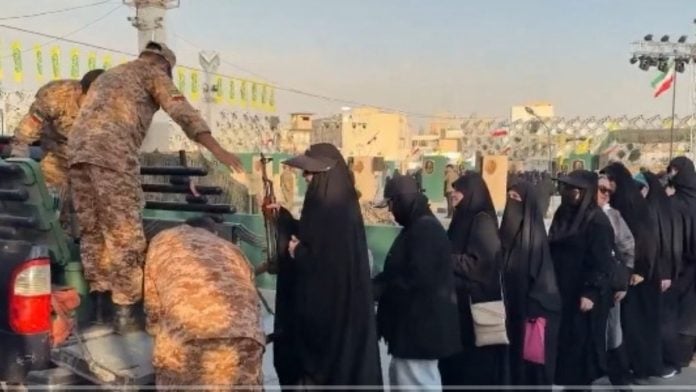
New Delhi: Iranian women have picked up arms as the country held its first military firearm training course for women. The course is a part of Iran’s mass mobilisation “Sacrifice for Iran” campaign.
The drive, formally known as Janfada (those who sacrifice their lives), is part of a broader effort by Iranian authorities to train and arm volunteer civilians under the Basij militia, a wing of the Islamic Revolutionary Guard Corps (IRGC). It was first unveiled in March 2026, at the peak of fighting involving the US and Israel.
Officials describe the programme as preparing citizens for security and support roles amid heightened tensions with the United States. Women have featured prominently in its public displays.
The parade in Tehran
At a large military-style parade on 18 September, many chador-clad women volunteers were seen carrying rifles and other weapons as they marched through downtown Tehran alongside men and teenagers. Some women rode motorcycles during the event, an activity officially banned for women in ordinary civilian life in Iran.
Iranian military hardware used in the March conflicts was also put on public display. State messaging across the capital has included banners asking passers-by whether they know how to operate rocket-propelled grenades, sniper rifles, assault weapons or communications gear.
Who is signing up
Hassan Hassanzadeh, the head of the IRGC in Tehran, told the state broadcaster IRIB that more than 600,000 people had registered for the active mobilisation phase. According to the organisers, as quoted by Al Jazeera, about 26 per cent of registrants chose military or security work. Others signed up for rescue, social services, media or financial support roles.
The campaign also targets the young.
“Our effort concerning children and teenagers, first and foremost, is to introduce them to the culture of sacrifice and resistance,” said Sasan Zare, the spokesman for the Janfada campaign. “The stronger their value system is formed from childhood, and the more they become familiar with concepts like patriotism and self-sacrifice, the more significant the impact can be on their future,” Zare added.
Also Read: Iran women’s kabaddi team is training in Sonipat. They’re rebuilding for 2026 Asian Games
An effort to rebuild the Basij’s image?
Authorities do not talk about an imminent ground invasion threat. Ali Alfoneh, a senior fellow at the Arab Gulf States Institute, noted that the effort appears aimed at rebuilding the Basij’s image.
“Since the end of the (Iran-Iraq) war in 1988, however, the Basij has evolved into an instrument of domestic coercion and the suppression of dissent, severely damaging the organisation’s public image,” he told Al Jazeera.
The campaign could therefore be seen as an attempt to restore the Basij’s former image as a patriotic volunteer force, rather than primarily a tool of domestic control, in anticipation of possible future unrest.
Alfoneh suggested the force may be preparing for other scenarios.
“If not a US ground invasion of Iran, then the prospect of a US and Israeli-instigated civil war in Iran’s peripheral regions, as well as large-scale popular uprisings driven by mounting economic pressure,” he said.
Readiness, talks and economic strain
Iranian officials continue to link the campaign to readiness in case the talks with Washington fail. Security chief Mohsen Rezaei noted that commanders remained prepared to resume fighting even as conditions for negotiations were relayed through intermediaries.
Meanwhile, Iranian President Masoud Pezeshkian urged volunteers at the parade to help ease domestic strains by consuming less fuel and electricity amid energy shortages and tighter US sanctions.
Edited by Maryam Hassan