







New Delhi: India has a head start in the healthy snacking race, and the market is growing at a much faster pace than the global average. Industry leaders say it’s time to seize the opportunity.
“India is a step ahead, and it’s only fitting that we capitalise on this opportunity and emerge as global leaders. We witnessed the IT boom in the 1990s. Today, we are seeing the foundations of a similar-scale boom in healthy snacking,” said Parminder Joshi, founder and CEO of FoodIntellé.
Joshi was speaking at Farmley’s Indian Healthy Snacking Summit, held at Bharat Mandapam in Delhi on 3 July.
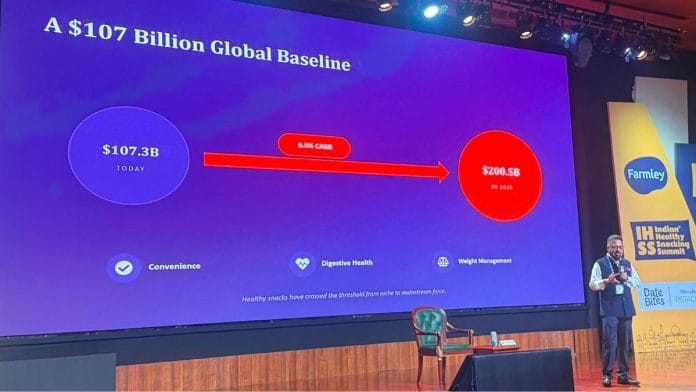
The former Nestle executive said the global healthy snacks market is projected to grow at a compound annual growth rate (CAGR) of around 6.5 per cent, while India’s market is expected to expand at nearly 10 per cent CAGR, making it one of the fastest-growing markets in the segment.
According to Joshi, the growth is being fuelled by three key factors: “rising disposable incomes, increasing fitness awareness, and compressed urban lifestyles”, which have pushed consumers to seek convenient yet nutritious alternatives to traditional packaged snacks.
Also read: Fish for votes, eggs for ideology in BJP’s Bengal. Children pay the price
Gen Z at the forefront
Joshi also credited Gen Z for accelerating this shift.
“Gen Z are global citizens. They are quick to adopt global food trends, whether it’s Korean noodles, the keto diet or healthy snacking. They are constantly looking for products that align with both their lifestyle and values,” he said.
That observation resonated with several young attendees at the summit.
Twenty-three-year-old Siddhi Kamra said she has become increasingly selective about what she eats, often avoiding products containing palm oil.
“I am very particular about my snacks. Beetroot chips, onion chips and salted makhanas are my go-to munchies. It’s been a while since I last ate Lay’s,” she said.
Her friend Aditya laughed, pointing out the irony behind the trend.
“My mother always says, ‘You kids are going back to what we have been doing for years. I’ve always stored makhanas at home, but you want to buy them in expensive branded boxes’,” he joked.
Joshi said this reflects a broader generational shift in consumer behaviour.
“Previous generations primarily looked for taste, convenience and affordability. Gen Z still wants great taste, but they also demand nutrition, clean ingredients and transparency. They want to know what’s inside the packet and where it comes from,” he said.
The trend mirrors India’s broader wellness movement, where traditional foods such as makhanas, millet-based snacks, seeds, and dry fruits are being reinvented as premium, on-the-go products. More palatable flavours like mint, peri-peri, cheese and others are added to make healthy snacks more tempting.
As consumers become more label-conscious and willing to pay for healthier alternatives, industry experts say India is well-positioned to become a global hub for healthy snacking innovation.
(Edited by Aamaan Alam Khan)