



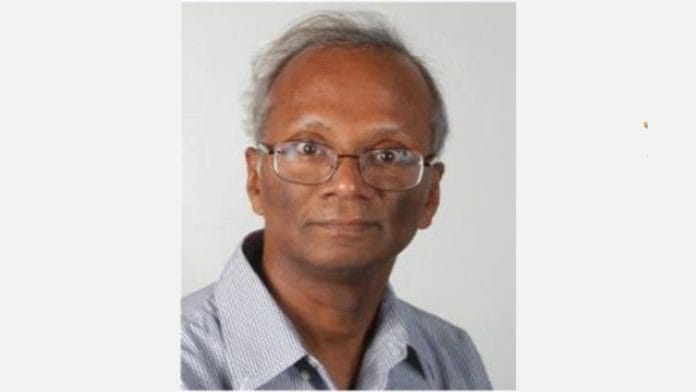
New Delhi: Indian physicist Deepak Dhar was named the 2026 winner of the Dirac Medal on Saturday for his contributions to statistical mechanics. Awarded by the Italy-based International Centre for Theoretical Physics, the medal has been given annually for the last 41 years to scientists from around the world.
This year, Dhar shared the award with Bernard Derrida of Collège de France, Marc Mezard of Italy’s University of Bocconi, and Haim Sompolinsky of Harvard University.
Dhar, 75, is an Indian Science Academy (INSA) Distinguished Professor at the International Centre for Theoretical Sciences (ICTS), Tata Institute of Fundamental Research (TIFR) in Bengaluru. He has been associated with TIFR since he returned to India after his PhD at the California Institute of Technology in 1978. He was also a distinguished professor at IISER Pune for a few years.
“The work of the 2026 Dirac Medallists has contributed to establishing theoretical physics … as a powerful framework to tackle a very broad range of questions that go far beyond its traditional domain of interest to encompass biology, computer science and artificial intelligence,” said ICTP Director Atish Dabholkar, who chairs the prize committee, in a press release.
According to the press release, Dhar’s work on the ‘sandpile model’ has far-ranging applications in thinking about earthquakes, avalanches, traffic jams, and other forms of unpredictable behaviour.
The sandpile model, proposed by Per Bak, Chao Tang, and Kurt Wiesenfeld in 1987, is a concept in statistical physics that studies self-organised criticality — the phenomenon by which systems can reach a state, naturally, in which small events can trigger large events. This is most perfectly described by sandpiles, where each added grain of sand can either lead to stable reactions or cause an avalanche.
Dhar’s work, specifically, has been to mathematically solve the sandpile model, since he figured out that the order in which the sand grains topple does not matter. However, the sandpile model does not just extend to physical sandpiles, and Dhar’s work helped explain messy, unpredictable phenomena with underlying mathematical rules.
The Dirac Medal is given in the memory of 20th-century English theoretical physicist Paul Adrien Maurice Dirac to scientists who have made “significant contributions to theoretical physics”. It has been awarded annually on his birthday on 8 August since 1985.
Also read: What were humans up to 60,000 years ago? Engravings on ostrich eggshells point to a clue
IIT to Caltech
A graduate of the University of Allahabad, Dhar went to IIT Kanpur to pursue his master’s in physics. He then went to the California Institute of Technology, or Caltech, for his PhD, where he studied under Professor Jon Mathews. However, after his PhD, he returned to India immediately and began working at the Tata Institute of Fundamental Research in Mumbai as a fellow.
Dhar’s work in theoretical physics has earned him many laurels, including the Padma Bhushan in 2023, as well as the Shanti Swarup Bhatnagar Prize in 1991.
Globally, he has also received the World Academy of Science prize in 2002 and the Boltzmann medal in 2022, making him the first Indian to receive the medal.
The awards, especially the Dirac medal and the 2022 Boltzmann Medal, recognise Dhar’s work and its contributions to understanding systems such as financial models, earthquakes, and avalanches — all connected by the world of physics.
(Edited by Aamaan Alam Khan)