





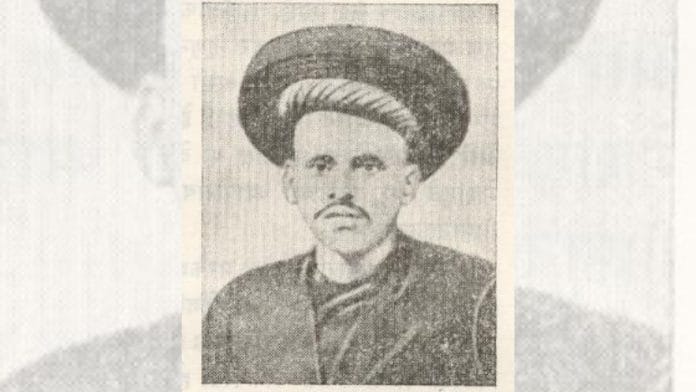


New Delhi: By the time Narayan Mahadev “Mama” Parmanand began dictating the book that would become his political testament, he was suffering from Parkinson’s disease. So he whispered his words to an aide and published it under the pseudonym “A Political Recluse”. But by the 1950s, there were only a handful of copies left of a book that had once been read religiously by Indian princes.
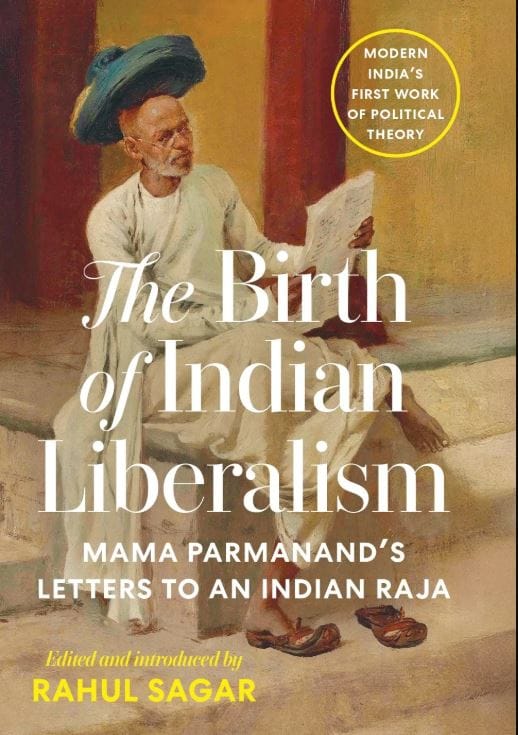
Now, author Rahul Sagar’s new book, The Birth of Indian Liberalism: Mama Parmanand’s Letters to an Indian Raja, is bringing that forgotten figure — a self-made 19th–century liberal intellectual from Maharashtra’s Sawantwadi — and the political ideas he represented back into view. Published by Juggernaut Books in India, the book restores Parmanand’s 1891 Letters to an Indian Raja, which Sagar, an associate professor at New York University Abu Dhabi, describes as the first work of political theory published in modern India.
Through Parmanand’s letters, Sagar argues that Indian liberalism did not arrive as a British package. It had its own concerns and its own political project: protecting individuals not only from arbitrary rulers, but from the power of caste, custom, and social hierarchy.
“I’m trying to restore the idea that Indians had agency,” Sagar told ThePrint in a Zoom interview. “They were thinking, they were acting, they were trying to create and build things.”
For Sagar, that is the crucial difference between much of 19th-century Indian liberal thought and its European counterpart. The great European liberal fear was often the power of the Church or the state. In India, he argues, liberals confronted another form of authority: the community.
And unlike the European liberal tradition, which often began with the problem of restraining an already powerful state, Indian liberals also had to grapple with how to build a functioning state in the first place.
So Parmanand becomes both the protagonist and the evidence: a man who believed liberty meant making individuals strong enough to resist the authority of their communities and who thought India’s princes could, paradoxically, be the ones to help make that freedom possible.
What made Parmanand political?
As a student, Parmanand was among a group of young men who ate a meal with a visiting Christian cleric in Bombay, inadvertently violating caste rules. When the episode became known, one of his friends apologised. Parmanand refused. Caste rule was not the only problem for him; it was that an individual had allowed a community to decide what he could eat, whom he could meet, and how he should live.
“That time, he said, we are not sufficiently strong-willed, this is not right. Parmanand refused to apologise to anyone for anything,” Sagar said. “And he did what he thought was morally right.”
He went on to be one of the earliest graduates of Elphinstone College, a newspaper editor, and a senior official in a princely state.
Sagar argues that the reformer, labelled an eccentric voice, was one of the most sophisticated representatives of a wider Indian liberal tradition that has largely disappeared from the national memory.
“Even back then, he had distinctive views. It was not quirky or unusual to him. These views are widely held by an array of liberals,” Sagar said. “He was the one who articulated it and developed it in the most sophisticated way.”
He was sceptical of the idea that local governments in rural India were automatically liberating. A panchayat, he argued, could simply place power in the hands of the village strongman, landlord, financier or caste elite. Instead, he wanted local institutions to give greater weight to people whose contribution to society earned them respect: the teacher who stayed in a small town, the librarian, the veteran or the person engaged in public service.
“He has this sort of emphasis on individuality,” Sagar said. “We’ve also thought about that less as we tend to think about group identities more.”
His other great hope was the city. Urban life, Sagar says, offered people the chance to encounter strangers, ideas, and ways of living outside inherited structures. Education and mobility could loosen the grip of caste and custom.
But it also makes his preferred political vehicle surprising. Parmanand had enormous faith in India’s princes.
Monarchy is the way
Parmanand did not necessarily put monarchy as inherently superior to democracy. He believed that enlightened rulers could use the powers they possessed to gradually create freer societies.
Sagar’s research challenges the typical image of princely India as little more than a collection of decadent courts. In the 19th century, he says, some princely states were laboratories of institutional and social reform. Mysore had representative institutions before British India, although voting was restricted by property qualifications. Gondal had achieved universal female literacy at a time when female education in British India remained limited. Kutch developed a representative assembly. Kolhapur introduced reservations for Dalits.
These rulers were not modern democrats. Their reforms were cautious and gradual. But that, Sagar argues, is precisely what has been lost in the conventional story of Indian modernity.
The later history of the princely states helped erase their earlier reformist experiments.
“Parmanand died in 1893. By about 1895, ten years into the Congress’s existence, it’s clear that the Congress was going to become the dominant force,” he said. “By 1919, Maharajas were starting to look like museum pieces. They were wary and cautious of the new system.”
Also read: Why India must return the British loot in its museums
What would Parmanand think of India today?
If Parmanand were transported into contemporary India, Sagar suspects he would experience something between satisfaction and alarm.
“If he was to look at our world today, where we are so much more free to live, dine, move, marry, travel, study with so many more people in India, he would be really happy about how things have gone,” Sagar said.
He points to the dramatic increase in Indians travelling to Britain in the 19th century as one example of how social rules were gradually breached through thousands of individual decisions. But caste, he says, would still disturb him.
“I think it’s the political side of caste that he will probably be most startled by,” Sagar said.
Parmanand was not looking for modest reform of caste. Sagar describes him as “absolutely, resolutely opposed” to the category itself. He belonged to secret societies where members deliberately broke caste rules, ate together, and encouraged inter-caste marriage. Many Maharajas, who read Parmanand’s letters, slowly adapted.
The Maharaja of Kohlapur had said his “goal” was to “destroy or eliminate” caste altogether. So he built boarding houses that did not segregate.
“My worry is by creating boarding houses, I’m going to reify, I’m going to concretise caste,” Sagar recalled the king words in one of the letters.
For Parmanand, Sagar says, the ideal politics would not be organised around caste identities at all. A politician should ask voters to support better schools, infrastructure and economic growth, not appeal to them as members of a particular caste.
“What was intended initially to be an emancipatory exercise is becoming one that’s producing fractures,” Sagar said. “It’s maintaining and producing new kinds of fractures in Indian politics.”
Yet Sagar is reluctant to turn the story into one of decline.
“It wasn’t as bad as we think, and we’ve improved much more than we think,” he said. “And maybe I’m too much of an optimist… But actually, I think when we look back and we take the long view, we have many reasons to be proud.”
(Edited by Aamaan Alam Khan)