





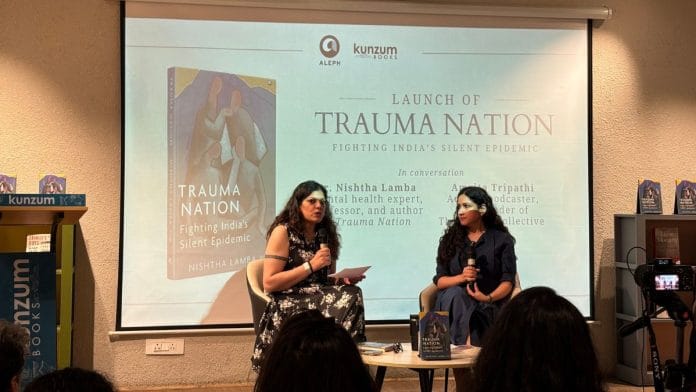


New Delhi: Trauma is not what happens to you. It is what happens within you. The line lingered over a packed room at Kunzum Books on 12 May as mental health expert and professor Dr Nishtha Lamba spoke about emotional pain, inherited fear, and the quiet ways trauma shapes everyday life in India.
Lamba was in conversation with author, podcaster, and Health Collective founder Amrita Tripathi for the launch of Trauma Nation: Fighting India’s Silent Epidemic, published by Aleph Book Company. The book examines how trauma manifests within Indian families, institutions, and communities and how unresolved emotional wounds are often carried across generations.
Blending survivor testimonies with scientific knowledge, Lamba’s book explores how trauma silently embeds itself into bodies and relationships, manifesting as anxiety, depression, physical illnesses, addictions, and chronic stress. The book pushes back against the idea of trauma as merely an individual problem, instead framing it as a wider social condition.
By the time the discussion began, the bookstore was overflowing with keen listeners of all ages and professions sitting as Lamba explained her attempt to create conversations around trauma without making them inaccessible or overwhelming.
The evening moved fluidly between psychology, neuroscience, family dynamics, social media and journalism. But at its centre was Lamba’s attempt to bring conversations around trauma out of academic spaces and into everyday language.
Trauma beyond the individual
Lamba returned repeatedly to the question of how trauma is understood and misunderstood in everyday Indian life.
“A lot of academic knowledge stays buried in research papers. This is sort of me trying to make mental health science more accessible so that anyone can pick it up and have a conversation about it,” Lamba said.
Again and again, she stressed the importance of understanding trauma within Indian social realities rather than through purely Western psychological frameworks.
“Mental health without the cultural context is a half-told story,” she said.
One of the book’s central arguments, and one that repeatedly surfaced through the discussion, was that trauma is shaped not only by the event itself, but by what follows afterward.
“Trauma is not about the event itself, but about how the people or systems around us, such as organisations or family, respond to it.”
Lamba expanded on the idea through examples from the book, including a fictional workplace sexual harassment case in which a survivor’s long-term trauma depended heavily on whether colleagues, HR departments and family members supported or dismissed her experience.
“We fixate on the event itself, while the real trauma gets defined in our bodies, in our context,” she said.
Memory, childhood and inherited fear
The discussion became particularly intense when it turned toward childhood trauma and fragmented memory. Lamba described interviewing survivors who struggled to reconstruct timelines of abuse because memories survived only in flashes, bodily sensations, or emotional fragments.
“Childhood trauma is very complex that way. You barely have a memory of it, but it gets deposited in your body,” she said.
Tripathi connected this to what she described as “trauma brain”—the memory gaps and fragmented recollections survivors often experience while trying to process painful events years later.
The conversation also explored intergenerational trauma, particularly within families shaped by Partition-era violence and silence. Lamba referenced research on Holocaust survivors that found unresolved trauma could influence future generations through parenting patterns, fear responses and emotional withdrawal.
“Our parents’ generation, our grandparents’ generation, especially those with the Partition, didn’t have the vocabulary, didn’t have the resources to access help,” she said.
Still, Lamba pushed back against fatalistic ideas about inherited suffering.
“People who had resolved their trauma were not passing it on,” she said, adding that healing and resilience were equally possible.
The gaps in India’s trauma conversations
Therapists involved with the book acknowledged the limitations of Trauma Nation in fully capturing the scale and complexity of trauma in India. Trauma therapist Akanksha Chandele, founder of I Am Wellbeing, which works with high-risk communities through trauma-sensitive care, said the book represents only one layer of a much larger and deeply under-addressed reality.
“Trauma is much vaster. The book is an introduction into understanding how big it is,” Chandele told ThePrint, pointing to the lack of funding, institutional support, and systemic infrastructure for trauma-informed care in India.
Chandele, who worked with Lamba during the research process, said the author had specifically reached out to therapists working on the ground in India to better understand how trauma manifests in everyday life beyond academic frameworks.
One of the biggest gaps in mainstream mental health conversations is the tendency to treat trauma as an isolated condition rather than something embedded in everyday behaviour and relationships.
“When people look at concentration, anger, relationship issues, so many day-to-day challenges, what people miss out is to go into the history of that person and actually see what their nervous system is like,” they said.
Chandele also argued that trauma-informed care is often misunderstood as something required only in extreme situations. “Some people require trauma-informed care, and some people don’t. That’s not the case. Everybody requires it.”
The therapist added that many of the survivors featured in the book had already reached some level of emotional processing and healing, making the conversations safer to revisit publicly.
“The book is also a representation of maybe just that much,” they said, suggesting that countless other experiences remain invisible because survivors still lack the safety, vocabulary, or support systems needed to articulate them.
Also read: Inside the ‘body shop’ system trapping H-1B workers
The age of secondary trauma
Secondary trauma is the psychological impact of constantly witnessing other people’s suffering in the news and on social media. Addressing the many journalists in the audience, Lamba described how repeatedly covering disasters, violence and grief can slowly reshape a person’s emotional world.
“You go back to those stories. You review them, write them, look at those photos again and again, and all of that does enter our psyche,” she said.
She argued that social media has intensified this emotional overload by collapsing traumatic news, personal updates and entertainment into the same endless scroll.
“We are getting into a meeting stressed already, and in the gap we flick through our phone and find five disturbing news alerts,” she said. “How you consume information is very important. It’s not just about the information.”
Amrita Tripathi added that platforms now force people to move instantly between joy and catastrophe. “You’re seeing wonderful snippets from your friends next to war, next to trauma,” she said.
Lamba warned that constant exposure to sensational coverage can quietly alter how people perceive the world.
“Research suggests that subconsciously we start believing that the world is an unsafe place,” she said.
Yet despite the heaviness of the subject matter, the evening repeatedly circled back to resilience, support systems and the possibility of healing. Lamba spoke about the importance of “active listening”, trauma-informed therapy and creating safe spaces where emotional pain can be discussed without shame.
As the event ended, with a reading of a Vinod Kumar Shukla poem, the audience questions ranged from trauma at the margins of poverty to the overuse and oversimplification of the word “trauma” in everyday language, as well as reflections on pandemic-era emotional distress. Readers queued up for signed copies, while conversations spilled beyond the bookstore shelves—about therapy, family silence, information fatigue and the strange relief of hearing difficult emotions articulated publicly.
(Edited by Ratan Priya)