







New Delhi: For thousands of Indian tech workers, the journey to the United States begins with a promise, but often ends in a system they cannot easily escape. The American Dream, long sold as a ladder to success for skilled migrants, traps the very workers it promises to serve.
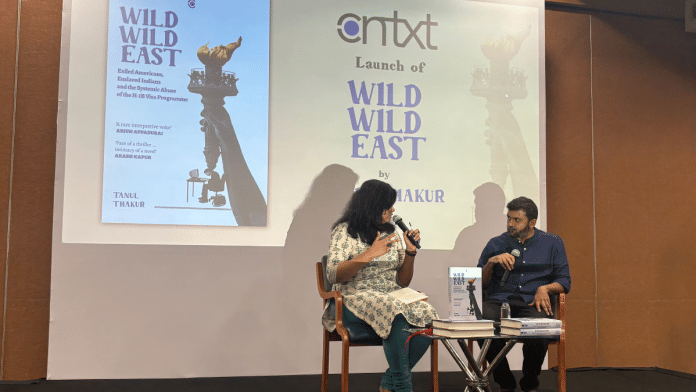
The launch of Wild Wild East by Tanul Thakur was held at the India International Centre on 12 May. The discussion, moderated by historian and author Narayani Basu, moved beyond the mechanics of visa fraud into far more unsettling territory: the system that sustains it.
Thakur spoke of “body shop” consultancies that funnel migrant tech workers into unstable and often exploitative jobs.
The book is an account of visa fraud, migrant exploitation and an investigation into a system that thrives on ambiguity and vulnerability. The book tells the stories of immigrants trying to build a better life while struggling to survive. It shows how consultancies, companies, and weak policies work together to create unfair conditions. These systems often look legal, but they still trap workers. It questions the idea that skilled migrants are always a success story and instead shows how insecurity and dependence are built into the system and quietly maintained.
Thakur said that the exploitation of migrant workers involves more than just one group harming another. And this system continues because many people benefit from it or choose to stay silent.
“If it doesn’t benefit Indian workers or American techies, then it’s obvious who gains—corporations. They’ve perfected the oldest trick in the book—turning workers against each other while they profit. Even now, it’s striking how many continue to blame Indian workers alone, when the system itself is designed this way,” said Thakur.
Fighting the system
At the event, Basu introduced Kumar—one of the central voices in the book and a long-time victim of the system—before a recorded video message from him was played for the audience. In it, Kumar spoke about years of displacement, betrayal and survival. His story may sound familiar in outline, but the details make it deeply painful and personal.
“I thought I’d go on-site and make $1 million in two years and come back to India… But when I landed, they said there was no job. You have to search for a project. That gave me a heart attack,” Kumar said in the video.
The promise of upward mobility dissolves almost immediately. What takes place is a cycle of instability—new employers, unpaid wages, constant relocation, and the erosion of dignity.
Kumar described how employers and consultancies repeatedly changed his identity details. He said he was forced to move between six different employers, often without regular pay.
Kumar’s story challenges the polished image of the global workforce. Promises of foreign jobs, high salaries, and international experience hide a much harsher reality, where workers often find themselves trapped in a system with little freedom, negligible growth, and no easy way out.
“If I had stayed in India, I might have grown into a CTO or even a CEO,” Kumar says in the video message.
Kumar’s account also pointed to why many workers do not report such conditions. He said many are afraid to speak up, and even when complaints are made, “the system won’t react” and there is “no punishment for white-collar crimes.”
If Kumar’s story reveals how Indian workers are drawn into the system, Virgil’s shows its impact from the other side. An American IT professional who once earned a six-figure salary, Virgil gradually found himself pushed out of the industry. Job interviews stopped coming—first for months, then for years.
Rather than blaming migrant workers, Virgil started looking deeper into the system. What he discovered led him to solidarity with those facing the same exploitation.
“Virgil began digging deeper, and years later, when he met Kumar, they both realised that the same system, the same forces, were exploiting them. They were never meant to be adversaries—they were meant to be allies. And honestly, I’m not just fond of them, I deeply admire them,” said Thakur.
Also Read: Delhi celebrates the oldest surviving form of Hindustani music—Dhrupad
Why the American dream persists
As the discussion drew to a close, Basu turned to a question that followed naturally from the stories presented: if the system is so widely known to be exploitative, why do workers keep returning to it? And why does the idea of the American Dream still hold such power?
Responding to this, Thakur pointed to a mix of economic pressure, social expectations, and psychological conditioning. Part of the answer is practical. Many workers take loans, support families, and invest years chasing stability abroad. Leaving can feel impossible after sacrificing so much. But Thakur argues that something deeper is also at work—a cycle where exploitation becomes normalised over time.
“Many workers believe that freedom will come only with a green card. After waiting 10, 15, even 20 years, some end up repeating the same psychological abuse they once suffered,” said Thakur.
The system survives not only because of politics and corporations but also because people who endure it often come to accept it as normal.
Thakur also makes an uncomfortable observation. For some workers, even exploitation in the US can seem preferable to insecurity back home.
“Some choose what feels like enslavement in the US over freedom in India. That says something about India itself,” said Thakur.
The question of who benefits is equally complicated. Corporations may gain the most, but exploitation does not move in only one direction.
“It’s Americans exploiting Indians, Indians exploiting Indians, Indians exploiting Americans—it’s a whole mix, a thali of things happening at once,” he said.
(Edited by Insha Jalil Waziri)