



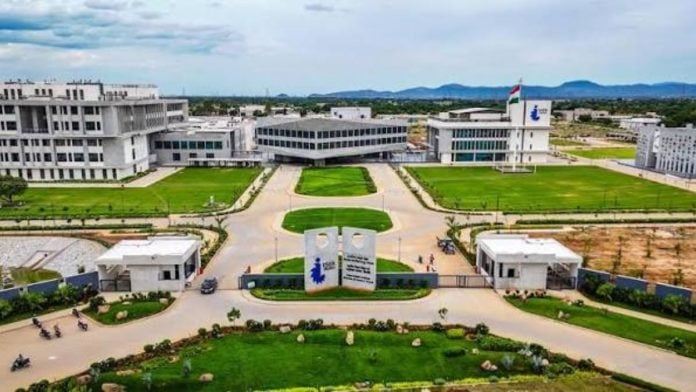
New Delhi: Australia’s University of Melbourne and the Indian Institutes of Science Education and Research (IISER) in Tirupati have tied up to provide hybrid undergraduate courses in foundational sciences. The two institutes signed a partnership on Monday that will enable students to attain a dual degree. It will provide an opportunity to study in both universities during the course of the degree.
Professor Moira O’Bryan, Dean of the Faculty of Science at the University of Melbourne and Director of IISER Tirupati, and Prof Santanu Bhattacharya were present in Delhi to sign the partnership between the two institutions.
“The University of Melbourne has always placed high value on diversity and we were looking to partner with India considering they already provide a certain foundation in subjects like Maths and Science to students in their early education,” Professor O’Bryan told ThePrint.
She explained that the programme will allow Indian students to spend the first two years of their degree in IISER Tirupati and their final two years in Melbourne. They will get an opportunity to graduate with two Bachelor honours degrees from globally renowned institutes. This will also open up avenues for earning a Majors in subjects including chemistry, ecosystem sciences, environmental sciences, biotechnology, genetics, physics and biology.
Students who take up the Bachelor of Science Integrated (Honours) can also move to a Master’s degree and automatically join the Science Global Scholars Programme, a collaboration that supports research and talent mobility between the two institutions for higher education.
Also read: Hall, Woodford win Nobel for research helping govt and central banks fight inflation, recessions
Process of admission
Professor Bhattacharya from IISER explained that the process of enrolling students for this new programme will involve a qualifying test. Students will also need to maintain a certain level of score throughout the course of their degree to be able to advance into the next stages of the programme.
In the first batch, around 50 students will be enrolled and later, depending on the interest and the quality of students, the batch size will be increased.
“We will be creating an entrance test, which would obviously be keeping basic foreign entrance test levels as well,” Bhattacharya said.
He said that with science education advancing and with facets coming up in the fields of artificial intelligence, genetics, and data sciences, students will need to be equipped with interdisciplinary education.
(Edited by Ratan Priya)