





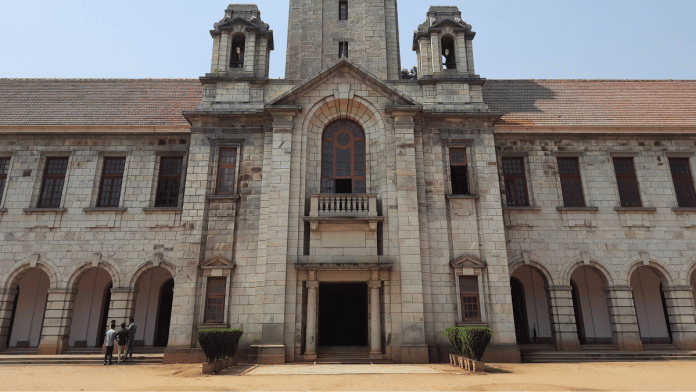


New Delhi: The Indian Institute of Science, Bengaluru, welcomed its first batch of undergraduate students to its aerospace engineering department on Monday, 84 years after the department was founded. This marks IISc’s entry into the small league of Indian universities offering BTech programmes in aerospace engineering, including IIT Madras and IIST Thiruvananthapuram.
“As the country’s oldest aerospace engineering department, we saw the need for aerospace engineers with deep conceptual clarity [who are] comfortable with contemporary tools,” said G Jagadeesh, chairperson of the IISc Department of Aerospace Engineering. “They can lead the next generation of space, aeronautics and defence start-ups in the country.”
Jagadeesh hopes the inaugural batch will benefit from IISc’s state-of-the-art facilities and testing laboratories, and even some new deep-tech start-ups could emerge from the department.
The IISc Department of Aerospace Engineering is one of the oldest in the country, having been founded in 1942 during British rule. It boasts famous alumni, including former ISRO chairmen K Sivan and S. Somanath, as well as founders of aerospace start-ups such as OrbitAID and Guerin Technologies.
“Aerospace engineering is a delicate science – dealing with spacecraft, rockets, propulsion,” said K Sivan, former ISRO Chairman, to ThePrint. “It’s great to introduce students to this at an early stage,” he added.
The four-year BTech programme has an introductory batch of 25 students, and will provide foundational teaching in physics, mathematics, and engineering. However, the main focus will be on elements of aerospace engineering, such as aerodynamics, propulsion, flight and space mechanics, and guidance systems.
Importantly, the programme also aims to offer hands-on experience in aerospace sector to students, with access to IISC’s Aerospace Engineering X Lab, and a final-year capstone project which will be based on a ‘Design-Build-Fly’ approach, allowing students to actually conceptualise and build an unmanned flying vehicle.
“With India’s space sector opening up, there is renewed interest in innovation and the research ecosystem, especially in aerospace,” said Jagadeesh. “We had been brainstorming a BTech course for a few years, and we felt it was the right time to launch it.”
Also read: Modi govt is giving more teeth to a paper leak law that has so far bitten none
Aerospace engineering at IISC
The aerospace engineering department at IISc was founded in 1942, in response to the strategic requirements of the British Empire during World War II. At the time, the need for the department arose out of training skilled experts and technicians to work on aeronautical capabilities, and IISC then collaborated with Hindustan Aircraft Limited (HAL).
Vishnu Madhav Ghatage, one of India’s few trained aeronautical engineers at that time, was ‘lent’ to IISc from HAL from 1942 to 1947 to set up the department’s post-graduate courses in aeronautics and train the next generation of Indian aeronautical engineers.
As the field of aeronautical engineering evolved to include spacecraft globally, with rocket designs, propulsion and spaceflight systems, so did IISc’s aerospace department. As a true research-focused centre, IISc’s aerospace engineering department was at the forefront of developing India’s aerodynamic research capabilities, alongside organisations such as the National Aeronautical Laboratory, which shifted to Bangalore in 1960.
IISC was then led by Satish Dhawan, an Indian aerospace engineer who would go on to become the 3rd chairman of the Indian Space Research Organisation (ISRO). Dhawan and IISC’s aerospace engineering department helped set up India’s first 1.2 m tri-sonic wind tunnel at the NAL, which tested aircraft, rocket and missile models both for ISRO and DRDO.
“Aerospace Engineering sits at the frontier of human ambition — designing systems that defy gravity, breach the atmosphere, and navigate the cosmos,” reads the programme’s website.
The three aerospace engineering courses at IISC – PhD, MTech (Research) and MTech – produced many stalwarts of India’s space and defence ecosystem as the years went on. Former ISRO chairmen S Somanath and K Sivan both pursued MTech programmes in the department, and others who graduated from the department include Kota Harinarayana, chief designer of the LCA Tejas fighter aircraft, and Bhagavatalu Dattaguru, Padma Shri awardee and pioneering engineer in structural integrity of defence systems in India.
Currently, four IITs offer BTech programmes in aerospace engineering — IIT Madras, IIT Kanpur, IIT Kharagpur, and IIT Bombay. Other government institutions include the Indian Institute of Space Science and Technology (IIST), Thiruvananthapuram, funded by the Department of Space.
“With the new space sector reforms, there’s also more demand for aerospace engineers, not just in government organisations but in the private sector too,” said Jagadeesh. “And IISC has a firm foundation of core concepts as well as hands-on learning.
(Edited by Ratan Priya)