





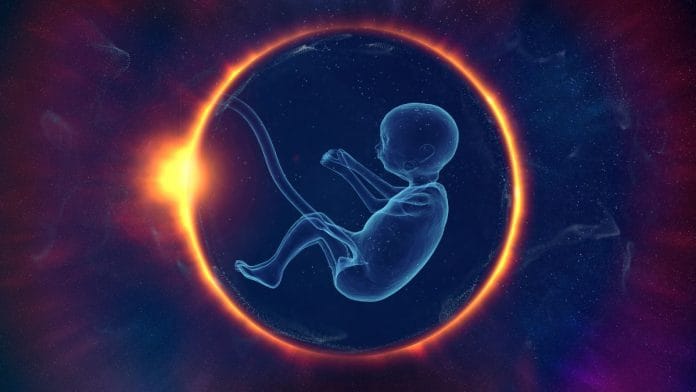


New Delhi: Sustaining human life in space is a question that has long occupied researchers. Now in an attempt to find out if human reproduction can occur in zero gravity, China has sent artificial embryos to its space station, becoming the first nation to do so.
The experiment was sent on China’s Tianzhou 10 cargo spacecraft, which took off on 11 May. It was part of a resupply mission that also delivered fuel, food, spacesuits, among other essential items, to the Tiangong space station.
The main aim of the experiment is to determine the effects of the microgravity environment on early human embryonic development. In space, humans experience zero gravity and high cosmic radiation, conditions that are difficult to create on Earth. Scientists suspect that this can hinder human reproduction, with past studies suggesting damage to embryos, according to Live Science.
The samples include two models of artificial human embryos — one cultured on uterine cells and the other observed inside a microfluidic chip. They have been developed using living stem cells and function like real human embryos. However, these embryos cannot develop into a foetus.
“The human artificial embryo is made of human stem cells as raw materials,” said Leqian Yu, a researcher at the Chinese Academy of Sciences (CAS), who is in charge of the experiment. “This is not a real human embryo and does not have the ability to develop into an individual. However, it can serve as a model for studying early human development.”
Also read: Japan has a new type of heatwave. It’s moist, deadlier
Why it matters
While the experiment involves artificial human embryos, the results of the study can shed light on whether human reproduction is possible beyond Earth.
The embryos will be observed for five days as they develop 14 to 21 days after fertilisation on the space station. This period is when human organs begin to form, and any abnormality recorded can provide scientists with crucial data.
Research on human embryos have raised ethical concerns in the past, with the International Society for Stem Cell Research (ISSCR) restricting experiments to 14 days after fertilisation, limiting the scope of research. However, this restriction was lifted in 2021, allowing scientists to dig deeper and study cancer cell growth, congenital diseases, and the causes of miscarriages.
Once the experiment is completed, the artificial embryos will be frozen and stored safely. They will be then analysed and compared with identical samples that are being observed separately on Earth.
“We hope that by comparing the development of space and ground samples, we can identify the factors affecting early human embryonic growth in the space environment, and address the risks and challenges humans may face during long-term space habitation,” Yu said.