



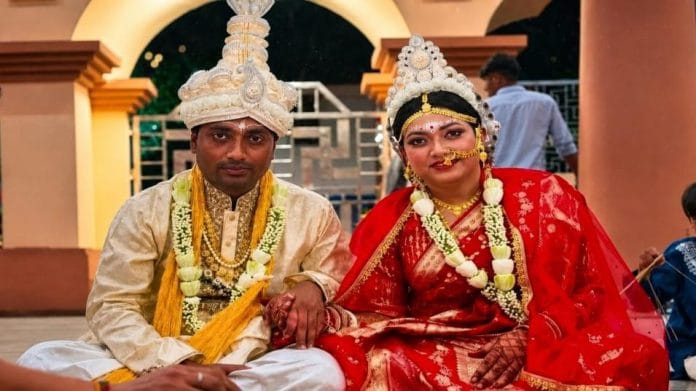
Kolkata: Bangladesh’s national temple has come under the spotlight after it, perhaps unwittingly, hosted a marriage between a man and a transgender woman, setting off a fierce debate over LGBTQ rights or the lack thereof in the country.
If that wasn’t reason enough for outrage in socially conservative Bangladesh, what made matters worse for those shocked by the union was that it was between a Hindu man and a Muslim transgender actor and former television news presenter.
The 10 July ceremony, the first reported transgender marriage in Bangladesh’s history, took place at Dhakeshwari temple in Dhaka. Founded in the 12th century by King Ballal Sen of the Sena dynasty, it was rebuilt after the Pakistani army severely damaged it during the 1971 war of independence and was later designated Bangladesh’s national temple.
Bangladeshi media reported that actor Tasnuva Anan Shishir arrived at Dhakeshwari temple dressed as a bride for the wedding ceremony. She wore traditional bridal attire, including vermilion and conch-shell bangles. The identity of the groom, a Hindu man, was not disclosed.
The couple reportedly completed the temple paperwork, after which priests performed traditional Hindu marriage rituals.
Dhakeshwari temple committee general secretary DN Chatterjee told the press that the ceremony was conducted according to Hindu religious rituals and that the temple received Bangladeshi Taka 2,000 as a customary offering. He denied allegations that the marriage had been arranged in exchange for a large payment.
Also Read: ‘Real Gen Z revolution will happen to welcome Sheikh Hasina,’ says Chhatra League president
A wedding that offended almost everyone
It was only weeks after the ceremony that pictures and unverified accounts from those who were present at the venue began circulating widely on social media. The wedding quickly became the subject of heated conversations around gender identity and inter-faith unions.
Questions were raised about how an important religious place like Dhakeshwari temple could sanctify unions that are not widely accepted in Bangladeshi society.
Bangladeshi media outlet Daily Waadaa reported that criticism came from conservative activists, members of the Hindu community and ordinary social media users.
“Some focused on the legality of the marriage. Others questioned how such a ceremony could have been conducted at Dhakeshwari in the first place,” the report said.
It added that 1,230 people, including “Muslim clerics and conservative professionals”, issued a statement circulated by conservative platform Mullobodh Andolon. It described the ceremony as an illegal “same-sex marriage” and demanded an investigation and legal action against those involved.
Mullobodh Andolon has also warned that a failure to act could fuel public anger and create problems for law and order, according to the report.
In a Facebook post, anti-LGBTQ activist Mohammad Sorowar Hossain demanded an explanation from Dhakeshwari authorities, asking how what he described as an “illegal male-male marriage” had been allowed to take place at the temple.
The problem with framing the marriage as a same-sex union is that the label comes with serious legal implications in Bangladesh. Section 377 of the Penal Code 1860 criminalises acts of “carnal knowledge against the order of nature”, with the maximum penalty being life imprisonment.
“Only men are criminalised under this law. The 1860 Penal Code was inherited from the British during the colonial period, in which the English criminal law was imposed upon Bangladesh. Bangladesh retained the law upon independence and continues to criminalise same-sex sexual activity today,” a report by UK-based charity Human Dignity Trust said.
The report added that section 377 is rarely enforced, but it is used as a pretext to harass LGBT people.
Reacting to the Daily Waadaa report on the marriage, multidisciplinary educator and cultural practitioner Oliur Sun put out a Facebook post criticising the publication for denying a transgender woman her “right to self-identify even though she has legally changed her name, undergone gender-affirming medical transition and has long lived publicly as a woman”.
“Yet you still dare to frame her marriage as a “same-sex marriage,” lending credibility to transphobic narratives instead of reporting facts,” Sun wrote in his post.
He added that this was a deliberate amplification of prejudice and that rather than informing the public, the media was fuelling anti-trans hatred and moral panic.
“It is deeply troubling to see a news outlet abandon accuracy, dignity, and basic human rights in favour of sensationalism. Hope this serves their funders well,” he wrote.
The Bangladeshi press has reported that Chakbazar Police Station Officer-in-Charge Sheikh Ashrafuzzaman Mamun said the police had received and examined documents from the temple and that legal action would be taken if a formal complaint was filed.
Also Read: 2 yrs after the student uprising, Bangladesh faces a question: What did the bloodshed achieve?
No country for trans people, interfaith couples
On 22 August 2025, the Global Press Journal put out a report saying the lives of transgender people in Bangladesh had become worse after the July 2024 uprising that led to the fall of the Sheikh Hasina government.
Since 2013, the report said, Bangladesh has allowed third-gender people to officially identify as such. Some even entered politics, and a rural town elected a transgender woman as mayor in 2021.
“But the revolution in 2024, led by young people who demanded widespread political change, opened avenues for hardline conservatives to gain ground. Now, conservative Islamist groups threaten minorities — specifically LGBTQ+ people,” it added.
Bangladeshi model, actor and human rights advocate Maria Kispotta told ThePrint it was high time society accepted couples like Tasnuva Anan Shishir and her husband, but Bangladesh was unfortunately not ready for them yet.
“Forget transgender couples, I urge Bangladeshi women today to stand in front of the mirror and ask themselves how safe and free they are today in society, in their work places, on the streets,” Kispotta said.
A Dhaka-based newspaper editor who spoke on condition of anonymity told ThePrint that what happened at Dhakeshwari temple would be considered nothing short of blasphemy in today’s Bangladesh.
“The couple has taken a great risk in getting married in full public view inside a temple. A marriage between an interfaith cis couple would not be accepted today, forget a trans marriage between a Hindu and Muslim. We have been regressing after 2024, not that things were perfect before,” the editor said.
For Bangladeshi Hindu rights activist Ranjit Roy, this is a moment of pride for Dhakeshwari temple as it solemnised the marriage between a Hindu man and a Muslim trans woman according to Hindu rituals.
“Tasnuva Anan Shishir has not just changed her gender but also her faith by dressing up as a Hindu bride and getting married according to Hindu rituals. This is the time for the Bangladeshi Hindu community, under siege since the fall of Hasina, to put forth their most liberal side to the world,” Roy said.
(Edited by Asavari Singh)