







New Delhi: Former Bangladesh Prime Minister Sheikh Hasina’s first press conference since she fled to India two years ago, held virtually on 5 August, has created a political storm in her country. Hasina said she will return to Bangladesh around December this year.
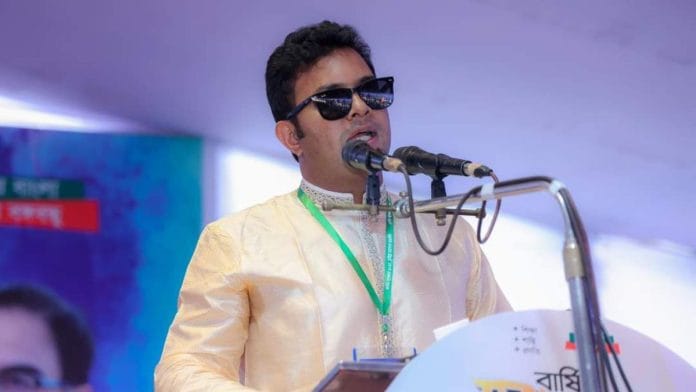
Calling her a “convicted mass murderer”, Bangladesh’s Ministry of Foreign Affairs has expressed “outrage” over the presser and called it a grievous insult to the 2024 student-led uprising. While many in Bangladesh’s current political dispensation, like State Minister for Liberation War Affairs Ishraq Hossain, have dismissed Hasina’s statement as “political gimmick”, Saddam Hussain, president of Bangladesh Chhatra League, the student wing of Hasina’s party Bangladesh Awami League, has said that the former prime minister will indeed return home.
In an exclusive interview to ThePrint, Hussain said Bangladesh’s Gen Z is ready to welcome Hasina back. “Gen Z is not a monolithic political bloc. While many young people participated in the 2024 quota reform movement, which our government agreed to, a growing number have since become disillusioned with the political trajectory that followed,” Hussain said in the email interview.
Hussain said Bangladesh’s youth have witnessed economic instability, deteriorating law and order, rising unemployment, and the concentration of political power in the hands of a narrow section of the youth, mostly the student’s party that came out of the July uprising, while the overwhelming majority remain excluded.
And in the two years that have passed since the fall of the Hasina government, the youth saw the shrinking of the democratic space, repression of minorities, attacks on the very idea of the Liberation War, as well as the growing influence of radical forces, Hussain said. “Many now believe they were used as political tools for a regime change operation rather than being the participants of a genuine democratic reform”.
‘A political witch-hunt’
Young women, in particular, according to Husaain, who participated in the uprising against Hasina during July-August 2024, find themselves marginalised in the socio-political space now, even as concerns over women’s rights, personal freedoms, and Bangladesh’s secular and inclusive character have grown.
“As a result, many young people are reassessing Sheikh Hasina’s tenure in government. A real Gen Z-plus-Alpha revolution will take place to welcome Sheikh Hasina for the restoration of constitutional, secular, inclusive, liberal democratic politics, institutional stability, development politics, and a development-focused national agenda,” Hussain said.
Hussain alleged there has been an unprecedented political witch-hunt going on in Bangladesh since August 2024, and the Awami League and its affiliate organisations, such as the Bangladesh Chhatra League, have been subjected to an extensive campaign of political repression.
“Through mass arrests, and politically motivated prosecutions, hundreds of thousands of our leaders and activists have been detained across the country. The suppression and banning of the Awami League and its various affiliate organisations first by the unelected Yunus regime, and the subsequent ratification of those measures by the government chosen through a managed election, cannot conceal the reality that our leaders and activists continue to face systematic political persecution,” Hussain said.
Hussain claimed that official records show more than 133 senior Awami League leaders, including former Members of Parliament, are currently in prison. Among them are 35 former ministers, state ministers, and deputy ministers, he said. The former Speaker of Parliament spent more than 18 months in extrajudicial detention before being released on bail a few months ago, while the former Deputy Speaker remains incarcerated, he claimed, adding that former constitutional officeholders, including former chief justices and former chief election commissioners, have also been held in prolonged detention.
“The broader crackdown has been extensive. Official figures show approximately 44,000 people were arrested during ‘Operation Devil Hunt’ between February 2025 and February 2026. Between August 2024 and June 2025, 3,59,798 people were arrested across Bangladesh over a period of ten months. In the face of this sustained campaign, hundreds of thousands more remain in hiding or have been forced into exile,” he said.
Hussain alleged that Bangladesh’s prisons are operating at approximately 170 per cent of their official capacity, with the majority of inmates being undertrial detainees awaiting legal proceedings.
On 29 June, Bangladesh’s highest circulated English daily, The Daily Star, reported that Bangladesh-based human rights organisation, Human Rights Support Society has expressed deep concern over the death of a Chhatra League activist in Detective Branch custody in Faridpur and the recovery of three bodies from the Turag river in Dhaka over a span of three days.
Also read: Suu Kyi and Hasina are back. South Asia still can’t move past its strongwomen
Disillusioned Bangladeshis
Hussain said another troubling feature of the current crackdown on Awami League leaders and workers has been the introduction of what he said is commonly known as “shown-arrest.”
“In most of the cases, even after a detainee secures bail in one case, they are immediately shown as arrested in another case while still inside the prison or at the jail gate, preventing their release. This practice has effectively created a revolving-door system of detention, undermining the practical effect of judicial bail and prolonged detention without meaningful relief,” he said.
Despite such crackdown, Hussain claimed the Awami League remains the single largest political party in Bangladesh and has an extensive grassroots organisational network built over more than seven decades, with leaders, activists, affiliates, and supporters in every district, subdistrict, city, municipality, union, and village across the country.
“The party continues to enjoy the support of the majority segment of Bangladesh’s electorate. Throughout its history, the Awami League has survived military dictatorships, the mass imprisonment of its leaders, political assassinations, and repeated attempts to dismantle both its leadership and the organisation itself,” Hussain said.
He said in such desperate times, he and other leaders of the party and its student wing remind themselves that Sheikh Hasina personally rebuilt the party after returning from exile in 1981 under the extraordinarily difficult circumstances following the assassination of her father, Bangabandhu Sheikh Mujibur Rahman, on 15 August 1975. “During this journey, she has survived an extraordinary 22 assassination attempts. Resilience in the face of repression is therefore embedded in the party’s DNA,” he claimed.
Despite the ongoing repression, according to Hussain, many of the party’s activists and supporters continue to organise peacefully, remain connected to their communities, and advocate for the restoration of constitutional, secular, and democratic politics through lawful and non-violent political mobilisation.
But what Hussain finds hope in is that a growing number of Bangladeshis are, according to him, becoming increasingly disillusioned with the current political dispensation. “Apart from the support base, as public dissatisfaction grows, support for Sheikh Hasina and the Awami League is rapidly increasing, and this trend will continue to consolidate,” he said.
According to Hussain, the February 2026 elections have done little to restore public hope in Bangladesh’s democratic process. He said the current Bangladesh Nationalist Party (BNP) government represents a continuation of the political trajectory of the Yunus regime. “The principal change has been the replacement of one set of beneficiaries with another. Tarique Rahman has continued to provide greater political space to fundamentalists and radicals,” he said.
The ruling BNP and the opposition Bangladesh Jamaat-e-Islami, according to him, are simply projecting the image of a conventional parliamentary democracy, which is a façade. “The partnership reflects a tactical convergence aimed at gaining and consolidating power while presenting a more moderate face to both domestic and international audiences. They are masking the original political orientation reflected in the BNP-Jamaat alliance government of 2001–2006 as well as their sustained political alliance until before the 2026 election,” he alleged.
Hussain said even though the Bangladesh government directed local print, electronic, and social media platforms to refrain from publishing or broadcasting statements from Hasina presser, the combined live streams across Bangladeshi social media platforms got more than 80 million views. “Those numbers alone demonstrate that millions of people wanted to hear directly from one of Bangladesh’s most consequential political leaders,” he said, adding that pictures were circulated online of people gathering at tea stalls and market places across the country to watch her address together.
“In many rural areas, people watched collectively even though many of them did not understand English. Language was not a barrier, people were eager to hear the voice of their leader, Sheikh Hasina. They are eagerly awaiting her return,” Hussain said.
(Edited by Aamaan Alam Khan)