





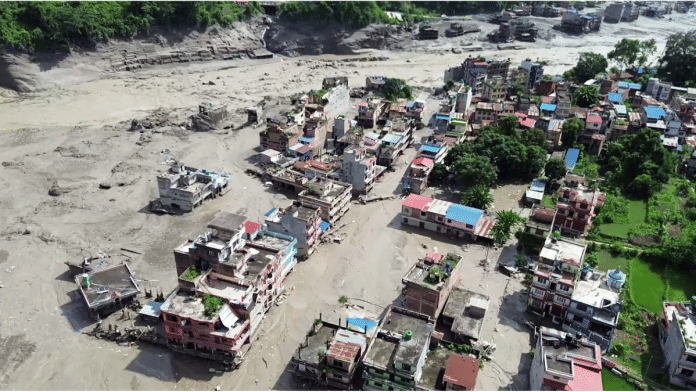

New Delhi: The August 26 flood has shown how quickly a disaster in the Himalayas can snowball from one country to another. After the devastation in Nepal and Tibet, Bihar and eastern Uttar Pradesh are on alert for possible flooding, even as a new barrier lake in China threatens another downstream surge into Nepal.
Environmentalists and climate scientists told ThePrint that disaster planning in the region cannot begin only after the damage is done, nor can countries tackle these risks on their own.
Climate change-induced disasters are bound to increase in the coming years and it will be key to strengthen early warning systems and disaster response systems to ensure that the impact is controlled, according to Mahesh Palawat, vice-president (meteorology and climate change) at Skymet Weather, a private weather forecasting agency.
“The global temperatures are rising and so is the risk of such disasters. We have been seeing a worrying spike in temperatures in the higher altitudes, and that will cause glaciers to melt faster. The impact will be felt in human habitations around it,” Palawat added.
On August 26, a portion of a glacier collapsed from the upper reaches of the Himalayas, at an elevation of roughly 5,200 metres, falling about 1,200 metres into the valley. According to satellite images released by ISRO’s National Remote Sensing Centre, nearly two-thirds of the glacier collapsed, generating a massive flow of ice, rock and debris. This torrent rushed down the valley, destroying houses, roads, bridges and hydropower infrastructure in its path. At least 359 people are confirmed dead and more than 1,000 still missing across Nepal and Tibet.
Also read: 5 deadly Himalayan floods: A history of frozen terror
‘Rivers do not see borders’
Disasters around the Himalayas are becoming more frequent and intense, according to Bhim Singh Rawat from the South Asian Network on Dams, Rivers and People (SANDRP), a collective working on water management. He said just last year, Rasuwa district in Nepal—which was the worst impacted in the August 26 floods—was hit with another flood. The impact then was much smaller, but the warning was ignored.
“There is undoubtedly an increase in frequency and impact of these disasters. The problem is that we are not learning from them. In India, we had the Chamoli landslide, the Sikkim GLOF and the Dharali floods, but instead of strengthening our early warning and rescue systems, we are waiting for these disasters to hit us unprepared,” Rawat said.
He also pointed to a lack of in-depth scientific studies into these disasters.
“In many cases, we do not even know the nature of the disasters. We do not have enough data to categorise them. Are these cloudbursts, flash floods, in many cases we do not know,” he said.
Experts also pointed out that authorities cannot come up with solutions for this climate crisis in isolation. They will need to bring in local community knowledge to ensure that development along these ecologically sensitive areas does not cost the residents.
“In the 2023 Sikkim GLOF, the local communities had warned of an impending disaster and even after the floods washed away critical infrastructure, it was the local communities that came together for effective resolutions,” said Vimal Khawas, a professor at the Special Centre for the Study of North East India at Delhi’s Jawaharlal Nehru University (JNU).
For Khawas, it’s important to understand that disasters do not happen in neatly contained areas.
“The most significant message from this disaster is that rivers do not see borders. Disaster management has to go beyond national and international constraints,” he said.
(Edited by Asavari Singh)